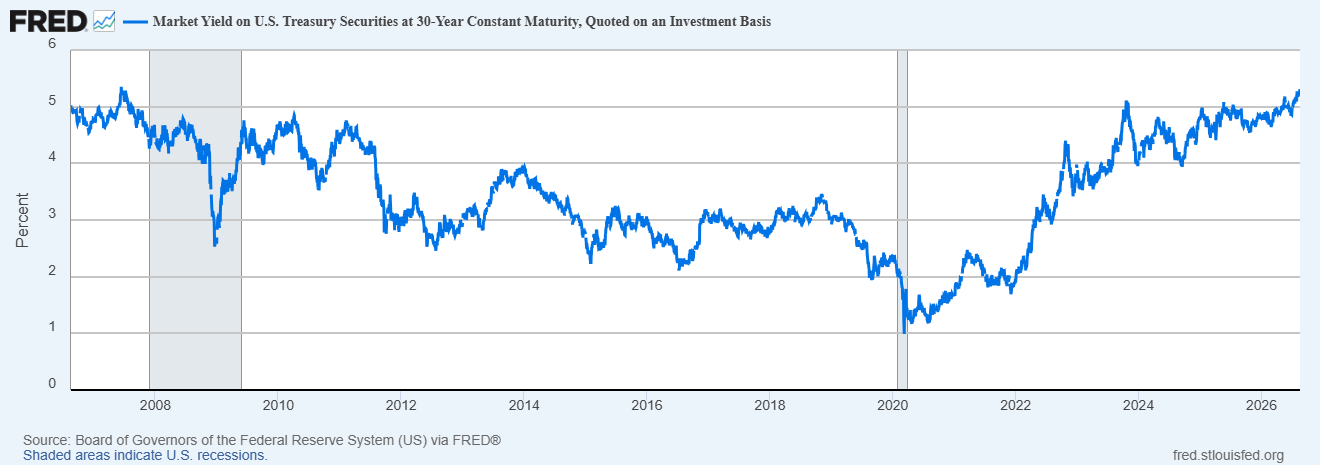
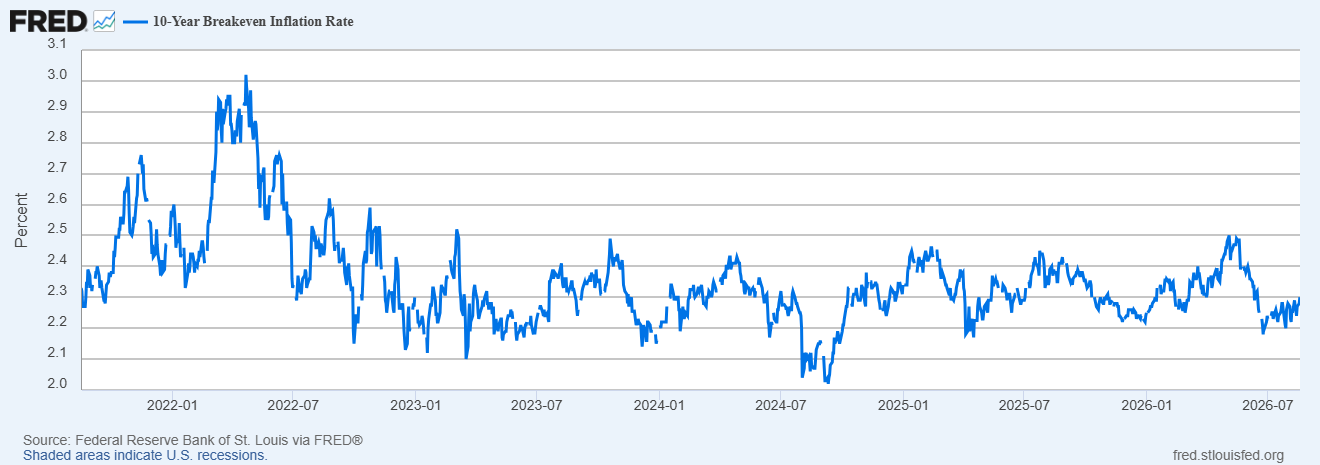
In other words, despite all the anxiety surrounding oil prices, federal deficits and the recent bond selloff, investors are not currently pricing in runaway long-term inflation.
That means much of the increase in nominal long-term interest rates has instead come from an increase in real interest rates—the return investors receive after accounting for expected inflation.
A surge in long-term rates driven by rapidly deteriorating inflation expectations would be an obvious warning sign, but rising real rates can send a very different message.
One likely explanation is simply that investors have become more optimistic about long-term economic growth.
Interest rates are ultimately the price of capital. When economic growth is weak and businesses see few attractive opportunities to invest, demand for capital tends to be relatively low.
This is especially true during recessions and market crises. During the pandemic in 2020, for example, 30-Year Treasury yields got close to 1%.
When businesses see tremendous opportunities to invest, the opposite happens. They compete for capital—and its price goes up.
This may be exactly what we are witnessing today.
Consider the extraordinary amounts of money being committed to AI, data centers, semiconductor manufacturing, power generation and electrical infrastructure. Add defense spending, energy infrastructure and the reshoring of manufacturing capacity.
The federal government, meanwhile, is running large deficits and competing for many of the same dollars. Capital that might otherwise have flowed into Treasury bonds now has an expanding menu of alternatives.
Large technology companies are borrowing aggressively to finance the AI buildout, adding hundreds of billions of dollars of corporate bonds to a market that must simultaneously absorb massive Treasury issuance.
When everyone wants capital, capital becomes more expensive.
A shrinking Fed balance sheet
There is also another important change taking place.
For much of the period following the Global Financial Crisis, the Federal Reserve was not merely setting short-term interest rates. Through successive rounds of Quantitative Easing (QE), it became an enormous buyer of long-term Treasury and mortgage securities.
The explicit purpose of these programs was, in part, to push longer-term interest rates lower.
At its peak, the Fed's intervention fundamentally altered the supply-and-demand equation in the bond market. Investors weren't simply determining the appropriate yield on long-term government debt. They were competing against a central bank with the unique ability to create money to purchase it.
Kevin Warsh has made clear that this framework is now under review.
The new Fed Chair has created a task force specifically charged with examining the size and composition of the Federal Reserve's balance sheet and the costs and benefits of the current ample-reserves regime.
A Federal Reserve that is less inclined to use its balance sheet to suppress long-term borrowing costs would naturally leave more price discovery to the market.
Long-term rates could therefore remain higher even without a major change in inflation.
Higher rates don't necessarily mean lower growth
There is plenty of historical precedent for strong economic growth coexisting with relatively high—and rising—long-term interest rates.
One of the clearest examples came during the postwar economic boom.
From 1959 through 1964, real GDP grew at an average annual rate of 3.9%, while productivity advanced 3.4% per year. Inflation, meanwhile, averaged just 1.3%.
Yet long-term Treasury yields averaged approximately 4%, considerably higher than they had been during the preceding five years.
The trend continued as the decade progressed.
Between 1964 and 1969, real GDP growth accelerated to 4.2%, while long-term Treasury yields averaged 5.3%.
Eventually, inflation became an increasingly important part of the story. But the experience of the early 1960s is particularly instructive because inflation remained so low.
The bond selloff of 1994
A more recent example may be even more relevant to investors today.
In 1994, the bond market got crushed. The Federal Reserve began raising short-term interest rates after economic growth came in considerably stronger than expected.
Long-term yields surged as investors concluded the economy was growing too quickly and inflation was likely to follow. But the feared inflationary breakout largely failed to materialize.
By early 1995, real GDP had been growing at a 4.2% annual rate since mid-1993, while business-sector productivity had increased at a 2.5% annual rate.
Inflation over the same period was only 2.6%.
In other words, the bond market had correctly identified that something important was happening in the real economy. Growth was getting stronger.
What investors could not yet fully appreciate was how much technology was beginning to change America's productive capacity.
Businesses were pouring money into computers, telecommunications equipment and other information technology. Those investments would eventually contribute to the productivity boom of the second half of the 1990s.
And despite the bond market turmoil of 1994, the stock market entered one of the greatest bull markets in American history.
Parallels to today
Once again, businesses are spending enormous amounts of money on a potentially transformative technology.
Once again, investors are debating whether surprisingly resilient economic growth must inevitably produce more inflation.
And once again, long-term real interest rates are moving higher.
AI may ultimately prove to be far more—or far less—transformative than the internet revolution of the 1990s. Nobody knows yet.
But the economic mechanism is similar.
If AI allows companies to generate substantially more output from the same number of workers, America's potential economic growth rate can increase.
Higher productivity means faster economic growth that does not necessarily produce proportionately higher inflation.
It also means businesses can potentially earn higher returns on invested capital.
If the expected return on private investment rises, the return investors demand for lending money to the government should rise as well. Treasury yields have to compete.
Look at the rest of the market
There is another reason we are skeptical that the recent rise in Treasury yields represents an impending fiscal or economic crisis.
Other market indicators are not behaving as though one is coming.
Stock prices have remained near record highs. Corporate credit spreads remain tight. Businesses continue to raise and deploy enormous amounts of capital.
Compare that with August 2011.
After S&P downgraded the United States, investors panicked and the S&P 500 plunged nearly 7% in a single day.
Yet Treasury bonds rallied.
Even though U.S. government debt was the asset that had literally just been downgraded, frightened investors rushed to buy it. Treasury yields fell.
That's what a genuine risk-off episode tends to look like.
Today's environment looks very different.
Stocks have been strong. Investors have been willing to take risk. Businesses are investing aggressively. And long-term Treasury yields are rising.
None of this makes America's fiscal problems disappear. But it suggests today's long bond selloff may be telling us something more complicated than the U.S. government is carrying too much debt.
It is also telling us that investors have many compelling opportunities elsewhere.