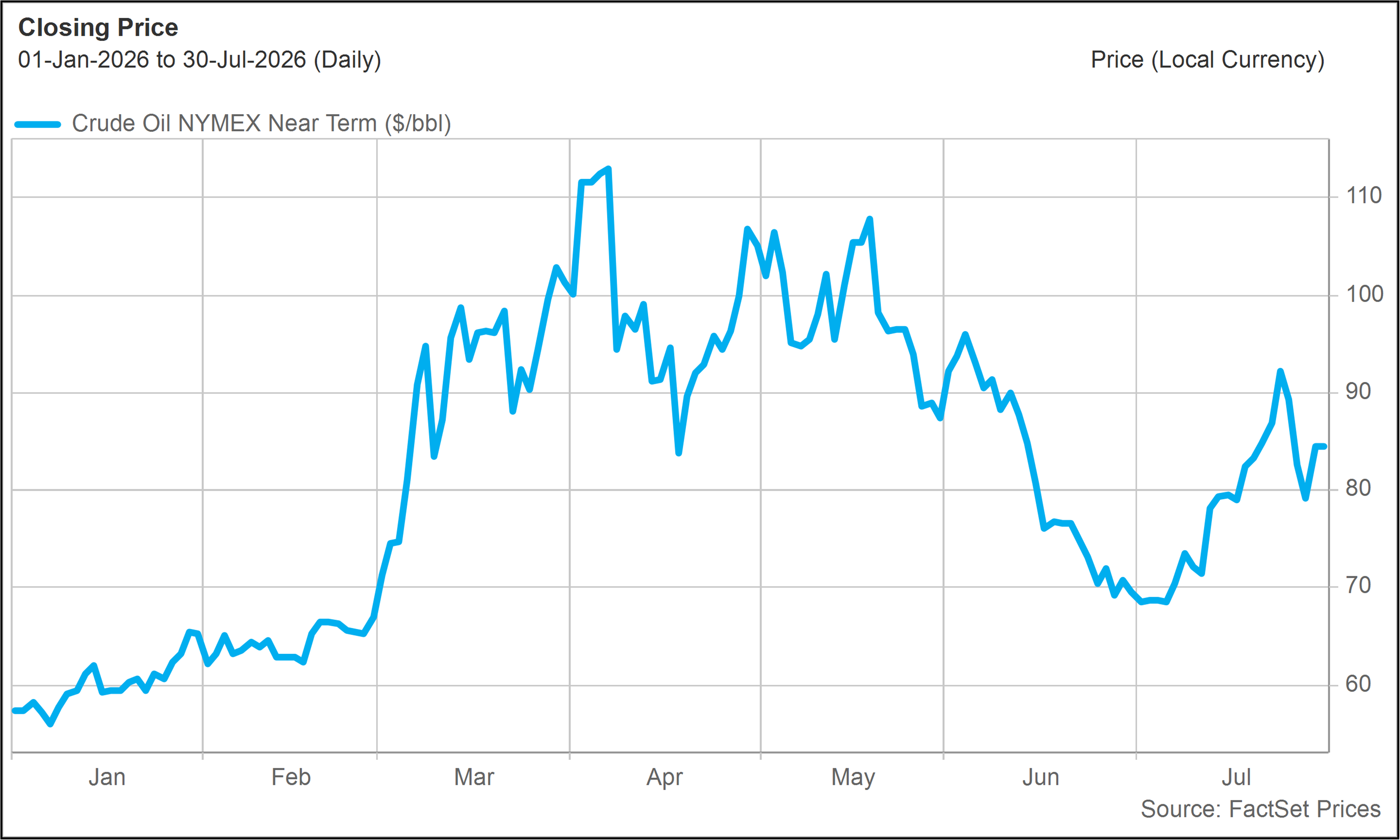
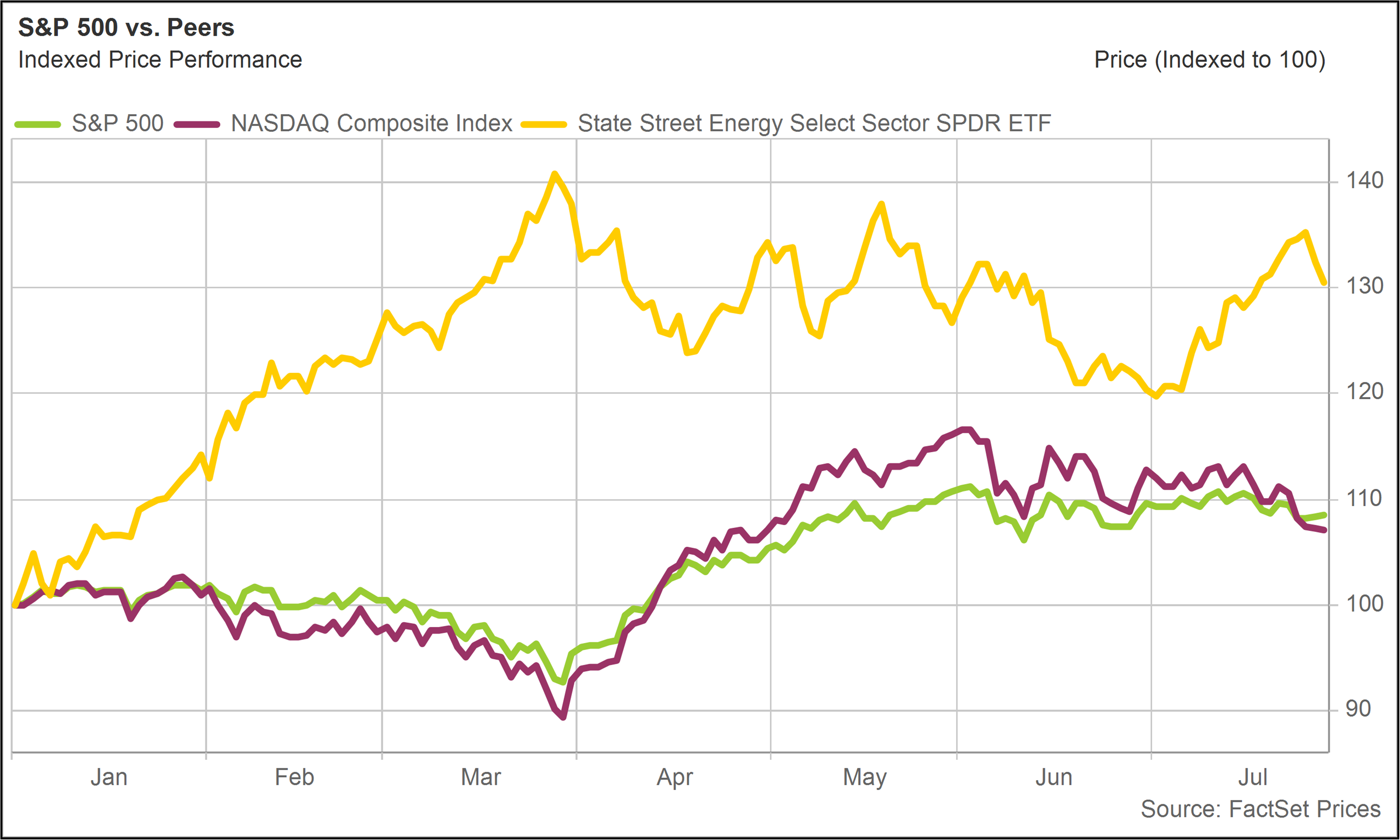
Higher oil prices have been good for energy stocks, but bad for stocks in general.
While the Energy sector, as reflected in the Energy Select SPDR ETF (XLE), returned 10.4% from June 30 through July 29, the S&P 500 has returned -2.4%. The NASDAQ Composite (which has minimal energy exposure) has fared worse, returning -6.7%.
In the current environment, energy stocks are proving exceptionally valuable as hedge instruments, superior in many ways to long-term Treasury bonds, which have been traditionally viewed as a tool for offsetting geopolitical risk.
The key geopolitical risk today is rising oil prices, making long-term bonds flawed as a safe haven in the current context. Higher oil prices lead to higher inflation, which in turn tends to put upward pressure on long-term interest rates, hurting bond valuations.
Gold and Bitcoin have also not functioned as ideal hedges in the current set of circumstances.
While we continue to favor both assets as hedges on other risks, especially long-term monetary debasement, they perform best when monetary policy is becoming easier, not more restrictive.
Preparing for more volatility
Investors should be prepared for a wide range of scenarios when it comes to Iran. The most likely outcome may be neither a clean peace agreement nor an uncontrolled regional war.
We could instead experience an extended period of unstable coexistence—military attacks followed by pauses, negotiations followed by breakdowns, and repeated attempts by both sides to gain leverage without triggering a conflict they cannot control.
Markets have largely assumed that the fighting will remain intermittent. But the risk is not confined to the Strait of Hormuz.
Iran-backed Houthi forces have also threatened shipping and energy infrastructure around the Bab el-Mandeb Strait, the narrow passage connecting the Red Sea to the Indian Ocean.
Disruptions across both routes could threaten roughly one-third of the energy and commercial traffic transported by sea.
The alternative Saudi export route illustrates the problem.
Saudi Arabia can move oil from its eastern fields across the country to the Red Sea, avoiding Hormuz. But tankers leaving the Red Sea generally need to pass through Bab el-Mandeb. If that route becomes unsafe as well, ships may have to travel around Africa, potentially adding several weeks and millions of dollars to a voyage.
Oil does not need to stop flowing entirely for the economic consequences to become significant.
Higher insurance premiums, longer shipping routes, delayed deliveries and greater inventory requirements can all raise the effective cost of energy. Refiners can also encounter shortages of the particular varieties of crude oil their facilities were designed to process.
There are other reasons the market may be more vulnerable than it was during prior geopolitical scares.
China is once again emerging as an important buyer of crude oil. Strong refining margins—the profits generated by turning crude oil into gasoline, diesel and other fuels—are encouraging Chinese refiners to increase activity.
Meanwhile, there is less oil sitting in floating storage aboard tankers, and emergency government reserves provide a smaller cushion than they did earlier in the conflict. Investors therefore face the combination of strengthening demand, thinner backup supplies and risks surrounding two critical shipping routes rather than one.
None of this guarantees that oil prices will continue rising. A credible peace agreement could send crude substantially lower. The possible outcomes range from a return to surplus conditions to a severe physical shortage.
But maintaining energy exposure does not require us to underwrite the worst possible outcome. It merely gives the portfolio a way to benefit if geopolitical instability, inflation and energy scarcity persist.
The world will adapt
The immediate risks are serious, but there are also good reasons to remain optimistic about the long-term outcome.
Energy markets respond to high prices and supply disruptions. Producers increase output. Governments release emergency inventories. Importing countries diversify their suppliers.
Most importantly, businesses invest in infrastructure that makes the system less vulnerable the next time a crisis occurs. That process is already beginning.
The United Arab Emirates plans an additional pipeline capable of moving approximately 1.5 million barrels per day to Fujairah, a port located outside Hormuz.
Saudi Arabia is also considering increasing the capacity of its East-West system by as much as 2 million barrels per day, potentially allowing neighboring countries with no practical alternative route to use Saudi infrastructure as well.
New sources of oil are also emerging outside the Middle East.
The United States, Canada, Brazil, Guyana and Argentina have become central sources of supply growth. Production from the Americas has already helped offset lost Gulf barrels and redirect oil toward markets east of the Suez Canal.
The long-term result could be a global energy system that is less dependent on a handful of unstable countries and narrow waterways. Ironically, by demonstrating how effectively it can disrupt the market, Iran may be accelerating the investments that ultimately reduce its geopolitical leverage.
More than just a hedge
There are also reasons to maintain energy exposure that have little to do with Iran.
The AI buildout is creating an enormous new source of electricity demand. Data centers require reliable power around the clock.
Wind and solar will play a role in meeting that demand, but their output varies with weather conditions. Nuclear plants will contribute over time, but new facilities generally take years to develop and face severe local resistance.
Natural gas is needed to fill the gap.
Natural gas is already the largest source of electricity consumed by data centers in the United States, supplying more than 40%. The International Energy Agency expects natural gas to be the largest source of additional U.S. data center electricity generation through 2030.
The Energy Information Administration expects natural gas consumption by the power sector to reach a new summer record in 2027, driven partly by new data centers and manufacturing facilities in regions such as Texas and Virginia.
Natural gas producers, pipelines, processing facilities, export terminals and power generation assets all stand to benefit from rising demand for dependable electricity.
The energy sector is also entering this period from a healthier financial position than it carried into many previous cycles.
Many energy producers have reduced debt, become more disciplined about drilling and focused more heavily on returning cash to shareholders. A broad group of producers recently traded at roughly ten times expected earnings, suggesting investors are not pricing in permanently high commodity prices or flawless operating results.
Energy stocks can therefore serve two purposes.
They can provide portfolio protection against war, inflation and supply disruptions. But they can also participate in longer-term growth tied to electricity demand, AI infrastructure, manufacturing, liquefied natural gas (LNG) exports and the rebuilding of global energy systems.
The conflict with Iran may eventually reach a peaceful resolution. We should hope that it does. But a peaceful outcome would not eliminate the need for energy, secure infrastructure or reliable power.
Investors do not need to predict the next move in Tehran. They need to prepare for a range of possible outcomes—and recognize that energy assets will remain valuable regardless of how or when the Iranian conflict plays out.