76report

4da675b013

January 2, 2026
*|MC:SUBJECT|*
͏ ‌     ͏ ‌     ͏ ‌     ͏ ‌     ͏ ‌     ͏ ‌     ͏ ‌     ͏ ‌     ͏ ‌     ͏ ‌     ͏ ‌     ͏ ‌     ͏ ‌     ͏ ‌     ͏ ‌     ͏ ‌     ͏ ‌     ͏ ‌     ͏ ‌     ͏ ‌     ͏ ‌     ͏ ‌     ͏ ‌     ͏ ‌     ͏ ‌     ͏ ‌     ͏ ‌     ͏ ‌     ͏ ‌     ͏ ‌     ͏ ‌     ͏ ‌     ͏ ‌     ͏ ‌     ͏ ‌     ͏ ‌     ͏ ‌     ͏ ‌     ͏ ‌     ͏ ‌     ͏ ‌     ͏ ‌     ͏ ‌     ͏ ‌     ͏ ‌     ͏ ‌     ͏ ‌     ͏ ‌     ͏ ‌     ͏ ‌     ͏ ‌     ͏ ‌     ͏ ‌     ͏ ‌     ͏ ‌     ͏ ‌     ͏ ‌     ͏ ‌     ͏ ‌     ͏ ‌     ͏ ‌     ͏ ‌     ͏ ‌     ͏ ‌     ͏ ‌     ͏ ‌     ͏ ‌     ͏ ‌     ͏ ‌     ͏ ‌     ͏ ‌     ͏ ‌     ͏ ‌     ͏ ‌     ͏ ‌     ͏ ‌     ͏ ‌     ͏ ‌     ͏ ‌     ͏ ‌     ͏ ‌     ͏ ‌     ͏ ‌     ͏ ‌     ͏ ‌     ͏ ‌     ͏ ‌     ͏ ‌     ͏ ‌     ͏ ‌     ͏ ‌     ͏ ‌     ͏ ‌     ͏ ‌     ͏ ‌     ͏ ‌     ͏ ‌     ͏ ‌     ͏ ‌     ͏ ‌     ͏ ‌     ͏ ‌     ͏ ‌     ͏ ‌     ͏ ‌     ͏ ‌     ͏ ‌     ͏ ‌     ͏ ‌     ͏ ‌     ͏ ‌     ͏ ‌     ͏ ‌     ͏ ‌     ͏ ‌     ͏ ‌     ͏ ‌     ͏ ‌     ͏ ‌     ͏ ‌     ͏ ‌     ͏ ‌     ͏ ‌     ͏ ‌     ͏ ‌     ͏ ‌     ͏ ‌     ͏ ‌     ͏ ‌     ͏ ‌     ͏ ‌     ͏ ‌     ͏ ‌     ͏ ‌     ͏ ‌     ͏ ‌     ͏ ‌     ͏ ‌     ͏ ‌     ͏ ‌     ͏ ‌     ͏ ‌     ͏ ‌     ͏ ‌     ͏ ‌     ͏ ‌     ͏ ‌     ͏ ‌     ͏ ‌     ͏ ‌     ͏ ‌     ͏ ‌     ͏ ‌     ͏ ‌     ͏ ‌     ͏ ‌     ͏ ‌     ͏ ‌     ͏ ‌     ͏ ‌     ͏ ‌     ͏ ‌     ͏ ‌     ͏ ‌     ͏ ‌     ͏ ‌     ͏ ‌     ͏ ‌     ͏ ‌     ͏ ‌     ͏ ‌     ͏ ‌     ͏ ‌     ͏ ‌     ͏ ‌     ͏ ‌     ͏ ‌     ͏ ‌     ͏ ‌     ͏ ‌     ͏ ‌     ͏ ‌     ͏ ‌     ͏ ‌     ͏ ‌     ͏ ‌     ͏ ‌     ͏ ‌     ͏ ‌     ͏ ‌     ͏ ‌     ͏ ‌     ͏ ‌     ͏ ‌     ͏ ‌     ͏ ‌     ͏ ‌     ͏ ‌     ͏ ‌     ͏ ‌     ͏ ‌     ͏ ‌     ͏ ‌     ͏ ‌     ͏ ‌     ͏ ‌     ͏ ‌     ͏ ‌     ͏ ‌     ͏ ‌     ͏ ‌     ͏ ‌     ͏ ‌     ͏ ‌     ͏ ‌     ͏ ‌     ͏ ‌     ͏ ‌     ͏ ‌     ͏ ‌     ͏ ‌     ͏ ‌     ͏ ‌     ͏ ‌     ͏ ‌     ͏ ‌     ͏ ‌     ͏ ‌     ͏ ‌     ͏ ‌     ͏ ‌     ͏ ‌     ͏ ‌     ͏ ‌     ͏ ‌     ͏ ‌     ͏ ‌     ͏ ‌     ͏ ‌     ͏ ‌     ͏ ‌     ͏ ‌     ͏ ‌     ͏ ‌     ͏ ‌     ͏ ‌     ͏ ‌     ͏ ‌     ͏ ‌     ͏ ‌     ͏ ‌     ͏ ‌     ͏ ‌     ͏ ‌     ͏ ‌     ͏ ‌     ͏ ‌     ͏ ‌     ͏ ‌     ͏ ‌     ͏ ‌     ͏ ‌     ͏ ‌     ͏ ‌     ͏ ‌     ͏ ‌     ͏ ‌     ͏ ‌     ͏ ‌     ͏ ‌     ͏ ‌     ͏ ‌     ͏ ‌     ͏ ‌     ͏ ‌     ͏ ‌     ͏ ‌     ͏ ‌     ͏ ‌     ͏ ‌     ͏ ‌     ͏ ‌     ͏ ‌     ͏ ‌     ͏ ‌     ͏ ‌     ͏ ‌     ͏ ‌     ͏ ‌     ͏ ‌     ͏ ‌     ͏ ‌     ͏ ‌     ͏ ‌     ͏ ‌     ͏ ‌     ͏ ‌     ͏ ‌     ͏ ‌     ͏ ‌     ͏ ‌     ͏ ‌     ͏ ‌     ͏ ‌     ͏ ‌     ͏ ‌     ͏ ‌     ͏ ‌     ͏ ‌     ͏ ‌     ͏ ‌     ͏ ‌     ͏ ‌     ͏ ‌     ͏ ‌     ͏ ‌     ͏ ‌     ͏ ‌     ͏ ‌     ͏ ‌    ­ ­ ­ ­ ­ ­ ­ ­ ­ ­ ­ ­ ­ ­ ­ ­ ­ ­ ­ ­ ­ ­ ­ ­ ­ ­ ­ ­ ­ ­ ­ ­ ­ ­ ­ ­ ­ ­ ­ ­ ­ ­ ­ ­ ­ ­ ­ ­ ­ ­ ­ ­ ­ ­ ­ ­ ­ ­ ­ ­ ­ ­ ­ ­ ­ ­ ­ ­ ­ ­ ­ ­ ­ ­ ­ ­ ­ ­ ­ ­ ­ ­ ­ ­ ­ ­ ­ ­ ­ ­ ­ ­ ­ ­ ­ ­ ­ ­ ­ ­ ­ ­ ­ ­ ­ ­ ­ ­ ­ ­ ­ ­ ­ ­ ­ ­ ­ ­ ­ ­ ­ ­ ­ ­ ­ ­ ­ ­ ­ ­ ­ ­ ­ ­ ­ ­ ­ ­ ­ ­ ­ ­ ­ ­ ­ ­ ­ ­ ­ ­ ­ ­ ­ ­ ­ ­ ­ ­ ­ ­ ­ ­ ­ ­ ­ ­ ­ ­ ­ ­ ­ ­ ­ ­ ­ ­ ­ ­ ­ ­ ­ ­ ­ ­ ­ ­ ­ ­ ­ ­ ­ ­ ­ ­ ­ ­ ­ ­ ­ ­ ­ ­ ­ ­ ­ ­ ­ ­ ­ ­ ­ ­ ­ ­ ­ ­ ­ ­ ­ ­ ­ ­ ­ ­ ­ ­ ­ ­ ­ ­ ­ ­ ­ ­ ­ ­ ­ ­ ­ ­ ­ ­ ­ ­ ­ ­ ­ ­ ­ ­ ­ ­ ­ ­ ­ ­ ­ ­ ­ ­ ­ ­ ­ ­ ­ ­ ­ ­ ­ ­ ­ ­ ­ ­ ­ ­ ­ ­ ­ ­ ­ ­

76report

January 2, 2025

Gold Soared 65% in 2025—Here’s Why the Rally May Still Have Legs

2025 will be remembered as the year the debasement trade went mainstream.


The idea is simple: when governments abuse their authority to print money and debase their own currency, investors eventually run for “hard assets” that cannot be printed.


As supply-constrained forms of money, gold and Bitcoin are viewed as the two key pillars of that trade.


Gold is constrained by geological scarcity and the realities of mining. (The total supply of gold only grows by 1%-2% per year.)


Bitcoin is constrained by code; the total supply of Bitcoin from mining obeys a strict protocol—and will ultimately top out at 21 million coins around year 2046.


Fiat money is what governments create to enable commerce within their borders. But the only constraint on the supply of fiat money is the ability and willingness of central banks to stop themselves. And let’s face it—governments (including our own) are rarely able to resist the lure of the printing press.


Given President Trump’s pro-crypto persona, his election helped drive a run-up in digital assets prices as many investors assumed digital assets would dominate the debasement trade.


After all, this is the age of AI. And the entire global financial system is preparing to go “on chain”—with even the largest banks and financial institutions aggressively adopting blockchain technology.


Cryptocurrency is the future, whereas gold is one of the oldest and most primitive forms of money. The economist John Maynard Keynes called gold a “barbarous relic”—and that was over 100 years ago.


Yet, in 2025, it was gold that stole the show.


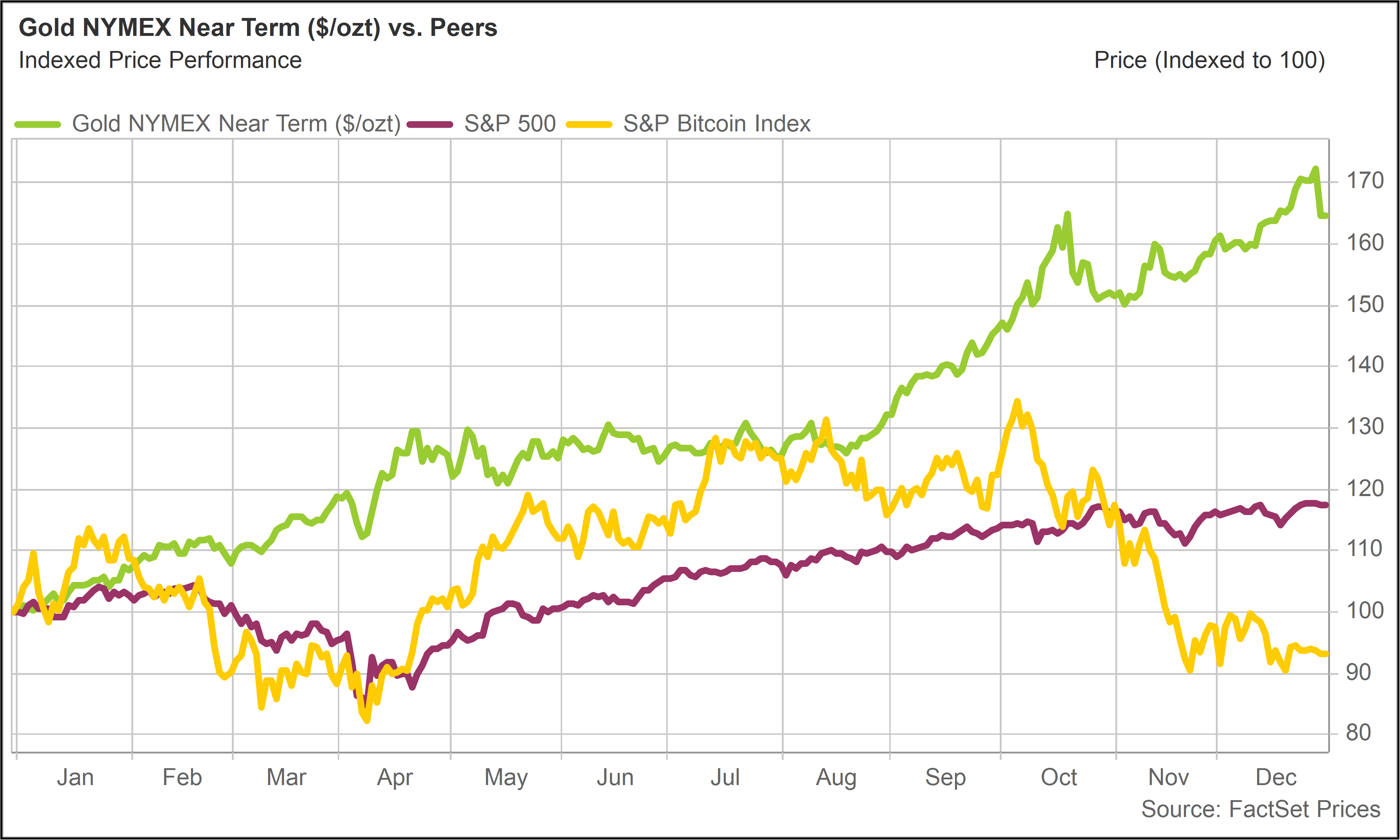
The price of an ounce of gold ended the year just above $4,300. Gold advanced 65% in 2025—its best calendar year performance since 1979.


Gold also substantially outperformed stocks, even with the S&P 500 delivering a highly respectable high-teens return.


Meanwhile, Bitcoin, seen by many as “digital gold” and seemingly tailor-made for the AI era, notably lagged. Bitcoin declined almost 10% in 2025.


The two assets were neck and neck for much of the year, but by mid-August, sentiment toward Bitcoin and the broader crypto complex began to unravel. Gold continued to surge.

Gold vs. S&P 500, Bitcoin

(Total Return - Year to Date)

Metallic money talks


Gold’s success in 2025 signals declining faith in the prevailing economic order. In times of uncertainty, like technological or political revolution, metallic money has great appeal.


A historical snippet from the American Revolution proves the point.


In July of 1780, a convoy of French warships carrying more than 5,000 soldiers entered Newport Harbor in Rhode Island to assist the Continental Army. Initially, locals were highly skeptical.


Just two years prior, another French fleet had arrived in Newport, which had been under British control since December 1776. Expecting strong French naval support, American patriots engaged the Redcoats. But bad weather and poor communication forced the French to retreat.


The attack was a complete disaster for the Americans. The Battle of Rhode Island in 1778 also devastated the local economy in Newport and sparked a wave of anti-French sentiment. Patriots were furious.


The Marquis de Lafayette was a young French nobleman, a major general in the Continental Army and one of George Washington’s closest aides. In a letter written shortly after the defeat, he wrote: “I never was in such danger as during this affair, not so much from the enemy as from the disposition of our own people toward the French.”


Yet when the French returned two years later, they were greeted warmly. It quickly became known that they would be paying local merchants with silver coins, not the rapidly depreciating paper bills issued by the Continental Congress, which were backed by nothing.


Baron Ludwig von Closen, a Bavarian-born French army officer, explained: “The inhabitants, who had at first shown some uneasiness at our arrival, soon became perfectly easy when they saw that we paid exactly for everything, and always in silver.”

Parallels to today


The Continental Congress was in far worse shape financially in 1780 than the U.S. government is today. But with U.S. debt now at $37 trillion and ever-growing entitlement liabilities, investors still have reason to doubt the long-term viability of the paper money the U.S. government issues.


In moments like this, throughout history, investors instinctively gravitate to money that cannot be printed. Digital assets like Bitcoin build upon this foundation, but gold has a track record that spans thousands of years.


Paradoxically, uncertainty surrounding AI and crypto’s reshaping of the financial system may be driving investors back to the oldest form of money.


Gold.


Why gold outperformed


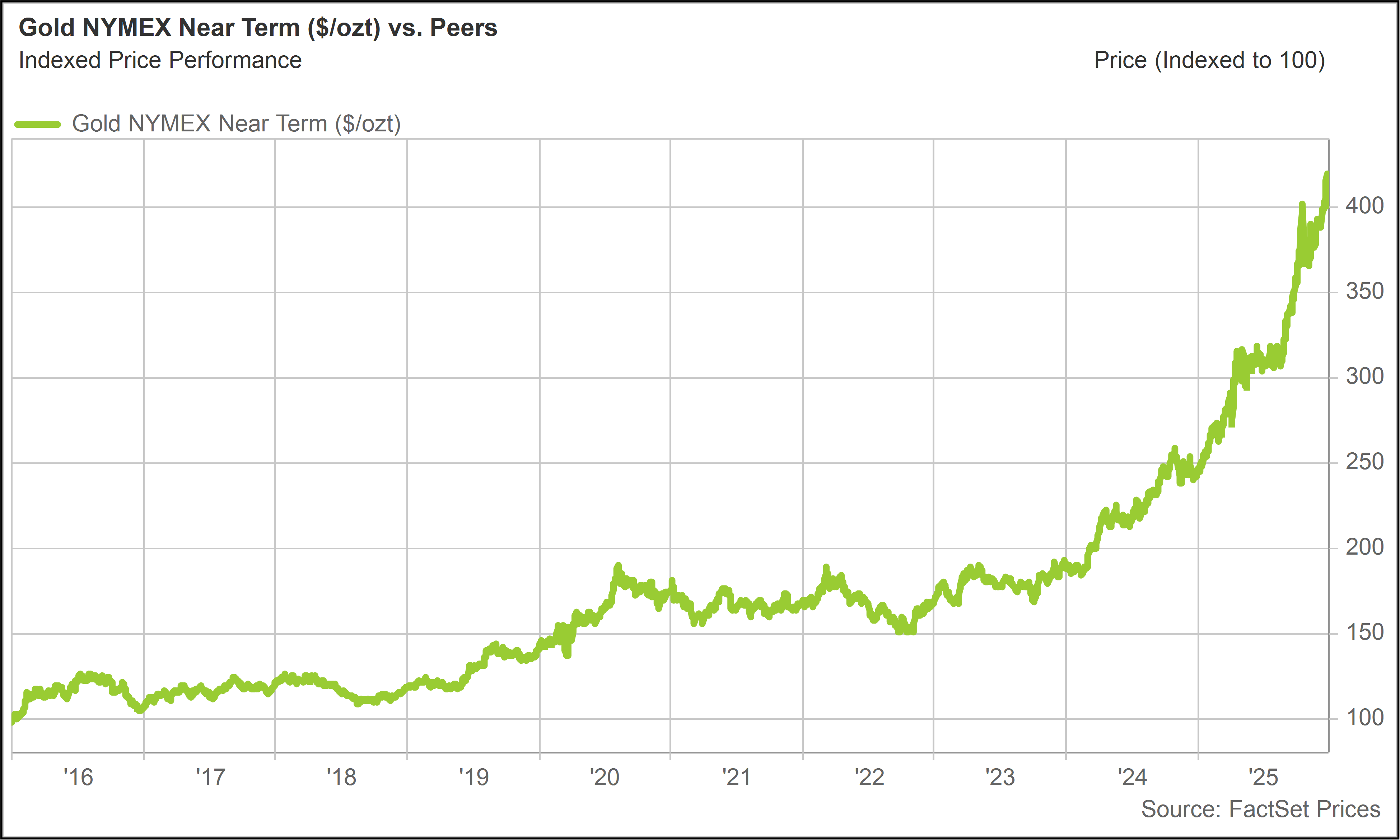
Gold delivered very high returns in 2025, but it also delivered a strong performance in 2024, a year that marked a critical turning point.


Gold returned an impressive 27% in 2024, after a protracted stretch in which returns on gold were much more moderate. For the ten years prior, gold in fact generated an average annualized return of approximately 5.5%.


This longer term performance was arguably acceptable, especially given gold’s utility as a defensive asset. But it was nowhere near the extremely high returns of the past two years.

Gold - Total Return

(Last 10 years)

Gold’s breakout in early 2024 and into 2025 was not driven by a single catalyst. It was the result of a confluence of factors, including a turn in interest rates, rising dollar skepticism, and a decisive shift in central bank behavior.


Those forces reinforced each other—and once they aligned, gold took off.


Turning the corner on rates


The foundation was laid during the pandemic.


In early 2020, the world’s major central banks—led by the Federal Reserve—dramatically expanded the money supply to offset the economic shutdown.


In the U.S., M2 money supply, which typically grows around 5%–6% per year, surged nearly 40% between year-end 2019 and year-end 2021.


That monetary expansion helped push gold roughly 20% higher over the same period. But the initial boost proved temporary.


As inflation filtered into the economy in 2022, the Fed reversed course aggressively. The Fed funds rate rose from near zero to 5.25%–5.5% by August 2023, forcing gold to compete with sharply higher short-term yields.


Gold stalled. With no yield of its own, it struggled in a world where cash finally paid. But by early 2024, something changed.


Inflation appeared to have peaked, even though rates remained high. Investors began to recognize that interest rates move in multi-year cycles—and that the tightening phase was likely ending.


Gold does not need falling rates to rally. It needs clarity. Markets accepted that the next move in rates was down, not up, which helped gold regain its footing.


Dollar skepticism


Meanwhile, confidence in long-term fiscal discipline was beginning to erode.


U.S. federal debt had ballooned from $23 trillion at the end of 2019 to $34 trillion by the end of 2023. The federal government essentially papered over the pandemic shock with unprecedented deficit spending.


This brought to the foreground an academic concept that generally only applies to fragile emerging market economies: fiscal dominance.


Fiscal dominance is the idea that a central bank may ultimately be forced to maintain easy monetary policy because the government is so indebted that it simply cannot afford high interest rates.


Keeping interest rates lower than they should be becomes a necessity, rather than an option.


For many central bankers abroad, the question was no longer theoretical. How will the U.S. manage a growing debt burden—and structurally insolvent entitlement programs—without effectively printing money to cover these obligations?


Against that backdrop, gold began to look far more attractive than U.S. Treasuries.


The lessons of Ukraine


Gold’s appeal wasn’t only economic. It was political.


For central banks, the Russia-Ukraine conflict delivered a blunt lesson: financial assets held within the Western system can be frozen—and ultimately taken—through political action.


That lesson became explicit on April 24, 2024, when President Biden signed legislation authorizing the confiscation of hundreds of billions of dollars of frozen Russian assets for use in Ukraine.


Securities or bank deposits that are custodied by western financial institutions can be seized in an instant. Gold that is held in domestic vaults carries no such risk.


On the day that law was enacted, gold closed at $2,316 per ounce, having only recently broken above $2,000. Over the next 20 months, the gold price nearly doubled.


Just as striking was the path it took. Only four of those months saw declines. The worst drawdown was just 3.4%, with the other three down months each less than 1%.


Central banks step in


Gold was now getting steadily accumulated.


The United States and major Western European nations have long held large gold reserves, built up over decades, if not centuries. Emerging market central banks, by contrast, entered this cycle with relatively low allocations.


Many of those countries also sit in a delicate geopolitical position—balancing relationships with both the U.S. and China—and are more sensitive to the risks of dollar-based asset dependence.


A country like France does not worry much about the U.S. seizing its reserves. Countries like Kazakhstan, Egypt, Pakistan, and Qatar—which were among the largest net buyers of gold in recent quarters—almost certainly do.


For them, gold is not just an investment but rather essential diversification—the one asset they can buy with no counterparty risk.


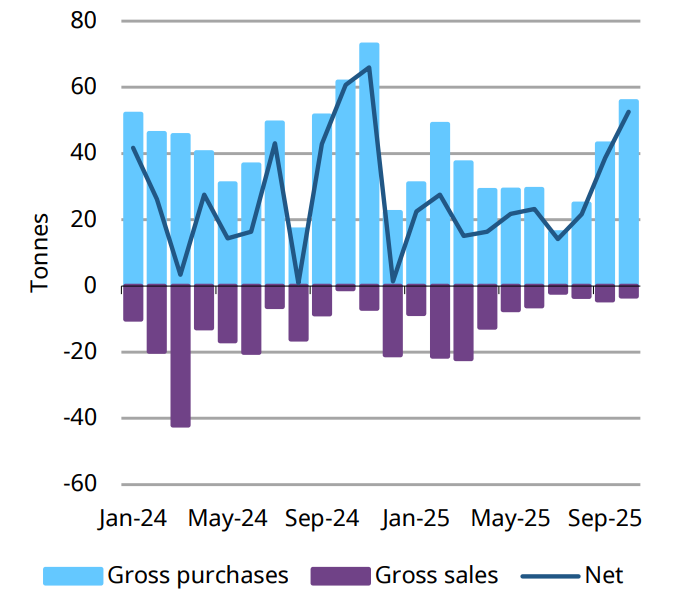
The weaponization of the global financial system following Russia’s invasion of Ukraine was pivotal. Central banks have been consistent net buyers of gold every month over the past two years.

Monthly central bank gold activity

(Source: World Gold Council)

Private investors, too


Individual and institutional investors look at the same set of facts as global central banks.


Even if private investors in stable countries may not be directly concerned about the government seizing their assets, they may see why a physical asset that cannot be seized is potentially attractive to others.


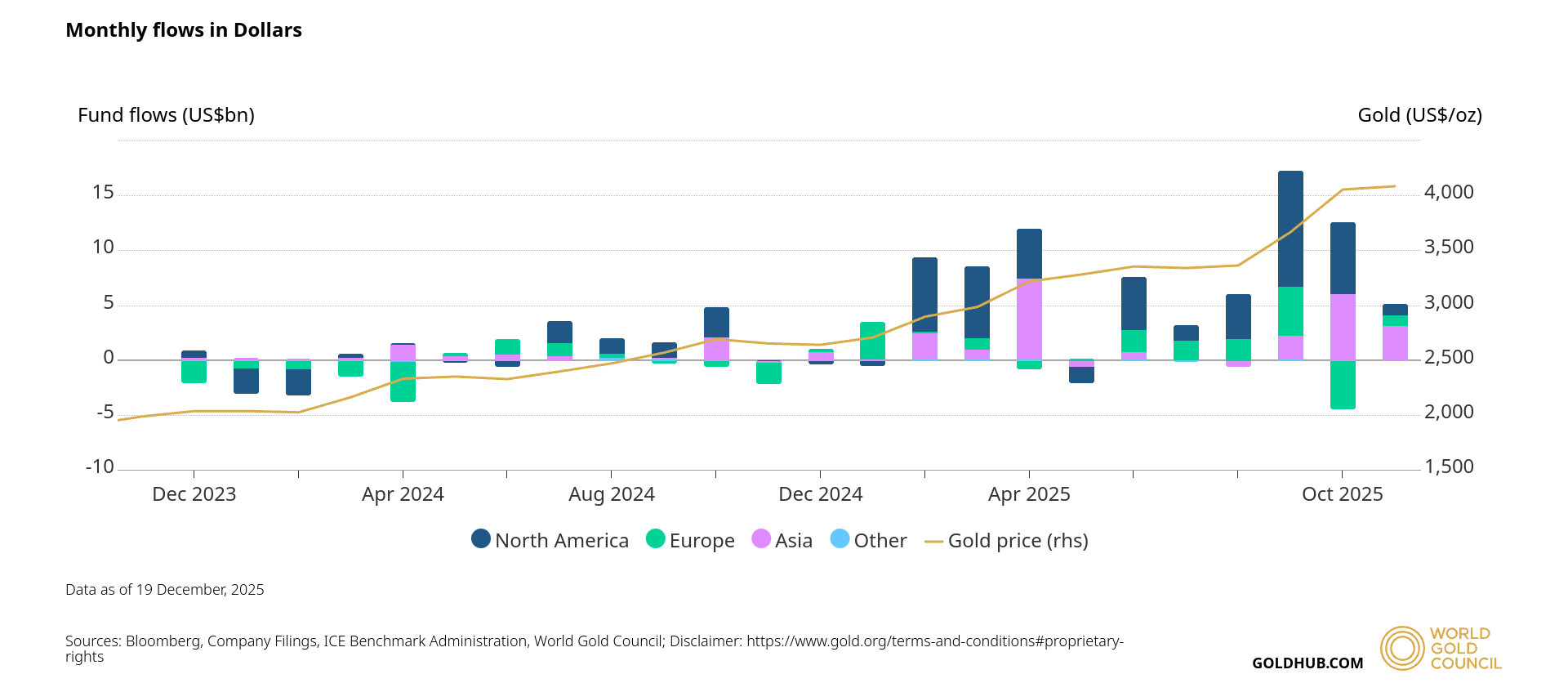
A pick-up in private investment in gold has contributed significantly to the total demand picture over the past two years. This is especially visible in fund flows into popular vehicles like gold Exchange Traded Funds (ETFs).


Global inflows into gold ETFs have accelerated since early 2024 and gained notable strength in 2025.

Global Gold ETF Flows

Tokenized gold arrives


Gold’s rally in 2024 was largely driven by familiar buyers: central banks and ETFs. In 2025, a new source of demand emerged—one that bridges the world’s oldest form of money with the newest and most advanced—cryptocurrency.


At the center of this development is Tether, the world’s largest stablecoin issuer. Stablecoins are digital tokens designed to maintain a stable value, typically backed 1:1 by reserves such as cash, Treasury bills, or, increasingly, commodities like gold.


Unlike most cryptocurrencies, stablecoins function less like speculative assets and more like digital cash. They are used for payments, settlement, and short-term savings, often outside the traditional banking system. Stablecoins offer greater liquidity and accessibility versus conventional bank accounts.


Regulatory clarity in 2025 accelerated the stablecoin trend.


New legislation—most notably the GENIUS Act (Guiding and Establishing National Innovation for U.S. Stablecoins Act)—has begun to formalize the stablecoin market.


That framework is encouraging scale, legitimacy, and institutional participation.


A new kind of buyer


Tether’s primary product is USDT, a U.S. dollar–backed stablecoin with a market capitalization approaching $200 billion. That is roughly equivalent to a mid-to-large U.S. commercial bank in terms of deposits.


Alongside USDT, Tether also issues Tether Gold (XAUT), a token backed one-for-one by physical gold stored in Swiss vaults. The product currently represents roughly $2 billion in gold holdings, with each token corresponding to one troy ounce.


Other issuers operate in the same space. PAX Gold (PAXG), launched in 2019, follows a similar model. But Tether’s scale sets it apart.


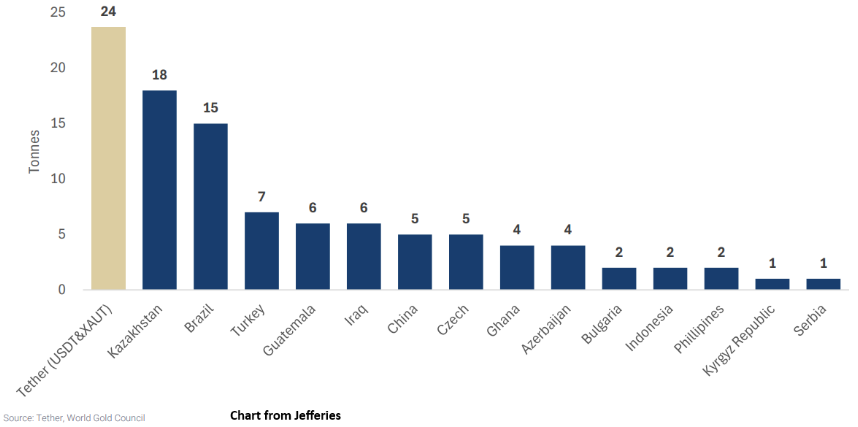
In 2025, Tether began accumulating gold aggressively, not just to support XAUT but as a broader reserve asset. In the third quarter alone, the firm purchased approximately 24 metric tons, bringing its total gold holdings to 116 tons as of September 30, 2025.


That quarterly buying exceeded the activity of Kazakhstan, the most active central bank in the global gold market during the same period.


The rise of tokenized gold underscores a broader point: gold is no longer competing against crypto. Increasingly, it is being embedded within crypto.

Tether Q3 2025 Gold Purchases


Can it keep going?


We have consistently advocated portfolio allocations to gold since we launched 76research in early 2024. The gold streaming stocks that are held within our Inflation Protection Model Portfolio have been among our best performers, significantly outpacing the stock market and gold itself in 2025.


With gold prices having more than doubled over the past two years, it is reasonable to ask whether the asset has simply become too expensive.


We continue to like gold for several reasons:


(1) Monetary policy is turning supportive again.


The post-pandemic inflation cycle is ending. While inflation proved persistent for longer than many expected, the direction is now clear.


Even where tariffs added pressure, the effect appears modest. New York Fed President John Williams recently estimated that tariffs contributed only about 0.5% to inflation in 2025 — a conclusion we view as reasonable.


With tariffs already embedded in prices, their incremental inflationary impact should fade. Meanwhile, labor markets are showing signs of slack, which gives the Fed a green light to continue easing.


Looking ahead, whoever President Trump appoints as Jerome Powell’s successor is likely to arrive with a strong preference toward rate cuts and easier monetary conditions, reinforcing a more gold-friendly backdrop.


(2) AI-driven productivity supports easier policy over time.


At its core, AI replaces and amplifies human intelligence. As AI spreads through the economy, its impact will be increasingly profound.


Productivity gains from AI should strip costs from the economy in a sustained way. Businesses will be able to deliver goods and services more efficiently—in some cases with fewer workers.


This directly influences the long-term trajectory of monetary policy.


The Federal Reserve targets price stability and maximum employment and maintains a long-run inflation goal of 2%.


If productivity suppresses price pressures and reduces labor demand, the Fed and other central banks will have strong incentives to inject liquidity to sustain growth and prevent inflation from undershooting targets.


In short, AI-driven productivity growth should lead to easier monetary policy, which favors scarce assets like gold.


As the supply of fiat money expands alongside productivity-driven wealth creation, demand rises for stores of value, while the gold supply increases at only 1%–2% per year.


(3) Central banks are unlikely to stop buying.


Central bank demand is the cornerstone of the gold market.


Western economies such as the United States, Germany, Italy, and France hold disproportionately large gold reserves built up over decades. Much of the rest of the world remains structurally under-allocated.


To put that imbalance in context, the U.S. and Western Europe collectively hold roughly 19 million tons of gold. All Asian nations combined (representing the majority of the global population and nearly 40% of world GDP) hold about 5.5 million tons.


The factors that reignited central bank demand in 2024—ballooning U.S. debt, geopolitical risk, and concerns over reserve security—have not diminished. If anything, they have intensified.


(4) Tokenization is still in its infancy.


Tokenization represents a structural expansion of gold’s addressable market.


We are at the very early stages of digitizing real-world financial assets. McKinsey estimates that tokenized assets—excluding cryptocurrencies and stablecoins—could reach $2 trillion by 2030.


Markets naturally evolve toward systems that are faster, cheaper, and easier to use. Tokenization allows assets to be bought, sold, and transferred instantly and continuously, without paperwork, intermediaries, or settlement delays.


Tokenized gold lowers barriers to ownership worldwide, particularly in emerging markets where domestic currencies are unstable and traditional financial infrastructure is unreliable.


Owning tokenized gold does not require a bank account—only a smartphone. Roughly two-thirds of the world’s population already has one.


Tokenization does not eliminate counterparty risk. Investors must still trust the custodian and the legal jurisdiction backing the asset. But it offers a potentially compelling and convenient alternative to physical ownership and ETFs that require brokerage access and financial intermediation.


Tether’s recent gold accumulation suggests tokenization has already begun to influence the physical gold market. As digital platforms scale, tokenization represents an open-ended source of incremental demand for gold—one that should not be underestimated.


What about crypto?


Gold clearly won the debasement trade in 2025 and enters the new year with momentum.


Investors should not necessarily expect another doubling over the next two years, and volatility is always a risk. But the key structural demand drivers supporting gold remain intact.


Bitcoin and the broader crypto market faced greater challenges, particularly in the latter part of the year, despite meaningful progress on regulation, legal clarity, and institutional adoption.


Crypto’s underperformance does not invalidate the thesis—but it does demand explanation.


We look forward to revisiting what went wrong for crypto in 2025 and why Bitcoin and digital assets may reassert themselves as the debasement trade evolves in the year ahead.


Until then, we wish you a happy, healthy, and prosperous new year.

Click HERE to learn more about our Model Portfolio subscription plans.

FOR SUBSCRIBER USE ONLY. DO NOT FORWARD OR SHARE.

Global Gold ETF Flows

This is an automated post