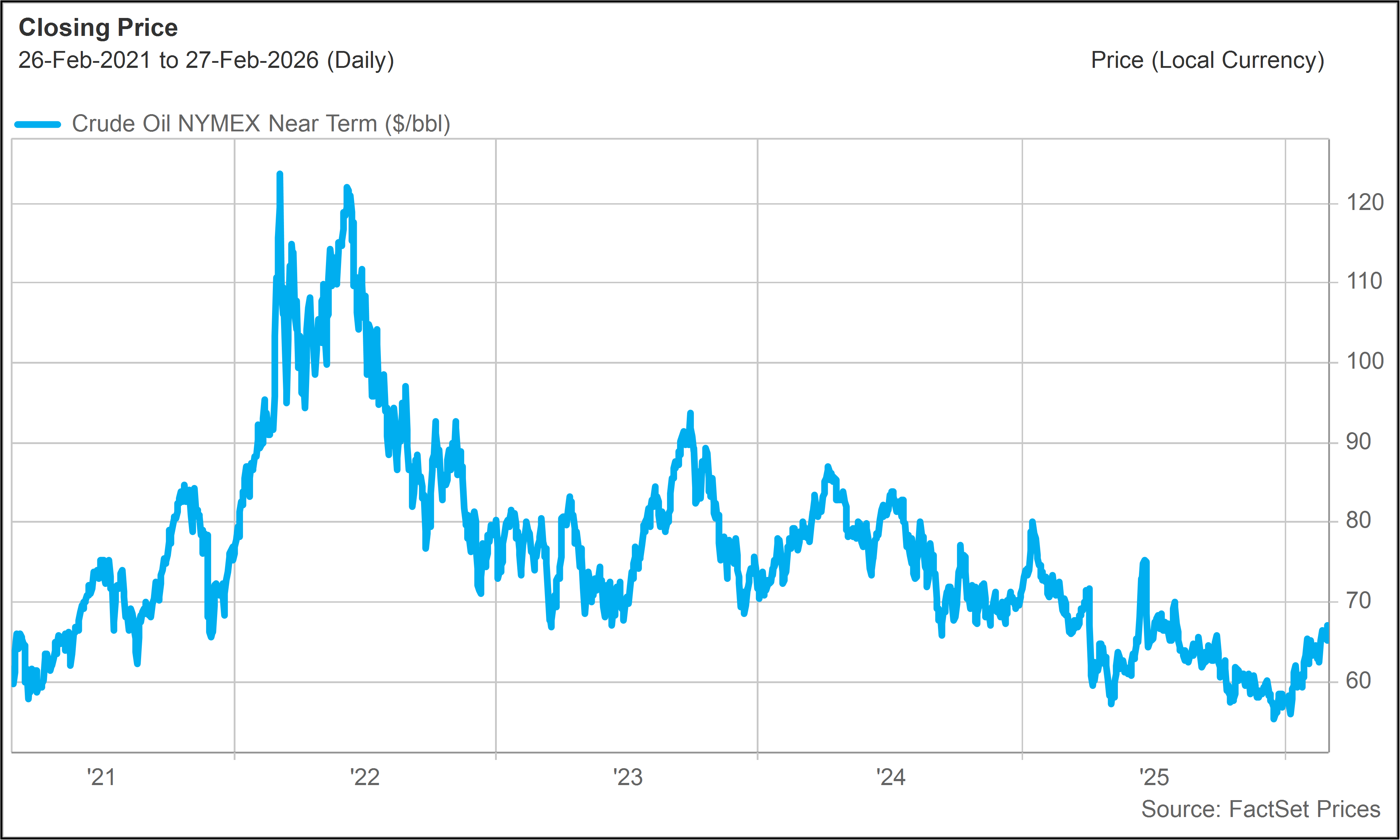
What energy traders are watching most closely is a potential disruption of traffic in the Strait of Hormuz.
Roughly 20% of global oil consumption moves through the Strait of Hormuz, the narrow maritime corridor between Iran and Oman. At its tightest point, it is only about 21 miles wide, making it one of the most strategically sensitive chokepoints in the world.
If that passage were meaningfully disrupted, oil prices could spike. A sustained closure would not simply add a few dollars per barrel—it would create an entirely different supply backdrop, potentially pushing prices sharply higher and tightening global financial conditions.
With Iran's military infrastructure already significantly degraded, its capacity to mount a credible blockade or mine-laying campaign in the strait has diminished sharply. This risk is not zero, however, and will likely weigh on markets so long as combat continues.
A strategic reordering
For decades, the Islamic Republic of Iran has acted as a destabilizing force across the region. Through proxies in Lebanon, Syria, Iraq, and Yemen, Tehran has projected power asymmetrically, often below the threshold of full-scale war.
This shadow warfare has shaped Middle East geopolitics since the late 1970s. It has fueled conflicts, targeted U.S. assets, and threatened regional allies.
Iran has been the epicenter of Middle Eastern instability for fifty years. Rather than responding incrementally to proxy escalation, the United States is now going straight for the source.
With Iran's command infrastructure, missile production facilities, and key military leadership targeted in a coordinated, high-precision operation, its ability to sow chaos in the region has taken a serious blow.
Proxy networks will not disappear overnight, but they lose coherence and resupply when the center stops functioning.
The China angle
China has benefited from its alliance with Iran. China imports a lot of oil from Iran, which supplies nearly 15% of its total oil imports. China was Iran’s top customer in 2025.
A dangerous and unpredictable Iran has also benefited China strategically by undermining the United States and its allies and complicating diplomacy in the region.
When Iran is strong and threatening, the United States is compelled to allocate military resources and spend political capital in the Middle East, distracting it from other critical regions, like Asia.
By changing the balance of power in the Middle East, the U.S. now has the opportunity to change the balance of power with China all around the world.
There is an important connection to the operation in Venezuela, where the removal of Maduro means the loss of a valuable strategic relationship for China in Latin America. The same goes for Trump’s seemingly successful assertion of territorial claims in Greenland, as China along with Russia jockeys for position in the Arctic.
Across the globe, Trump has been freezing out Chinese influence.
AI and the new shape of war
What made this operation different from anything that came before was not just political will—it was technological capability.
Military analysts are pointing to the role of AI-assisted targeting, real-time intelligence fusion, and autonomous precision systems in making strikes of this complexity possible with minimal collateral damage.
Five years ago, a mission of this scope would have required weeks of manned surveillance, imperfect intelligence, and a far wider destructive footprint. Today, AI systems can process satellite imagery and other data at speeds no human analyst can match, identifying targets with a precision that changes the moral and strategic calculus entirely.
The result is arguably a new kind of deterrence built on technological advantage—one where the threat is not massive retaliation but exact retaliation. The rules of geopolitical engagement are being rewritten in real time.
Rising American prestige
It remains to be seen who will lead Iran in the future. A best case scenario likely involves a complete regime change and new leadership that is friendly to the U.S.
But even in a worst case scenario for the United States, where the faction now in charge keeps its grip on power, Iran will emerge from this experience a much weaker and less threatening power.
International politics is as much about perception as firepower. For years, adversaries tested the boundaries of American deterrence, probing whether responses would be incremental or symbolic.
A controlled but decisive action recalibrates that perception. It signals capacity and willingness.
From a strategic standpoint, the United States may emerge with enhanced credibility, both among allies and rivals. Regional partners who rely on U.S. security guarantees view strength differently from hesitation. And adversaries reconsider cost-benefit calculations when deterrence feels credible.
Financial markets also price credibility. Nearly two-thirds of global stock market capitalization is now made up of American firms. Much of the remainder is highly integrated with the U.S. economy.
By carefully exercising its high-tech military capabilities, the United States continues to improve its overall geopolitical positioning and leverage. Markets ultimately seem to appreciate this.