The new socialist threat is not theoretical. It is showing up in polls, campaigns and election results.
The most visible example has been New York City, where Zohran Mamdani, a self-described democratic socialist, shocked the political establishment by winning the Democratic mayoral primary in 2025.
Since taking office, Mamdani has moved quickly to turn campaign promises into policy. New York City’s Rent Guidelines Board recently voted to freeze rents on roughly one million regulated apartments for up to two years—a major victory for one of Mamdani’s signature campaign themes.
In recent weeks, three Mamdani-backed congressional candidates—all members of the Democratic Socialists of America (DSA), a network of socialists operating as a faction within the Democratic Party—recently won Democratic primaries, defeating establishment-backed opponents.
Days later, a democratic socialist defeated a 15-term incumbent in a Denver-area Democratic primary, solidifying the DSA as a powerful force in deep-blue urban politics across the nation.
Socialism is no longer just a campus slogan or a fringe protest movement. It is winning real elections by leveraging increasingly negative attitudes towards capitalism across the American population.
Gallup recently found that only 54% of Americans have a positive view of capitalism, down from 60% in 2021 and near the lowest level it has recorded.
Socialism remains less popular overall, with 39% viewing it positively, but the partisan divide is striking.
Among Democrats, the ideological balance has flipped. According to Gallup data, 66% of Democrats view socialism positively, while only 42% view capitalism positively.
The generational numbers are even more concerning.
Harvard’s Fall 2025 Youth Poll found that only 39% of young Americans support capitalism, down from 45% in 2020. Only 19% identify as “capitalist,” down from 29% five years earlier.
We’ve been here before
This is not the first time socialism has inserted itself into American politics.
In the early 20th century, industrial capitalism produced extraordinary wealth, but also harsh working conditions, monopoly power, urban poverty and visible inequality. Socialist politicians gained real traction in that environment.
In 1912, Eugene V. Debs ran for president on the Socialist ticket and won almost a million votes, equal to 6% of the national popular vote. That remains one of the strongest national showings for socialism in American political history.
The Great Depression was the deepest crisis of confidence American capitalism has ever faced. Banks failed. Unemployment soared. The stock market collapsed. Millions of Americans understandably wondered whether the system itself had broken.
Norman Thomas, the Socialist Party’s presidential candidate, received 885,000 votes in 1932, his best showing, although still a small minority.
Socialism naturally gains ground when economic conditions are challenging. The early 1900s had monopolies, labor unrest and inequality. The 1930s had unemployment, bank failures and collapsed asset prices.
But America’s answer has historically been practical, focusing on preserving the core of the free market capitalist system while making certain adaptations.
During the Progressive Era, America responded to monopoly power with antitrust.
The Sherman Antitrust Act was the first federal law outlawing monopolistic business practices. Congress later strengthened the framework with the Clayton Act and Federal Trade Commission Act in 1914.
During the Great Depression, the country did not nationalize the entire banking system. It created deposit insurance through the Banking Act of 1933 and established the FDIC to restore confidence in banks. It also created the SEC under the Securities Exchange Act of 1934 to bring greater transparency and oversight to public markets.
The New Deal also created a basic safety net. The Social Security Act of 1935 established old-age benefits, unemployment insurance and aid for vulnerable groups.
These reforms remain debated to this day, but politically, they helped blunt the socialist critique that capitalism offers no protection against old age, unemployment, exploitation or financial panic.
For the most part, these 20th century regulatory and social welfare frameworks have become accepted features of the American political system and are rarely challenged. Social Security, in particular, is extremely popular among voters, with more than 90% of Americans polled judging it favorably.
How to respond today
An important contrast with prior instances of American socialism is that the Mamdani socialists of today are not working from a foundation of extreme economic hardship.
The unemployment rate is historically low, around 4%. Inflation was painful in the post-Covid years but is now moderating toward low single-digit levels.
To be sure, there are real economic concerns in an increasingly “K-shaped” economy that tends to reward asset owners and highly skilled professionals, leaving many households behind.
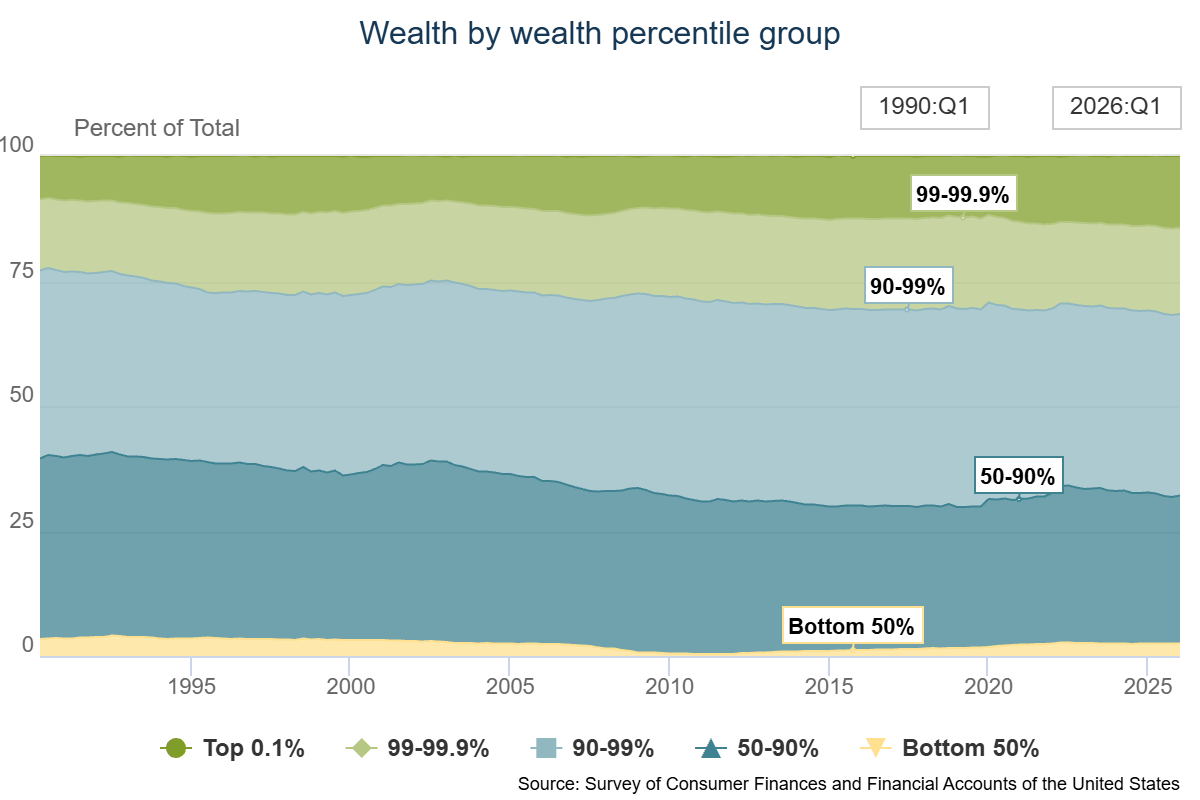
The top 10% of U.S. households now own about 70% of the nation’s total wealth. The bottom 50% of households only own about 2.5%.
It is interesting to note, however, that while this wealth distribution has gotten slightly more skewed in recent decades, the change has been relatively modest (and to some extent explained by demographic changes in household composition as the population has aged).
In 1990, the top 10% of U.S. households still owned about 60% of the nation’s total wealth. The bottom 50% only owned 3.5%.