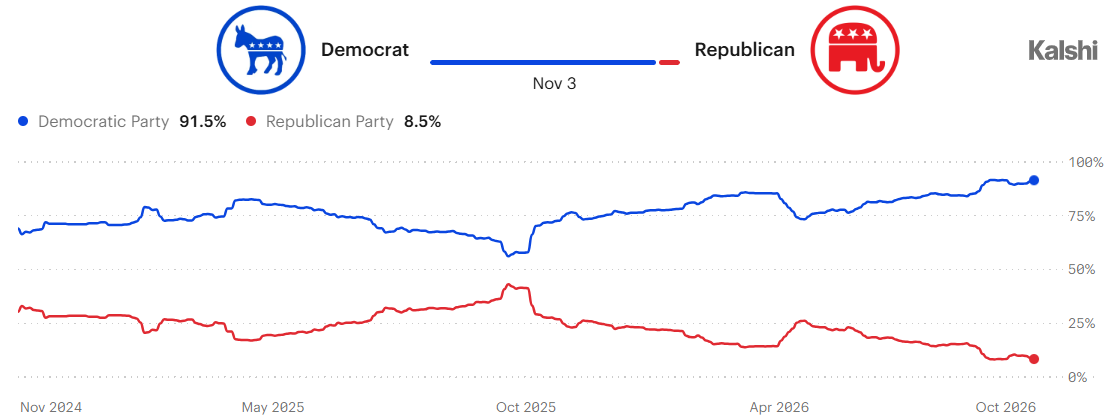
A change in congressional control would therefore hardly come as a shock to Wall Street. But even if Democrats make substantial gains, there are reasons the market could take the outcome in stride.
For one thing, the election itself will finally be over.
Historical market performance around midterm elections is surprisingly encouraging.
Various studies of historical market reaction in the modern era demonstrate that the S&P 500 has overwhelmingly generated positive returns in the 12-month period following midterms—with an average gain well above historical market returns.
These historical patterns suggest the stock market has often benefited simply from the resolution of political uncertainty, regardless of which party emerged victorious.
How much would really change?
A shift in congressional control would certainly affect Washington. Democratic majorities could intensify investigations, complicate budget negotiations, and prevent Republicans from advancing new legislation.
But much of the Trump administration's economic agenda is already in place.
Existing tax legislation would remain on the books. Many regulatory priorities are being implemented through executive agencies. Trade policy, foreign affairs, and immigration enforcement are also areas in which the executive branch exercises considerable authority.
The recent failure to advance the CLARITY Act, which would establish a comprehensive regulatory framework for cryptocurrencies, illustrates how important policy objectives can move forward through executive action even when Congress is gridlocked.
It also serves as a reminder of the status quo. Republicans now hold only narrow congressional majorities. This has made major legislation difficult to pass even without divided government.
Despite the setback on the CLARITY Act, the Trump administration has continued making substantial progress on cryptocurrency regulation through the Securities and Exchange Commission (SEC) and the Commodity Futures Trading Commission (CFTC).
The two agencies have been working together to clarify the legal treatment of digital assets, establish more accommodating rules for cryptocurrency trading, and reduce regulatory uncertainty for the industry.
Comprehensive legislation would provide greater permanence and legal certainty. But its absence has not prevented the administration from meaningfully reshaping the regulatory landscape for digital assets.
It will still be close
Even if Democrats manage to gain control of both chambers, their majorities would likely be quite narrow. And they would face a major obstacle to advancing their legislative agenda: a Republican in the White House.
Trump would retain his veto power, substantially limiting Democrats' ability to enact major legislation opposed by the administration. Overriding a presidential veto requires a two-thirds majority in both chambers—an exceptionally high hurdle for a narrowly divided Congress.
Vice President JD Vance, meanwhile, would also retain the power to break tie votes in the Senate, even under Democratic control.
A 50–50 Senate would effectively favor Republicans. Even with a narrow Democratic majority, just one or two senators crossing party lines could produce a tie, allowing Vance to cast the deciding vote on important legislation or nominations.
Can Democrats derail the AI revolution?
AI has not only been the primary engine of earnings growth for the world's largest technology companies, it has been the largest contributor to growth across the American economy.
The scale of investment remains extraordinary, with hyperscalers committing hundreds of billions of dollars annually to data centers, equipment, and related infrastructure.
At the same time, AI has become increasingly controversial politically.
Opposition to large data centers has emerged as an important issue for some Democratic candidates, reflecting public concerns about electricity prices, environmental impacts, and the potential displacement of workers.
This political resistance is a genuine consideration for investors.
Yet there is a fundamental difference between opposition to AI infrastructure and the ability of Congress to meaningfully restrict the technology's development.
Much of the decision-making surrounding data centers takes place at the state and local levels, where communities and regulators determine access to land, power, water, and construction permits.
Opposition is not exclusively Democratic, either. Communities in Republican-controlled states have raised similar concerns about electricity costs and infrastructure demands.
There are also some positive investment implications to the resistance to data center construction.
Making new data centers harder to build could increase the strategic value of existing facilities, secured power capacity, and other infrastructure assets. The check on supply growth also helps prevent overinvestment and the potential formation of an AI bubble (along the lines of the fiber overbuild of the dotcom era).
Ultimately, the most important questions for our increasingly AI-dependent economy are technological and commercial, not political.
Will AI models continue improving? Will businesses discover new ways to deploy them profitably? Will productivity gains justify the enormous investments currently being made?
The answers to these questions will matter far more to long-term technology valuations than the congressional election results.
The path of oil prices
Oil is the other dominant macroeconomic factor. Oil prices have become the key variable driving monetary policy through their impact on inflation data.
The Iran conflict has created a major economic burden, driving up energy prices, lifting inflation, and contributing to pressure on long-term interest rates.
It has also become an important political liability for Republicans.
There is some irony here: oil prices may have a major influence on the election, but the election itself may have relatively little influence on oil prices.
The ultimate resolution of the Iran conflict depends primarily on military realities, economic pressure, diplomacy, and the ability of the global energy system to adapt.
Congress can influence military funding and exercise oversight, but control of the House or Senate will not determine when the conflict ends—or when energy prices begin to retreat. The vast majority of the decision-making resides in the White House.
Meanwhile, we have seen some favorable developments in the physical oil market.
According to new reporting, Gulf oil producers excluding Iran exported approximately 24.6 million barrels per day during the week ending October 18, exceeding the prewar average of 23.3 million barrels.
This is a notable recovery considering the ongoing violence.
Importantly, shipments directly through the Strait of Hormuz have not fully returned to prewar levels. Instead, oil producers have adapted through alternative pipelines, new shipping arrangements, and transfers between vessels.
Saudi Arabia and other regional producers have demonstrated considerably more flexibility than many observers initially anticipated.
Yet oil prices remain elevated, with Brent crude trading around $110 per barrel.
If physical export volumes have recovered so dramatically, why is oil still so expensive?
Part of the answer lies in the extraordinary costs and risks associated with getting that oil to market.
Shipping rates have soared. War-risk insurance remains expensive. Tankers are taking longer routes or operating through complicated transfer arrangements. The continuing threat of attacks creates a substantial premium for uncertainty.
There are also shortages of refined petroleum products, particularly diesel, which has become exceptionally expensive.
Ukrainian attacks on Russian refineries have been genuinely impactful by removing much needed capacity from a tight market.
Russia accounts for approximately 11% of the global seaborne diesel export market. Because demand is inelastic, even a small reduction in capacity can have a large impact on price.
High diesel prices actually make the cost of shipping oil even higher, driving up oil prices globally. Crude oil is largely transported by diesel-powered cargo ships and trucks.
Global oil inventories also remain substantially below prewar levels, leading to elevated short-term demand. Buyers around the world are willing to pay high prices to ensure adequate backup supply.
While the recovery in crude exports is encouraging, it has not yet translated into a fully normalized energy market.
These extraordinary costs could begin to retreat, however, as security conditions improve, shipping routes normalize, and refining operations recover.
We cannot predict precisely when that happens. Iran still has the ability to disrupt shipping and infrastructure. Diplomatic efforts could fail.
But the recovery in regional oil exports suggests the market is already adapting to challenging conditions and will continue to do so.
Furthermore, as President Trump has argued, Iran has potentially been deliberately stalling on negotiations, hoping that high oil prices and ongoing military engagement help Democrats in the run-up to midterms.
He may be correct. If he is, this would suggest that getting past midterms will in itself serve as a catalyst for some kind of resolution.
Looking beyond November 3
The midterm elections are important—no doubt about it.
They will shape the political environment for the remainder of Trump's presidency and could produce meaningful consequences for individual sectors and industries.
But investors should resist the temptation to equate election results with stock market results.
Republican losses are widely anticipated. An electoral surprise could create upside, while simply moving beyond the uncertainty of the election could itself be helpful.
More fundamentally, the most powerful forces shaping the economy are unlikely to be decided at the ballot box
AI will continue to advance according to technological and commercial realities. The resolution of the Iran conflict—and the associated outlook for energy prices—will depend largely on circumstances beyond congressional control.
We remain optimistic about the long-term economic potential of AI. And while the energy outlook remains uncertain, the recent recovery in Gulf oil exports offers a tangible reason to believe the current inflationary pressures will eventually ease.
November 3 will determine which party ends up with what is most likely to be—either way—slim majorities in the two chambers of Congress. For long-term investors, the combination of continued AI progress and an eventual reversal in oil prices represent the more pressing concerns.