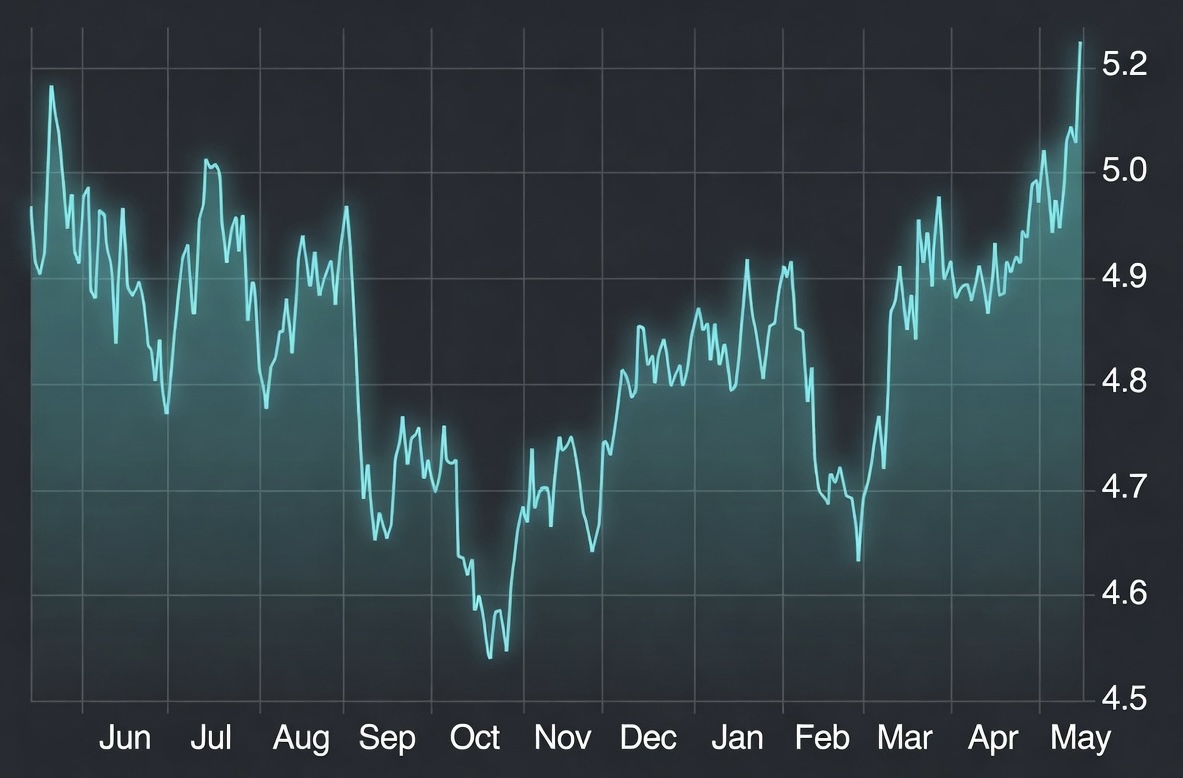
In support of Hassett’s viewpoint that this is just a temporary situation is the fact that Core CPI, excluding food and energy (which are heavily influenced by oil prices), rose much more modestly at 2.8%.
It has also been noted that a key element of core CPI—shelter—increased at a higher rate because of a technical adjustment to the data related to missing data from the government shutdown last fall.
If we finally get a breakthrough in the Persian Gulf, as oil markets anticipate, this debate may be entirely academic.
A normalization of traffic in the Strait of Hormuz means that over the next twelve months, energy would flip from an inflationary to a deflationary factor, potentially even causing CPI to undershoot the 2% target.
AI deflation
Perhaps the most interesting part of the inflation debate is what happens over the long term. Here is where Kevin Warsh’s productivity argument comes in.
Warsh has repeatedly emphasized that technological progress—particularly AI—has the potential to expand the productive capacity of the economy in ways many economists may be underestimating.
Productivity is ultimately the most important long-term antidote to inflation. The essence of productivity growth is getting more goods and services at lower cost.
Right now, even though inflation (ex-energy) is subdued, AI could actually be having a net inflationary effect, because AI is creating a lot of demand for resources and labor across the economy.
Data centers are being built at extraordinary scale. Utilities are spending heavily to expand power generation. Companies are investing hundreds of billions into infrastructure.
But the next phase of the AI cycle, emphasizing adoption and implementation, could look much different.
In healthcare, AI can reduce administrative overhead that consumes enormous portions of medical spending today.
In manufacturing, AI-powered robotics can increase output while reducing waste and downtime.
In finance and law, tasks that currently require large teams of analysts could increasingly be automated.
The economy may currently be experiencing the expensive “build phase” of AI—the period where enormous capital must be deployed upfront. But if the technology delivers the productivity gains many expect, the payoff later could be profoundly disinflationary.
In other words, as Warsh has suggested, AI could eventually become one of the largest deflationary forces the modern economy has ever seen.
Tightening now into a temporary oil shock looks all the more absurd, if this is the case.
Investing for inflation protection
When we think about our own Inflation Protection Model Portfolio strategy, we are primarily focused on protecting investors from the effects of monetary expansion, i.e. growth in the money supply.
People sometimes refer to this risk as monetary debasement.
More colloquially, it is known as “money printing,” which is how it actually happened in the pre-digital era. Today, monetary expansion is accomplished through computers rather than actual paper currency creation.
The reason the Fed has an informal inflation target of 2% is that, while inflation is generally seen as a negative, uncontrolled deflation is worse. In our highly indebted, fiat money system, deflation can be dangerous.
Consumers, if they expect continuously falling prices, may refrain from purchases, placing even more downward pressure on prices by reducing demand.
So the Fed and other central banks have a bias to maintain moderate but positive inflation rates.
Monetary expansion is the tool central banks use to respond to falling prices.
If more money is injected into the economy (for example, by lowering interest rates to stimulate more borrowing) that means more money is chasing the same quantity of goods and services. The effect is to generate inflation.
Two scenarios
There are two main scenarios for monetary expansion: one good, one bad.
The good scenario involves the technology-driven productivity dynamics described above. Technologies like AI have the potential to make goods and services cheaper… a lot cheaper.
There is a less rosy scenario that could similarly lead to aggressive monetary expansion, one that has plagued governments throughout time.
Excessive government spending leads to excessive debt loads that become unmanageable.
Under a gold standard, a government would default. In a fiat money system, the default takes places gradually through money printing and currency devaluation.
Monetary expansion, in the bad scenario, is not about maintaining a low inflation target. It is about the survival of the government.
This type of monetary expansion inevitably involves high rates of inflation, potentially even hyperinflation, but it is necessary when a government finds itself drowning in debt and unable to meet its obligations.
How investors can prepare
For investors, the way to prepare for either scenario is the same.
Own real scarcity. Own assets and enterprises that cannot be destroyed by monetary expansion and may even benefit from it.
Within our Inflation Protection portfolio, we focus on companies that are built around supply-constrained commodities (like gold and copper), resources (like energy), and business models (like distributors) that we believe will perform well in periods of monetary expansion.
Our strong preference is that any monetary expansion that does occur comes as a result of a productivity boom that necessitates loose policy to stave off deflation. With the advent of AI, this scenario may be more likely than it has ever been, as the new Fed Chair believes.
But we are also mindful of the fragile public debt position and unchecked growth in entitlements, with record levels of debt-to-GDP.
Our goal is to own investments that will perform well as the money supply expands, regardless of the reason… whether it is in the context of an AI productivity boom, papering over the massive public debt burden, or some combination of both.