

Unlock Our Free Investment Insights

Inside The MAG7 MONITOR

Trish Regan is one of America’s most recognized financial journalists and digital media hosts. An award-winning reporter, author, television personality, and speaker, Trish is a leading economic and political thought leader who helps viewers to better understand the most critical issues facing the economy and American business today. With extraordinary access to newsmakers and industry sources, as well as a knack for anticipating opportunities and risks in investing, Trish leverages her knowledge of how the mainstream media works to enable subscribers to best understand the information moving markets.
Trish is the Co-Founder and Executive Editor of 76research. She is also the founder, owner, and host of the daily livestreamed Trish Regan Show with more than 80 million views per month. Prior to founding 76research with longtime friend Rob Hordon, Trish anchored some of the most highly rated financial programs at America’s most noted financial networks including CNBC, Bloomberg, and most recently, Fox Business News.
Throughout her career, Trish has interviewed numerous heads of state, including multiple U.S. Presidents, foreign leaders, Fortune 500 CEOs and other institutional, charitable, and government leaders.
Trish credits her start in journalism to her fifth grade position as school correspondent for her local New Hampshire newspaper. But, while Trish showed an early interest in reporting and writing, it wasn’t until years later that she chose to make journalism her career. In fact, she originally intended to pursue a career in finance and worked as an analyst in emerging debt markets at Goldman Sachs while a student at Columbia University. Fluent in Spanish, Trish focused primarily on Latin American sovereign debt markets including Argentina, Mexico, Venezuela, and Brazil, but when Bloomberg Television offered her an opportunity to work as a correspondent, she made the jump into financial media.
Beginning at Bloomberg in 2000, Trish was on the front lines as the dot-com bubble burst. She covered its aftermath from Silicon Valley and San Francisco as a correspondent at MarketWatch before moving back to New York to work as a correspondent for CBS News. In 2006, Trish returned to her financial roots as an anchor on CNBC’s top-rated daily markets program The Call where she reported on the 2008 financial crisis in real time. While an anchor at CNBC, Trish also reported business news for NBC's Nightly News and The Today Show. In addition, she produced and hosted the two most highly rated documentaries in CNBC's history – Marijuana Inc and Marijuana USA, which investigated a massive and fast-developing underground industry. Trish predicted that industry would soon become mainstream in her book Joint Ventures: Inside America's Almost Legal Marijuana Industry, published by Wiley & Co. in 2010.
In 2011, Trish went back to Bloomberg Television to anchor the network's afternoon market close coverage as host of Street Smart with Trish Regan. While at Bloomberg, Trish was the network's main political anchor for all political television coverage of the 2012 election, including both the Republican and Democrat conventions and the election itself. From 2013 through 2016, Trish also worked as a front-page economic columnist for USA Today, writing on the biggest trends in business, markets and the economy.
In 2015, Trish left Bloomberg Television to join Fox News and Fox Business as the anchor of her new program The Intelligence Report with Trish Regan during FBN’s market hours. She would later move to an evening program and become the only woman in cable TV at that time to host a primetime show. Trish Regan Primetime grew 8pm ratings to a level never before seen at Fox Business.
While at Fox, Trish Regan also anchored two Republican Presidential debates – making history as part of the first all-woman team, with colleague Sandra Smith, to anchor a Presidential debate. She also appeared as an economic and markets contributor to all Fox News programming and was also a guest anchor on Cavuto, Fox and Friends, The Five, and primetime programming. In addition, Trish anchored all primetime coverage of the 2016 Democrat and Republican conventions for Fox Business and was a co-host alongside Neil Cavuto, Maria Bartiromo, Lou Dobbs and Stuart Varney for the network's main political events. Trish left Fox in 2020 and began work on the creation of her own digital media enterprise which debuted in August 2020. Her focus now is her own program and 76research, although she still appears regularly on other platforms both in cable news and in digital media.
Trish graduated with honors from Phillips Exeter Academy before going on to study opera at New England Conservatory and graduate cum laude with a degree in history from Columbia University. While at Exeter, Trish was the first-place winner of the Harvard Musical Association’s Competition for Excellence in Music, becoming the first singer to win the top prize since the organization was founded in 1837. She later studied opera and German at The American Institute for Musical Studies in Graz, Austria. Her operatic singing skills enabled her to represent her home state as Miss New Hampshire in The Miss America Pageant, where she won the talent competition and the first B. Wayne Award for the contestant with the most promise in the performing arts.
Trish's journalism awards have included multiple Emmy nominations for her documentary and investigative reporting. Trish was also recognized with a George Polk nomination for her long-form reporting covering the aftermath of Hurricane Katrina with a team from CNBC. While at MarketWatch in San Francisco, Trish was named SF’s Society for Professional Journalists most promising broadcast journalist.
Trish Regan was born and raised in New Hampshire. She now makes her home outside New York City with her husband and three young children.
A successful fund manager and stock picker, Rob Hordon has extensive experience investing across asset classes, sectors, geographies and strategies. With consistent emphasis on ways to preserve and grow assets and manage risk, Rob has offered guidance to thousands of financial advisors and wealth management professionals in the United States and abroad over the course of a multi-decade Wall Street career.

Rob’s professional investment career began in the late 1990s as an associate in the Equity Research department of Credit Suisse First Boston, where he covered wireless telecommunications stocks at the dawn of the mobile phone era. As a recent college graduate, Rob had a front row seat at one of the epicenters of the tech bubble. He witnessed for the first time the stock market’s potential to deliver immense value creation through innovation but also its characteristic tendency towards excess.
Rob went on to obtain his MBA from Columbia Business School, where he focused on security analysis and through his course work learned from some of the top investment practitioners in the country. Upon graduation from Columbia, he took an analyst role in the Risk Arbitrage department of a firm then called Arnhold and S. Bleichroeder Advisers, which would later be renamed First Eagle Investment Management.

For approximately seven years, Rob worked as a member of a small team that ran a hedge fund strategy focused on identifying mispriced long-short opportunities among companies involved in merger and acquisition activity. Just prior to the 2008 financial crisis, he transitioned over to First Eagle’s Global Value team under the auspices of the legendary international investor Jean-Marie Eveillard.

As an analyst on the team, Rob was responsible for initiating and covering several billion dollars of public equity investments across a wide range of industry sectors and countries. This move also reunited him with renowned Columbia Business School economist and author Bruce Greenwald, who had recently joined as Director of Research. As colleagues and mentors, Bruce and Jean-Marie would become the two most formative influences on Rob's investment career.
In 2011, Rob proposed and worked with the team to develop a new multi-asset investment strategy built around the same long-term value-oriented investment philosophy pioneered by Jean-Marie. As co-portfolio manager of the First Eagle Global Income Builder Fund, Rob was directly responsible for over a billion dollars of assets under management with a particular focus on dividend-paying stocks and credit instruments. Rob and his partner later re-created and managed this strategy at a London-based boutique investment firm, J O Hambro Capital Management, beginning in 2017.
In 2023, Rob teamed up with his longtime friend Trish Regan to form 76research, where he is Co-Founder and Chief Investment Strategist. This entrepreneurial venture merges his passion for investing, research and writing with his desire to help others benefit from the long-term wealth creation potential of the stock market.

The son of an economics professor and elementary school teacher, Rob is a proud husband and father of three whose interests include history, philosophy, sailing and world travel. He was born in New York City and grew up in northern New Jersey, where he attended local public schools.
Rob Hordon is a Chartered Financial Analyst. In addition to his MBA from Columbia Business School, he received his Bachelor’s degree in Politics from Princeton University and was awarded a Certificate in Political Theory. His senior thesis, entitled Justice without Truth: Contingency in American Moral Thought, explores how the philosophical tradition of American Pragmatism offers a roadmap out of the moral and political abyss of postmodern relativism.
Inside The MAG7 MONITOR
Enter Your Email to Access this Content
- The world's most valuable companies are also the ones at the forefront of the AI revolution.
- The MAG7 MONITOR has been launched as a recurring series within the 76report.
- Investors can track performance, valuation, and key developments shaping these companies—and the entire stock market.
Since the launch of 76research, we have been confronted with a new reality facing all stock market investors. A handful of companies—all global technology leaders—now represent an unprecedented percentage of total stock market capitalization.
These stocks have been given the nickname the Magnificent Seven, although over the past few years another tech stock, Broadcom (AVGO), has emerged as a key player that ought to be included within this elite circle.
The idea here is not to be rigid in our classifications but to focus on the technology giants—in our view, eight now—that collectively dominate the investment landscape. The list may evolve over time.
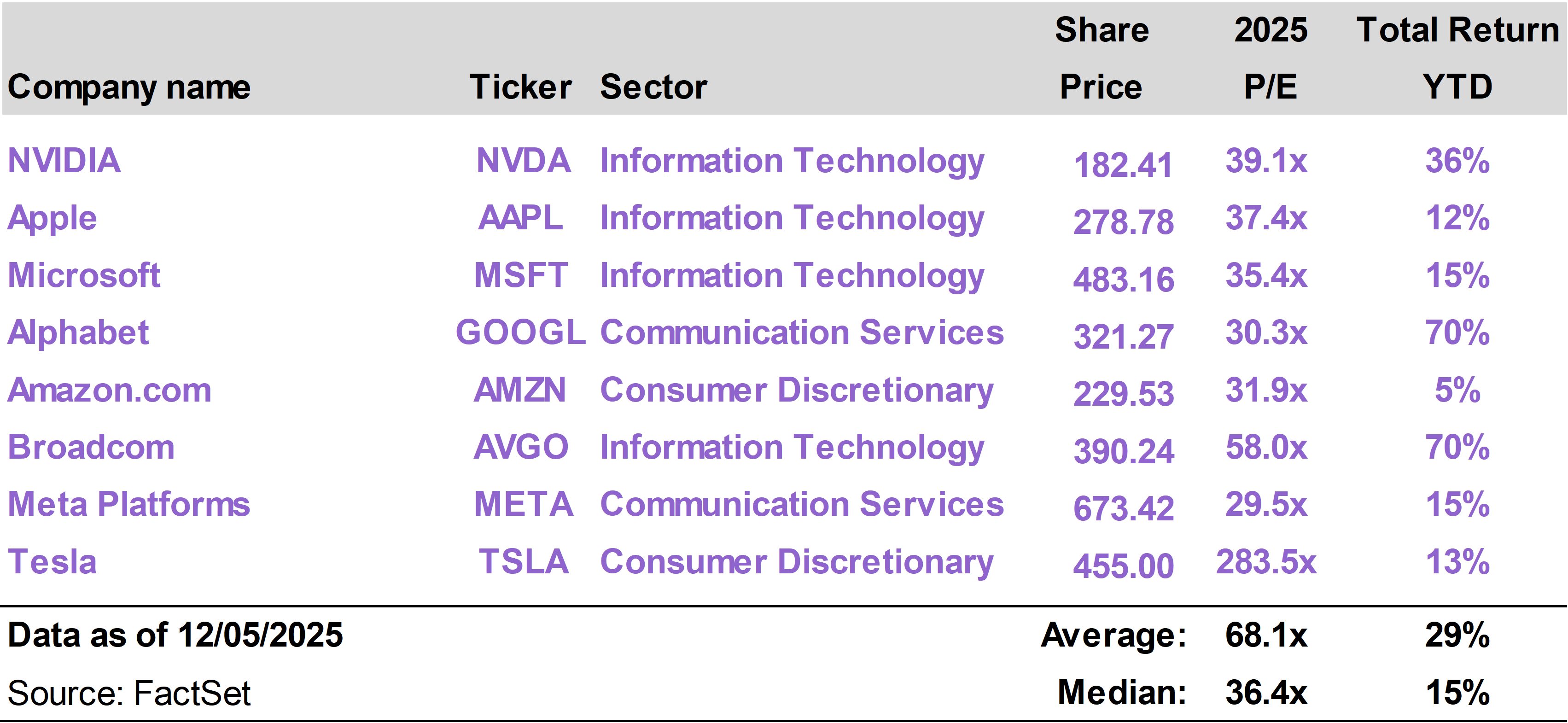
Our coverage universe for The MAG7 MONITOR—from largest to smallest, by current market cap—consists of NVIDIA (NVDA), Apple (AAPL), Microsoft (MSFT), Alphabet (GOOGL), Amazon (AMZN), Broadcom (AVGO), Meta Platforms (META), and Tesla (TSLA).
Get full access to all 76report research — including The MAG7 MONITOR — for as little as $1/month with promo code DOLLAR. Click HERE to begin!
For starters, the Magnificent Seven (plus one) are important because they make up such a large chunk of the stock market. These eight stocks now represent almost 40% of the S&P 500. They are more than 50% of the Nasdaq-100.
But they are also crucial to understand because of their relevance to the economy. What they all have in common is a deep connection to the one structural trend that is reshaping everything—AI.
Just a few years ago, NVDA was a secondary player in the semiconductor space. Having emerged as the key hardware provider enabling the AI revolution, it now leads the Magnificent Seven as the most valuable company in the world.
All of these companies have extremely valuable legacy franchises that preceded the large-scale commercialization of AI. Yet they are all strategically adapting to an inevitable future in which AI is the dominant technological force.
Even a stock like TSLA, which many investors may view as a car maker, is inherently an AI play. The most important thing about Tesla vehicles is not that they are electric but that they are on their way toward becoming completely self-driving.
TSLA’s biggest long-term business opportunity may not even be cars. It could be humanoid robots, as Elon Musk has described. (See The Robots Are Coming: Positioning for the Next Leg of AI, recently published in the 76report.)
Why investors need to follow these stocks
The top reason investors should track these stocks is that, in all likelihood, they already own them.
The vast majority of investors have some (if not most) of their allocation to the stock market through index funds or funds that resemble major indexes like the S&P 500, the Nasdaq Composite, or the MSCI World.
It has been estimated that nearly one-third of stock market ownership is linked to passive or quasi-passive index approaches. Taking into account the large direct ownership of stocks by company founders and insiders, retail exposure to index strategies may be even higher.
To be clear, we support this sort of index exposure as a foundation for almost any investment strategy. The stock market, as a whole, delivers over time. Index exposure is low-cost, tax-efficient, and diversified.
Should they be owned?
Through index and related strategies, many investors have ended up with very large allocations to the Mag 7. Indexing has become, quite unintentionally, a mechanism for investing in these AI leaders.
Concerns about valuation and market concentration are valid, but we do believe it makes a lot of sense to have long-term, essentially permanent exposure to the Mag 7.
These companies have several unique qualities versus the rest of the stock market universe, justifying their place at the top of many investment portfolios.
In different ways, these businesses have carved out dominant positions across the digital economy, backing them with competitive moats that are hard to erode.
They are also, for the most part, immensely profitable. This means they have an unrivaled ability to reinvest their cash flows into innovation.
It also means they can take risks other companies cannot. They can operate with a long-term vision that is often absent within the typical public company.
Because technology changes so rapidly, these companies are not what they were five years ago. And they are not today what they will be in five years.
They are in a constant state of evolution that creates new upside opportunities for them. This helps explain their substantial outperformance over the years and separation from the rest of the pack.
Historical performance
The extent to which these stocks have in fact outperformed over the past ten years needs to be emphasized.
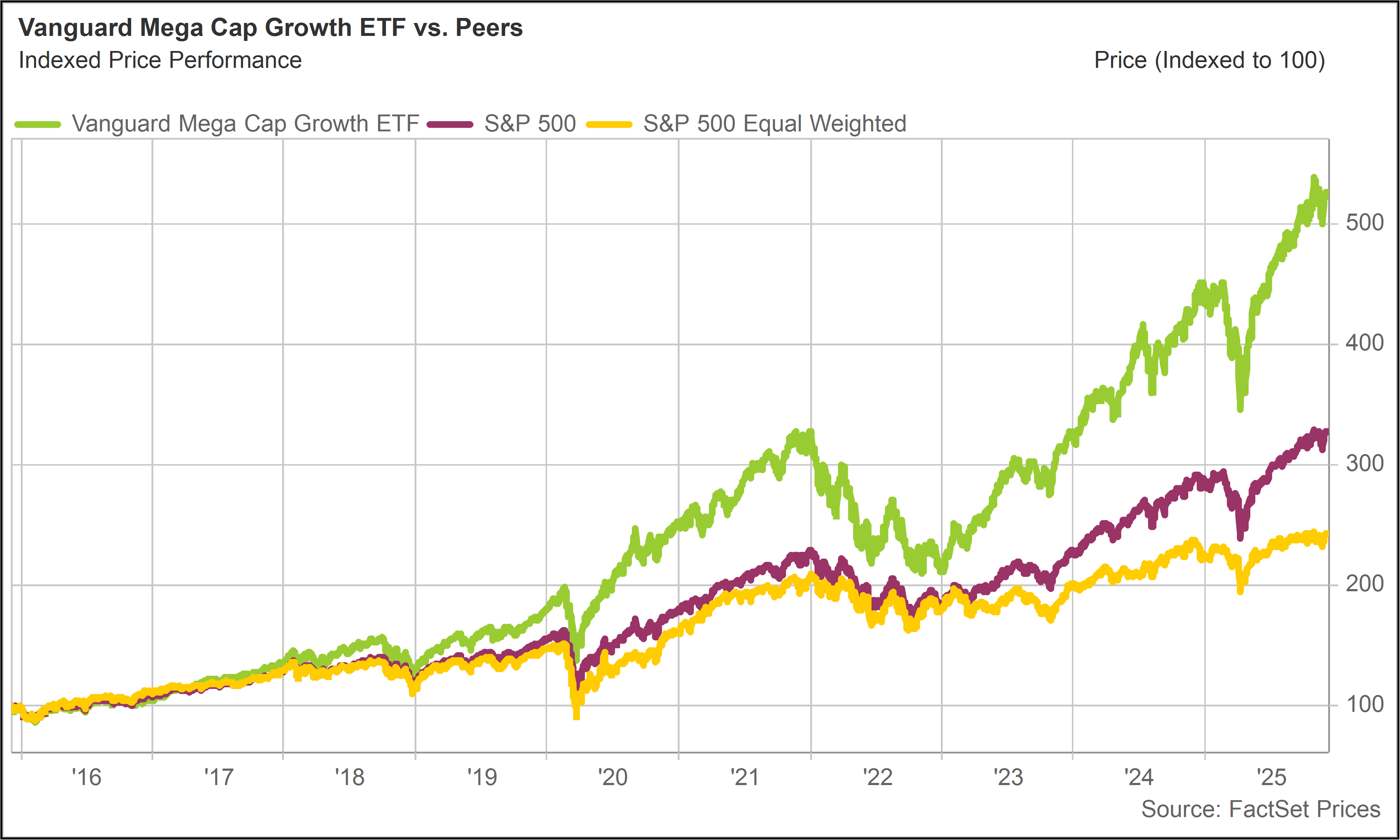
One of the most efficient ways investors can both track and access the Mag 7 is through the Vanguard Mega Cap Growth ETF (MGK).
MGK is a highly liquid (over $30 billion in assets) passive ETF that provides exposure to the largest market cap growth stocks. The Mag 7 (plus AVGO) now represent approximately two-thirds of the total value of MGK.
Powered by its high exposure to these names, MGK has returned over 400% over the past 10 years, versus just over 200% for the S&P 500 (which also has had high Mag 7 exposure).
For perspective, the S&P 500 Equal Weight Index (limited contribution from Mag 7) has returned less than 150% in this time frame.
As always, past performance is no guarantee of future success, but over the past ten years, having exposure to the Mag 7 has been a clear difference maker.
Despite all of these positive attributes, within our Model Portfolios, we have generally deprioritized these stocks, with the exception of NVDA, which is now held in the American Resilience portfolio.
The main reason for this is that we believe investors already do have substantial exposure to them through index-based investments.
Where we see our Model Portfolios adding the most value is by offering subscribers differentiated stock ideas that can supplement broad market and Mag 7 exposure. We do not wish to simply replicate the S&P 500.
Investors have many readily available ways to invest in the Mag 7 as a group, including relatively concentrated ETFs like MGK. To the extent they wish to invest in these funds or invest directly in particular names, The MAG7 MONITOR is intended as a helpful resource to guide decision making.
An indispensable lens
Whether or not one has significant exposure to the Mag 7, directly or indirectly, these businesses must be followed. They are leading the economy.
The choices they make, the challenges they face, their breakthroughs, and their failures—the implications for other companies across sectors are vast.
It is not just that they are large. Because they are innovation leaders, they offer a window into changes within the economy that are not available elsewhere.
These businesses are too important to ignore. You cannot say you understand what is happening in the economy today unless you have at least a basic understanding of what these companies are facing and doing.
The MAG7 MONITOR will be published on a regular basis as a recurring series within the 76report—with a focus on tracking performance, valuation, and the strategic and competitive developments that matter most.
In addition to quarterly updates, we will publish interim coverage to address major earnings releases, material news, and emerging controversies as they arise.
All paid subscribers to any of our subscription plans will receive The MAG7 MONITOR through the 76report.
Why now?
The world has changed. The stock market has changed. There is no going back. The AI genie is out of the bottle.
Recent talk of an “AI bubble” relates to concerns over valuation risk.
We expect these concerns to persist because we are in the midst of a relatively unpredictable innovation wave. Growth trajectories and profitability are inherently hard to determine, so there will be constant fear that expectations are too high.
But there may be more to this anxiety than just valuation concerns.
A great deal of it could be anxiety about AI itself… how it will change the economy, our jobs, and society as a whole? Change is exciting, but it can also be terrifying, especially when it is radical.
To some degree, we see AI bubble speculation as a form of denial. For some people, the mind may want to believe that it’s all hype, it will come and go like a passing fad, there is nothing to see here.
These may be comforting thoughts, but they do not reflect a wise attitude for an investor. This technology is here, it is in its infancy, it is improving rapidly, and it is expanding into more and more areas.
Investors who want to understand how they should be positioned in the stock market need to understand AI. This means they need to understand the Mag 7, which are the main companies driving AI forward.
By introducing The MAG7 MONITOR, we are elevating this goal as a top priority for our subscribers.
Click HERE for access!