Addressing the problem
To its credit, Strategy ultimately responded in a serious and comprehensive way. The first step was to rebuild liquidity.
Strategy paused its Bitcoin purchases and redirected capital toward its U.S. dollar reserve. By June 28, that reserve had risen to approximately $2.55 billion, providing about 17 months of coverage for preferred dividends and interest payments.
The board also adopted a formal policy requiring Strategy to maintain at least 12 months of coverage. The reserve is now designated specifically for preferred dividends and interest rather than serving as a general pool of corporate cash.
Strategy also authorized an additional $1.25 billion of potential Bitcoin sales to replenish the reserve, which extended total potential liquidity coverage to approximately 26 months.
This policy change may be more important than the reserve balance itself.
The previous reserve was largely discretionary. Investors had just watched management use much of it to retire convertible debt.
The new policy provides preferred holders with a clearer understanding of how much liquidity will be maintained and what that liquidity can be used for.
Strategy then demonstrated that its willingness to monetize Bitcoin was real.
Between June 29 and July 5, the company sold 3,588 Bitcoin for approximately $216 million. The proceeds were used to fund preferred distributions and replenish the cash reserve.
The sale represented less than half of 1% of Strategy’s total Bitcoin holdings, but it sent an important credit-friendly message: management would no longer allow Bitcoin maximalism to interfere with basic balance sheet management.
By July 12, Strategy’s U.S. dollar reserve had increased further to approximately $3 billion.
Strategy has also increased the annual dividend rate on STRC from 11.5% to 12%. The rate will continue to be reviewed monthly based on the Bitcoin price, credit spreads, reserve coverage and overall capital-market conditions.
Buybacks on the table
Importantly, the company has clarified that the dividend will not be mechanically increased every time STRC trades below $100.
Continually raising the dividend could become counterproductive, increasing Strategy’s obligations and potentially making investors even more concerned about the sustainability of the instrument.
Instead, the company has introduced another tool. Strategy authorized up to $1 billion of repurchases across its various preferred stock instruments—STRC, STRF, STRK and STRD—with STRC initially receiving priority. These repurchases cannot be funded from the protected U.S. dollar reserve.
Repurchasing preferred stock below par could be highly accretive. It would allow Strategy to retire a perpetual dividend obligation for less than its stated value, permanently reduce annual cash expenses and improve the credit profile of the remaining securities.
The company also authorized a separate $1 billion repurchase program for MSTR common stock when management believes the shares are trading below intrinsic value.
Taken together, these measures represent a fundamental improvement in Strategy’s capital allocation framework.
The company can now sell a limited amount of Bitcoin rather than issue deeply discounted securities.
It can repurchase its own preferred stock when the market offers it at an unusually attractive yield.
It can protect a dedicated pool of cash for its obligations.
And it can buy back common shares if MSTR trades below the value management assigns to the business and its Bitcoin holdings.
Strategy is no longer narrowly focused on maximizing the amount of Bitcoin it owns under every conceivable circumstance. It is trying to maximize long-term value across the entire capital structure, while taking a long-term view on growing Bitcoin per share.
The road ahead
The recent changes do not eliminate the central risk. Bitcoin still needs to recover for any of the various forms of Strategy common and preferred stock to perform well.
Strategy remains one of the largest and most leveraged expressions of the Bitcoin investment thesis. A prolonged decline in Bitcoin would continue to pressure the value of its assets, limit access to capital and make its dividend obligations more burdensome.
The new policies make Strategy better equipped to survive that environment. They do not make it immune to it.
There are, however, some encouraging developments.
Bitcoin appears to be finding support after its severe decline. The cryptocurrency has recently recovered into the mid-$60,000 range, helped by improving inflation data, a modest return of investor risk appetite and renewed optimism surrounding digital asset legislation.
For Strategy, a sustained Bitcoin recovery would have several benefits at once.
It would increase the value of the company’s Bitcoin holdings. It would likely improve investor confidence in the preferred securities. It could allow STRC to move closer to its $100 stated value, reopening an important source of capital.
And it could restore some of the valuation premium that has historically allowed MSTR to grow its Bitcoin holdings on a per share basis.
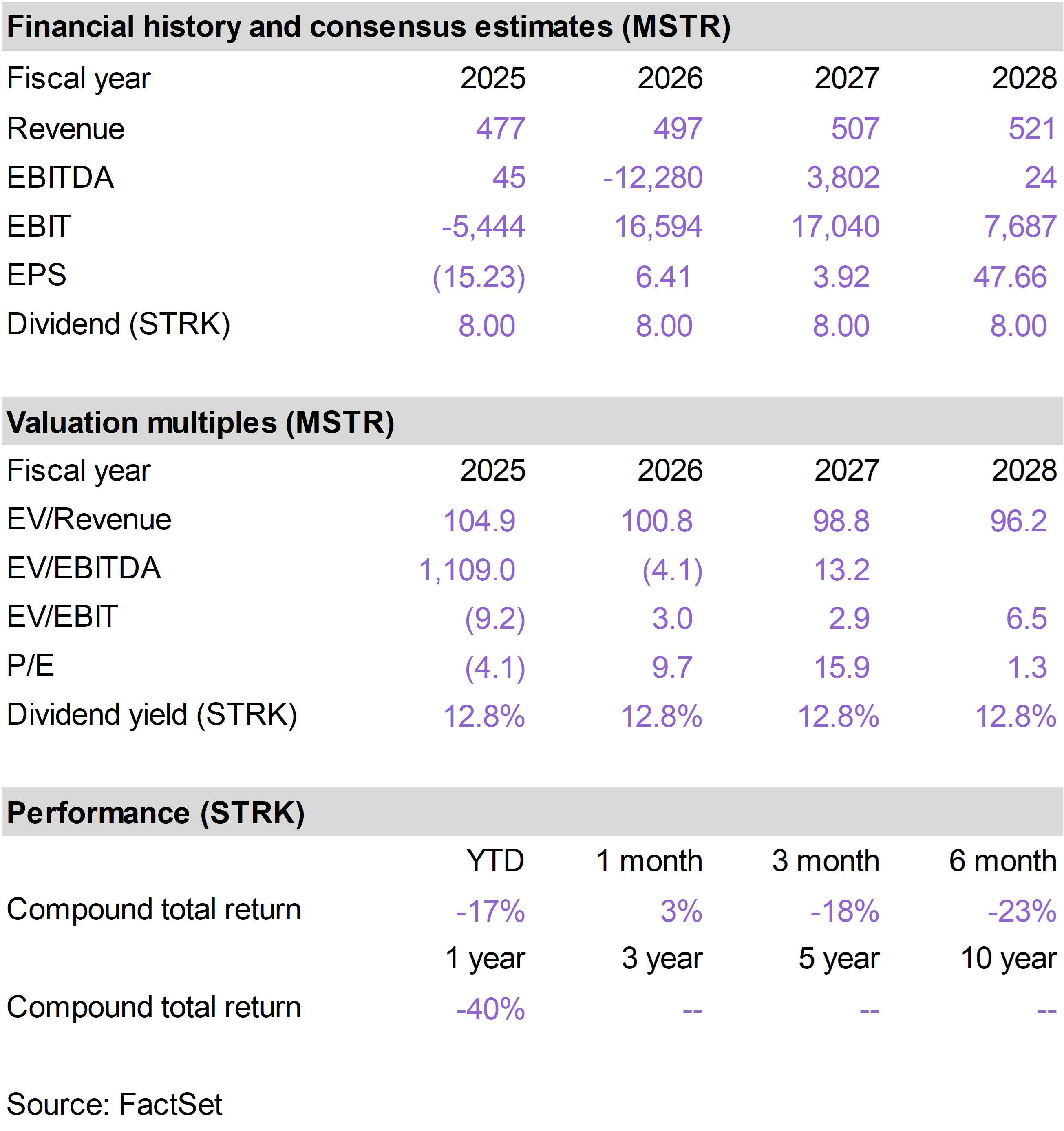
For investors who can stomach the volatility, we continue to favor STRK, which now offers an approximate 13% dividend yield. It remains the only preferred stock instrument that is convertible into MSTR common stock.
The option to convert is uneconomic now, but to the extent Bitcoin and MSTR eventually become extricated from this recent downturn—it could have real long-term value.
In the meantime, investors benefit from a fixed quarterly dividend of $2 per share. As a reminder, these dividends are paid out as “return of capital” and are thereby exempt from standard dividend taxation.