As expected, the Federal Reserve held short-term interest rates steady at its regularly scheduled FOMC meeting today. But the messaging on future rate cuts was on the margin discouraging, which led to some pressure on stocks.
Jerome Powell—who will remain as Chair until at least mid-May (and possibly longer due to expected delays in Kevin Warsh’s confirmation by the Senate)—expressed caution about the possible impact of higher oil prices on inflation.
He and other Fed officials lifted their inflation forecast to 2.7% from 2.4% by year-end 2026, as they attempt to factor in higher energy costs. The range of forecasts for future interest rates (the “dot plot”) also moved slightly higher.
The last time the Fed shared its dot plot was December of last year. Since then, a few of the FOMC members have shifted their position from an expectation of two rate cuts to no rate cuts over the remainder of 2026.
The median forecast now calls for one rather than two additional rate cuts this year.
This was not disastrous, but it was also not exactly what investors in the stock market would have liked to hear. The S&P 500 closed down 1.4% today and is now down about 3.2% for the year.
Waiting for the storm to pass
As we discussed last week (Stocks Stabilize as Oil Shock Risk Fades), Operating Epic Fury has created a short-term headwind for investors and has led to some volatility.
In the larger scheme of things, we would characterize this volatility as mild and understandable.
It is not every week that the United States initiates a military operation of this magnitude. And the spike in spot oil prices through $100 a barrel could have some kind of negative impact on the economy, depending on how long it lasts.
It therefore makes sense that some investors would “de-risk” or at least take a more cautious approach as Epic Fury plays out. In times of armed conflict, you never know what might happen next.
Over a longer time horizon, however, our view is that this period will likely seem like a bump in the road.
The current surge in oil could create some short-lived inflation pressure, but energy markets are signaling that the supply/demand situation will normalize in the not so distant future. This helps explain the stock market’s relatively muted reaction, despite all the unsettling headlines.
Deep “backwardation”
The spot price of oil—what someone needs to pay to get their hands on a barrel of crude right now—is elevated, but oil traders do not expect this to last very long.
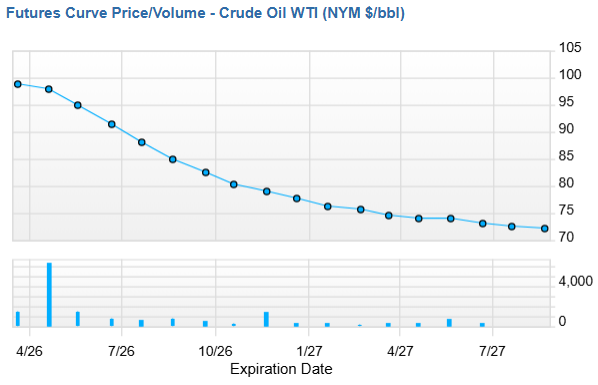
The oil market is currently in a state of deep “backwardation,” meaning prevailing oil prices are expected to fall sharply in the months ahead.
Oil futures pricing currently implies that a barrel of West Texas Intermediate (WTI) crude will fall from current levels, close to $100, towards $75 by the end of the year.