|
| | | | Locking Down the Hemisphere |
|
|
The new year has opened with a display of boldness in American foreign policy that has not been seen in decades. Whether in Latin America or the Arctic, President Trump is signaling that the era of strategic hesitation is over.
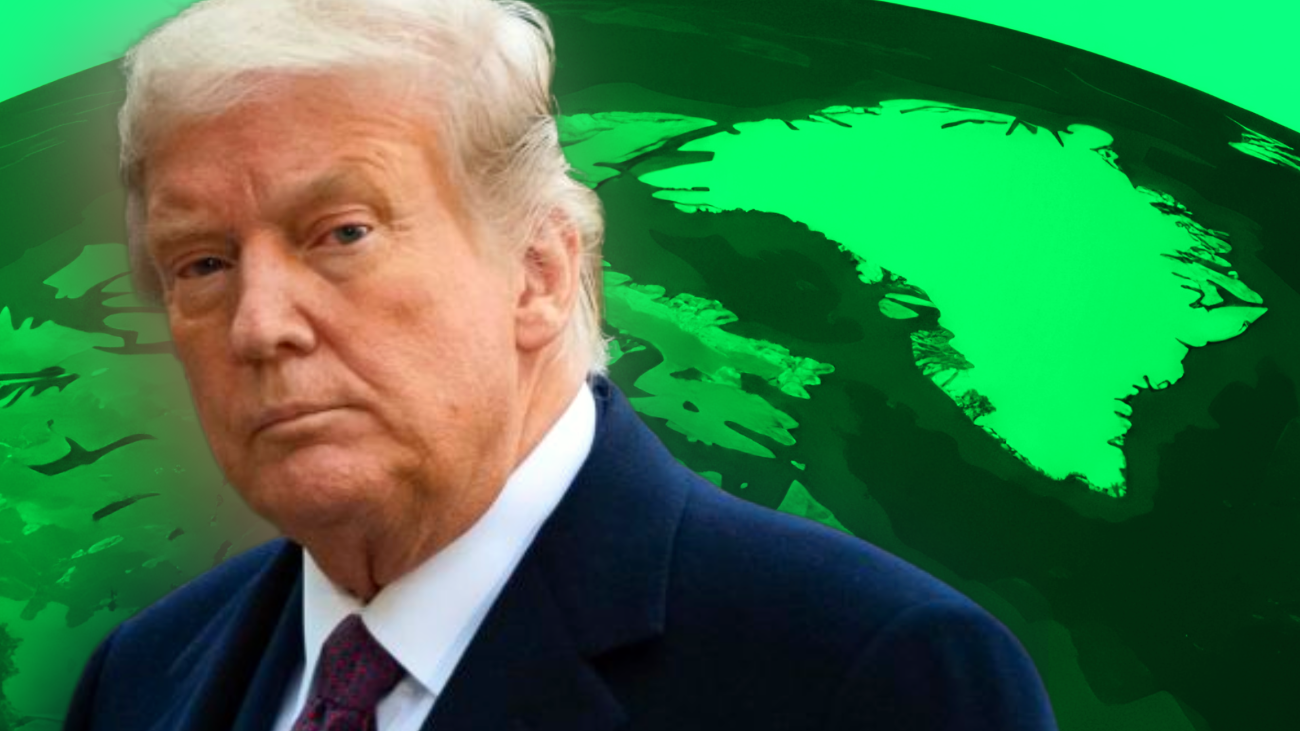
On Saturday, January 17, Trump announced his intention to execute “the Complete and Total purchase of Greenland,” which currently belongs to Denmark.
To get this done, he is applying economic pressure. Trump intends to impose tariffs on various European nations that have opposed the U.S. takeover of Greenland, starting at a 10% rate on February 1. The tariffs escalate to 25% on June 1, 2026 if a deal has not been completed.
The risk of renewed trade disputes contributed to stocks selling off today after the long holiday weekend, with the S&P 500 down around 2%. Gold continued its rally, trading up approximately 2% versus last Friday’s close.
The Greenland dispute explains part of today’s risk-off sentiment, but not all of it. A notable rise in long-term interest rates in Japan, following the announcement of new government stimulus efforts, put upward pressure on long-term Treasury yields. This had a negative impact on stocks as well.
Despite today’s weakness, investors should not lose sight of the highly encouraging macro environment that has been developing, largely driven by productivity gains.
Inflation is coming down, now officially at 2.7% with certain private sector measurements closer to 2%. Meanwhile, the Atlanta Fed is currently forecasting fourth quarter GDP growth above 5%.
The new geopolitical reality
The potential for additional trade friction has led to some market volatility, but over the long-term, U.S. actions to address strategic risks in the Western Hemisphere should be seen as positive.
The capture of Nicolas Maduro in Venezuela and the push to buy Greenland may appear unrelated but reflect a single governing idea. The United States is pursuing geographic advantage at a moment when great power competition is rising.
The U.S. may still be the most powerful country in the world, but, under Trump, it is no longer taking its dominant position for granted. The United States is now acting more assertively to secure its real interests in a world that has become considerably more fragile and contested.
An ascendent China, increasingly aligned with Russia, has methodically reshaped global power dynamics in ways that can no longer be ignored. Alliances and institutions that were built for a different era and different threats are now showing their age.
From the standpoint of long-term U.S. national security interests, western Europe is not what it once was. Demographics and political attitudes have shifted.
Perhaps Denmark is a reliable ally today, but democracies are fluid. Relationships between nations change over time.
Geography, on the other hand, is permanent.
Why Trump wants Greenland
We discussed the strategic significance of Maduro’s removal from power a few weeks ago (Why Markets Celebrated the Fall of Maduro).
The fate of Venezuela matters for many reasons: its close proximity to the United States, its abundance of natural resources (from the world’s largest proven oil reserves to rare earths), its relevance to the immigration problem, and its vulnerability to the meddling of foreign powers.
Greenland presents a different but in many ways similar set of strategic considerations.
In his announcement on Truth Social, Trump spoke to Greenland’s military importance, with special emphasis on the Golden Dome—a proposed next-generation U.S. missile defense architecture intended to protect the American homeland from ballistic, hypersonic, and advanced cruise missiles.
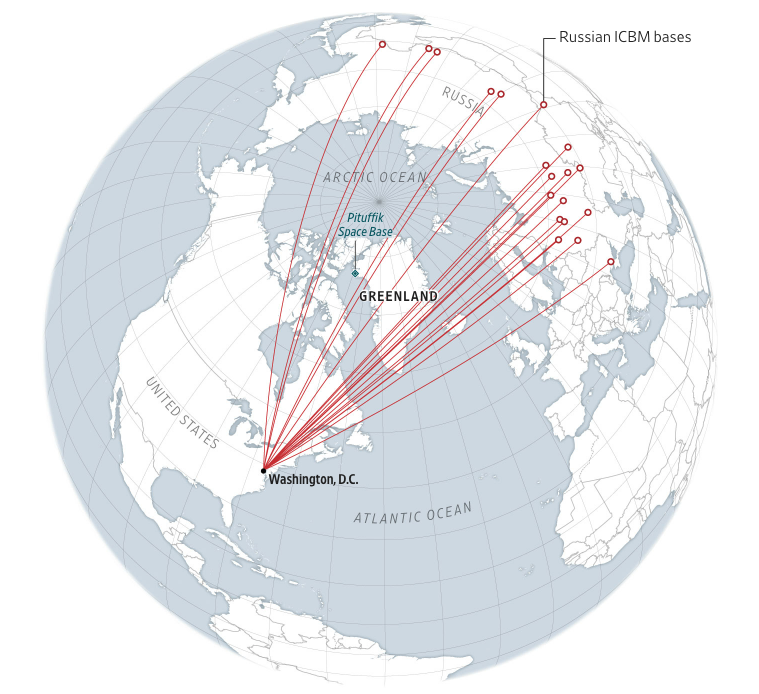
The concept centers on combining space-based sensors, advanced radar, and interceptors to detect and defend against missiles launched from adversaries like Russia, China, or North Korea. If missiles were ever fired on the continental United States, the most direct flight path would be over the Arctic Ocean and, in many cases, Greenland itself. |
|
|
| Russian Missile Flight Paths(Source: Wall Street Journal) |
|
|
Critics of Trump claim that Greenland can remain in the hands of Denmark, a NATO ally, and provide the same security benefits. Trump sees things differently.
He made quite clear his view that this sparsely populated Arctic territory, about three times larger than Texas, cannot be adequately defended by the Danish military. |
|
| | Now, after Centuries, it is time for Denmark to give back — World Peace is at stake! China and Russia want Greenland, and there is not a thing Denmark can do about it. They currently have two dogsleds as protection, one added recently. - Donald Trump (1/17/2026) |
|
| | In communicating his position, Trump focused on the missile defense situation, which may be his strongest argument, given the existential nature of the threat. But there are other variables as well.
The Arctic Ocean is thawing, with Arctic sea ice having reached its lowest measured level in 47 years in 2025. Polar access is expanding, which affects trade routes, naval mobility, air dominance, and intelligence operations.
Like Venezuela, Greenland has also vast natural resources.
Greenland is believed to hold some of the largest untapped rare earth deposits outside China, including heavy rare earths that are harder to source and more valuable for defense applications.
Development of these resources has been slow due to environmental concerns, lack of infrastructure, and political complexity, but the geological potential is well established. U.S. ownership of Greenland would make these easier to access.
Beyond minerals, Greenland also has energy resources. Offshore areas are believed to contain oil and natural gas, though exploration has been limited and politically constrained. As technology improves and energy security regains importance, those resources become more relevant—even if they are not immediately developed.
Water is another underappreciated asset. Greenland contains vast quantities of freshwater locked in ice. While large-scale export is not imminent, freshwater scarcity elsewhere makes this a long-term strategic consideration. |
|
| Growth by acquisition
Trump’s Greenland gambit might seem unusual, but it actually fits well in the larger story of American territorial expansion. Nearly half of the United States was acquired by writing checks, not directly through conquest—one of the most underappreciated facts in American history.
The largest and most famous territorial expansion was the Louisiana Purchase in 1803, when Thomas Jefferson acquired more than 800,000 square miles of land from Napoleon.
This was followed by the Treaty of Guadalupe Hidalgo in 1848, after the Mexican-American War, when the U.S. formally acquired territory including California and several western states (500,000+ square miles).
The real estate deal that was perhaps most similar to Trump’s proposed Greenland transaction was the Alaska Purchase of 1867 (660,000 square miles).
What all of these deals had in common is that the prior owners of the land really had no choice but to sell—because their ownership position was indefensible.
Napoleon dumped Louisiana after a massive slave revolt in Haiti led to the destruction of France’s main Caribbean base. Without this important naval outpost, Louisiana was likely fall to the British. Napoleon cut the deal with Jefferson because he preferred to see the land in American hands and wanted the cash to prepare for war against England.
The land acquired after the Mexican-American War was a diplomatic resolution that formalized United States control of these western areas. Mexico could not realistically protect it, after ceding other territory directly as a result of the war.
When Russia’s navy was handily defeated by the British in the Crimean War, Tsar Alexander II saw the handwriting on the wall. He sold Alaska to the United States mainly because he understood the British would probably end up taking it anyway, given their strong position in neighboring Canada.
By making Denmark and its allies an offer they possibly cannot refuse, Trump is continuing a long tradition in American foreign affairs. A nation that cannot defend highly strategic territory only owns it in a technical sense.
Treaties and legal agreements are nice, but, from a security standpoint, they pale in comparison to physical possession. |
|
| Back to 19th century
The fact that we are trying to make sense of current reality by discussing 19th century land deals is not a total coincidence. In many ways, what we are witnessing is a return to the fractured international system of that era.
Our contemporary sense of global politics is heavily shaped by the lopsided conditions that prevailed throughout the 20th century and into the current one.
By the turn of the 20th century, a period known as the Pax Brittanica, Britain came as close to global supremacy as it had at any point in history.
This fell apart during the World Wars and the Great Depression. But after World War II, the United States rapidly achieved global hegemonic dominance (notwithstanding a fairly serious challenge from the Soviets between the late 1950s and early 1970s).
As the Soviet Union began to deteriorate, ultimately collapsing in the early 1990s, the U.S. became, without question, the strongest economic and military power in the world. This geopolitical structure was sustained for decades.
In recent years, however, American global dominance has been giving way to a more tenuous multi-polar scenario.
The key to understanding all of this is the rise of China.
The China threat
The last time a U.S. President projected American power in such an aggressive manner—to the consternation of many friends and enemies alike—was the regime change operation in Iraq undertaken by George W. Bush in 2003.
Back then, China as an economic and military force was practically meaningless.
Yes, China was rapidly growing, just two years after having gained membership in the World Trade Organization with strong support from the United States. But its economy was only a quarter the size of the U.S. economy and even smaller than the economies of England and France.
Conventional wisdom in the early 2000s viewed the entry of China into the global capitalist system as an opportunity rather than a threat. In the wake of 9/11, the focus was on Islamic radicalism and managing the power vacuum left by the collapse of the Soviet Union.
Large swaths of China were still impoverished. The possibility that China would eventually threaten the United States economically or militarily was theoretically interesting but otherwise a backburner debate in foreign policy circles.
China’s economy, however, did subsequently grow at extraordinary rates, thanks to extensive integration with the U.S. economy.
Today, China’s GDP is $18 trillion, more than ten times larger than it was in 2003 in constant currency terms. This is still smaller than the U.S. economy at $27 trillion but actually larger in “purchasing power parity” terms (which takes into account relative prices of goods and services). |
|
|
| China GDP (Last 50 Years) |
|
|
From a military and technological standpoint, China has matured into a serious adversary. And in contrast with its standing during the Bush/Cheney era, its global influence now truly rivals and in some ways exceeds that of the United States.
A manufacturing juggernaut as well as America’s only real rival in technology, China has established strong economic ties with virtually every nation on the planet, including many resource-rich countries like Venezuela.
China has also cultivated a tight military and economic alliance with Russia that was largely non-existent twenty years ago.
During the Iraq War time frame, the two countries were becoming more cooperative, but they were still highly distrustful of one another. This reflected residual hostility from the late 1960s Sino-Soviet split (which the U.S. artfully exploited in 1971 when Secretary of State Henry Kissinger opened relations with China).
In the early 2000s, Russia was aligned with the U.S. in the War on Terror, with Putin famously spending time with George W. Bush at his ranch in Texas and family compound in Kennebunkport. But U.S. relations with Russia gradually deteriorated, especially after the 2014 coup in Ukraine, which was aided (if not orchestrated) by the American government and threatened core Russian security interests.
As the West became more hostile to Russia, China’s economy grew and grew, and China developed into a very attractive strategic partner. Finally, after the U.S. and its allies sponsored the proxy war against Russia in Ukraine during the Biden administration, the Russia-China “no limits” partnership was forged.
Foreign policy humility
Donald Trump is perhaps not the first name that comes to mind after hearing the word “humility.” But his actions on the international stage, while relatively aggressive, paradoxically reflect a sense of humility about America’s position in the world.
As he sees it, the U.S. is losing ground against its rivals. While the foreign policy establishment still congratulates itself for winning World War II and the Cold War, America’s adversaries jostle for strategic advantage—and are making progress.
The hubristic foreign policy of neoconservatism emerged in the early 21st century within a geopolitical environment of total American dominance. Neocons aspired to pacify the problematic nations of the world by exporting democracy and economic freedom (by force if necessary).
Regime change operations in Iraq and later Ukraine were both neocon projects.
It may be tempting to equate Trump’s moves in Venezuela and Greenland to the same kind of American imperialism that energized Bush, Cheney, Rumsfeld and the gang. But that would be a total misread of Trump’s foreign policy instincts.
When Trump first emerged on the scene as a Presidential candidate in 2015, his harsh criticism of the Bush administration was one of his defining positions. This was almost shocking at the time. Most Republicans still felt intellectually and emotionally committed to the U.S. mission in Iraq.
Trump flipped this narrative completely. In February 2016, in a contentious exchange at the Republican primary debate in South Carolina, Trump made waves when he went after his rival Jeb Bush (and by extension the Bush legacy) on the Iraq question. |
|
| | Obviously the war in Iraq was a big, fat mistake…. We spent $2 trillion, took thousands of lives, we don't even have it. Iran is taking over Iraq with the second largest oil reserves in the world…. We should have never been in Iraq, we have destabilized the Middle East. - Donald Trump (2/13/2016) |
|
| | The new realism
The Bushes represented an era of unquestioned American supremacy in which the United States defeated the Nazis, then the Communists, and even tried to export liberal democratic values to the Middle East.
The rise of Trump marked a pivot away from dreams of American dominance and idealistic faith in 20th century institutions—and toward an honest accounting of our own (increasingly vulnerable) position in the world.
Trump’s foreign policy is driven not by grandiosity but healthy self-doubt and pragmatic awareness of our own limits. It is a response to questions like: How strong are we really? Does it make sense to put so much pressure on Russia? What his happening in Latin America, in our own backyard? Are we capable of manufacturing what we need if there is a crisis? Why are we letting so many people with questionable motivations into our country? Do we have access to the resources we need? How can we win the AI war?
Instead of trying to manage American decline through alliances and slow, consensus-driven processes, the Trump administration is leveraging American economic power to shore up important strategic positions.
Greenland sits squarely at the center of this shift. Once seen as a remote afterthought, it has become one of the most strategically valuable places on the map, tying together Arctic shipping routes, missile defense, and access to critical minerals.
Could Greenland remain forever safe in Danish hands? Maybe, but, from Trump’s point of view, why find out?
European leaders have reacted with predictable alarm to this bold assertion of U.S. strategic interests.
Yet the diplomatic structures and procedural norms now under strain are the same ones that have long amplified Europe’s influence beyond its underlying economic and military weight. The population of Denmark (six million) is slightly smaller than Maryland’s.
President Trump was inaugurated one year ago today, with three years still ahead. He will likely continue pressing to lock in stronger U.S. geopolitical positioning, even at the cost of discomfort among allies.
Trump’s approach will at times unsettle markets and generate short-term volatility. Over the long run, it aims to leave the United States in a more durable and defensible strategic position.
China and other heavily populated nations are rapidly gaining economic influence and advancing technologically. They are still the underdog, but they are always looking to exploit our vulnerabilities. This is no time for complacency. |
|
| | | Click HERE to learn more about our Model Portfolio subscription plans. |
|
|
| | | FOR SUBSCRIBER USE ONLY. DO NOT FORWARD OR SHARE. |
|
| | | |
| |
|
|
|
| |
|