| | | | How AI Is Helping Crypto Claw Its Way Back |
|
|
It has been a rough winter for crypto investors. After reaching all-time highs in September and October of last year, major cryptocurrencies—Bitcoin, Ethereum, Solana—have taken a beating. In some cases, prices have fallen more than 50%.
That kind of decline shakes confidence. And it is especially surprising given how optimistic investors were just a few months prior.
Following President Trump’s election, digital assets soared. Markets were betting on a new era of pro-crypto regulation and institutional adoption.
Much of that optimism, frankly, was justified.
Tremendous progress has been made in Congress as well as regulatory agencies. Wall Street is embracing the sector and integrating the technology like it never has before.
Yet despite all these positive developments, crypto prices began sliding late last fall. And the reasons for the decline were not entirely obvious, making it all the more disconcerting.
In mid-October 2025, a technical glitch on Binance—the world’s largest offshore crypto exchange—triggered a cascade of forced liquidations. Billions of dollars in leveraged positions were unwound immediately.
Predictably, markets panicked. Crypto prices fell.
An isolated mishap like that typically causes some short-term stress but eventually gets absorbed. Markets take the hit and move on. Liquidity returns.
But this time, things only got worse. Something more was going on beneath the surface.
The software sell-off that hit crypto
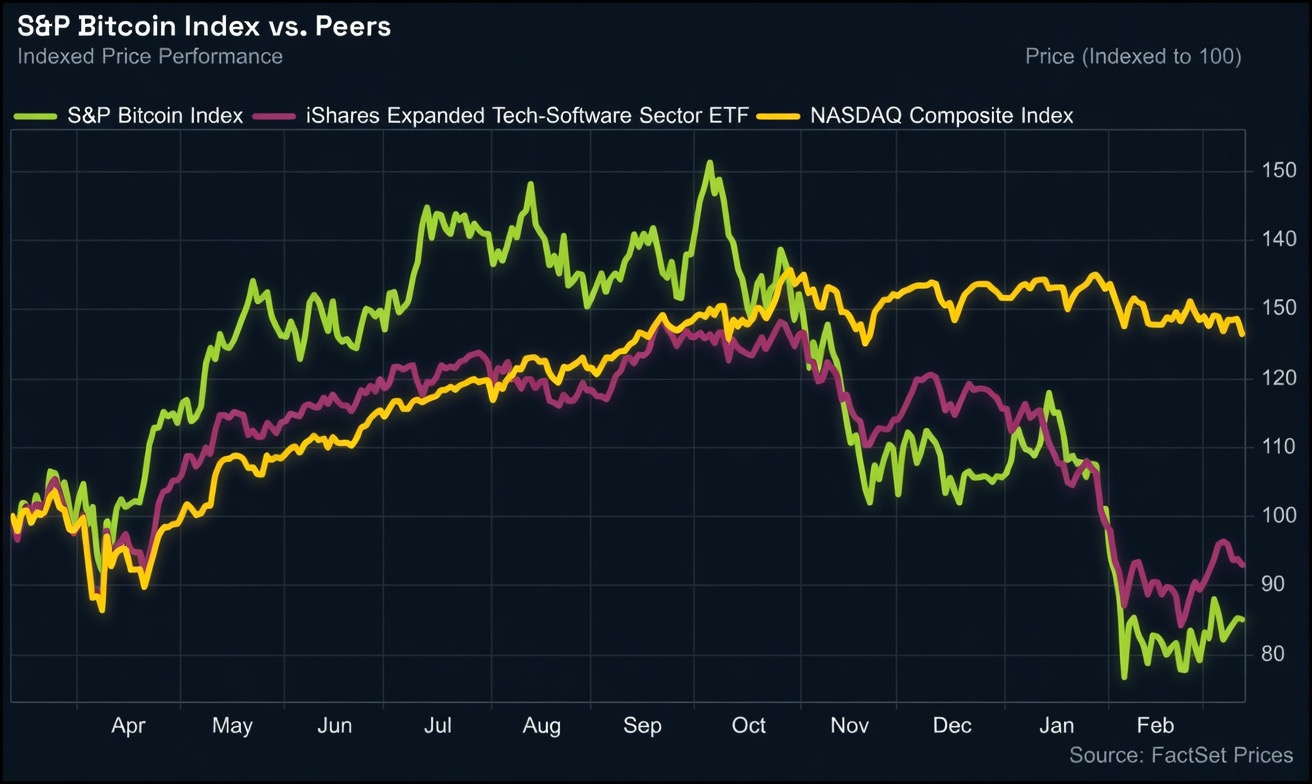
Around the same time crypto began faltering, another major market shift was underway. Software stocks started to break down, trailing not just the overall market but the rest of the tech sector.
Since October 2025, the performance of Bitcoin has been strikingly correlated with the performance of software companies. That is unusual. |
|
|
| Bitcoin vs. Software ETF (IGV), NASDAQ(Total Return - One Year) |
|
|
There is no fundamental reason crypto should rise and fall alongside enterprise software stocks. But markets, at least in the short-term, often move based on liquidity, not fundamentals.
As investors began rotating out of tech—especially software firms threatened by AI—crypto seems to have been dragged down with them. In other words, crypto may have been collateral damage from the software meltdown.
The last five months have certainly been painful for crypto investors, regardless of the cause, but there is a silver lining.
If the sell-off was not primarily driven by crypto fundamentals, then the recovery may come just as quickly.
Why AI could be crypto’s biggest tailwind
Ironically, the same force disrupting software companies could now become crypto’s biggest catalyst: AI.
Over the past year, AI platforms like Claude and ChatGPT have demonstrated they can perform many of the tasks software companies charge subscription fees for. As we discussed in early February (Software as a Sell-Off), the market interpreted this as an existential risk for many software businesses.
But something fascinating is happening at the same time. The builders of AI systems are increasingly realizing that AI needs crypto.
Brian Armstrong—the CEO of Coinbase (COIN)—recently made this point in a widely read social media post. |
|
| | Very soon there are going to be more AI agents than humans making transactions. They can’t open a bank account, but they can own a crypto wallet. Think about it. - Coinbase CEO Brian Armstrong (3/9/2026) |
|
| |
AI agents cannot walk into a bank and open a checking account. They cannot apply for a credit card. But they can hold digital assets. And they can transact instantly on blockchain networks.
For autonomous software systems, crypto is not a curiosity, as it may still be for some human beings. It is the infrastructure that connects them to the real world.
The rise of the AI “claw”
If you have been paying attention to the tech world recently, you have probably seen one word popping up everywhere. Claw.
The term comes from an open-source project originally called Clawdbot, created by developer Peter Steinberger. The tool allowed AI systems to autonomously control computers.
After a trademark dispute with Anthropic, which operates Claude, the project was renamed OpenClaw—but the branding stuck.
Developers loved the concept. Suddenly the “claw” became shorthand for AI that does not just talk but also acts. AI that can grab files. Execute tasks. Make decisions. AI that can actually do things.
Now the trend is spreading rapidly. And this week it may accelerate dramatically. |
|
|
| |
NVIDIA (NVDA) is hosting its annual GTC 2026 conference in San Jose this week. CEO Jensen Huang is expected to unveil a new open-source platform called NemoClaw.
The point of the initiative is to bring enterprise-grade reliability and security to autonomous AI agents.
Early “claw” tools—while powerful—had serious security vulnerabilities. Jensen wants to fix that.
The company has reportedly been pitching NemoClaw to software giants like Salesforce (CRM) and Adobe (ADBE)—the very companies that have been among the biggest losers in the AI disruption trade.
NemoClaw is being presented as a way for these businesses to efficiently leverage AI, rather than get destroyed by it. In other words, NVIDIA may be throwing them a lifeline.
But there is another implication investors should be thinking about. If AI agents begin operating autonomously across the internet, they will need a way to pay for things. And that’s where crypto comes in.
How to play it
NVDA is the world’s leading provider of AI hardware. The fact that it is now making a hard push into agentic AI represents an important turning point—one that may bring renewed momentum into the crypto space.
AI agents may be a big problem for certain software companies—but they are a clear positive for crypto.
Below, we share our latest thinking on a wide range of crypto-related investments that we believe stand to benefit. These include many now trading at levels that are still quite depressed relative to last year’s peaks. |
|
| |
Stablecoins: the currency of the AI economy
Today, stablecoins are mostly used inside the crypto ecosystem. But that is changing.
Autonomous AI systems will need to purchase data, computing power, and digital services—often thousands of times per second.
Traditional payment rails—credit cards, bank transfers, wire payments—simply cannot handle that. They are slow, expensive, and not designed for automated machine-to-machine commerce.
Stablecoins solve that problem. They settle instantly. They operate globally. They are programmable. And they can be integrated directly into software.
That’s why some of the smartest investors in the world believe stablecoins will dominate the future of payments. Stan Druckenmiller recently said exactly that. |
|
| | On the other hand, blockchain and the use of stablecoins, if you want to throw crypto into that, tokens—incredibly useful in terms of productivity. I assume our whole payment systems will be stablecoins in 10 or 15 years—efficient, quicker, cheaper. - Stan Druckenmiller (3/12/2026) |
|
| |
The Circle (CRCL) opportunity
One of the most direct ways to invest in the stablecoin boom is Circle (CRCL), the latest addition to our Model Portfolios. CRCL is the company behind USDC, one of the world’s largest stablecoins.
We first wrote about CRCL in the 76report on February 11, 2026 (Capitalizing on the Tech Downturn). We revisited the stock on February 26, 2026 (Tech and Crypto Snap Back) after the stock surged following the earnings announcement, when we reiterated our positive view.
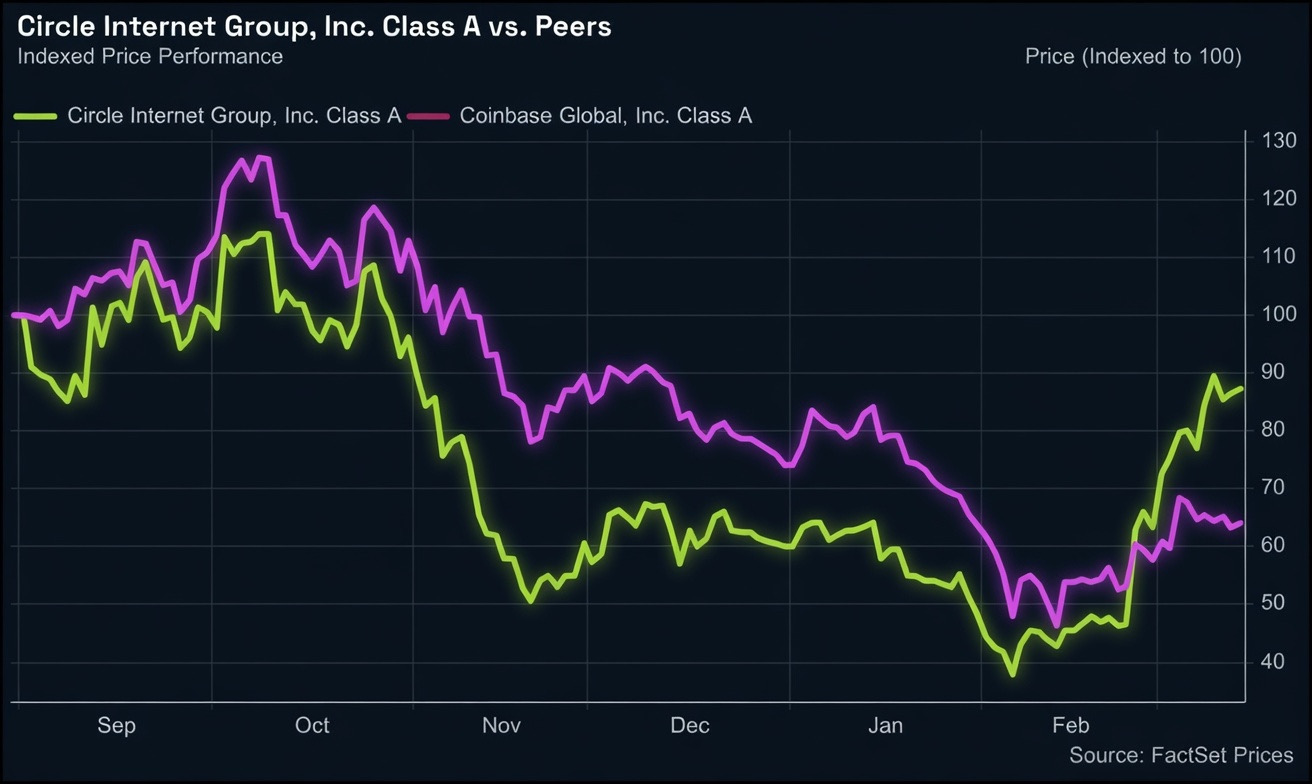
CRCL shares have now advanced about 90% since we first alerted subscribers to the opportunity in mid-February, yet the story may still be early.
The CRCL story is worth paying attention to, not just as an investment opportunity, but also because of what it signals about the rest of the crypto space.
The sharp turnaround in CRCL over the past few weeks could be a prelude to a broader crypto comeback.
The earnings report and subsequent conference call were a wake-up call for investors. The company’s blowout earnings forced the market to refocus on fundamentals.
CEO Jeremy Allaire made a striking observation on the call. Developers building AI agents are increasingly using USDC as the default payment infrastructure.
AI systems need a trusted, low-cost medium of exchange. And right now, USDC is becoming the standard. |
|
| | But something happened really a month ago, which is this turning point with Claw code, what's now called OpenClaw. And we really saw this kind of incredible leap in the ability for the average person, but also sophisticated developers, to spin up agents to do an incredibly wide array of tasks…. The developers of those AI agents are realizing that agent transactions need a reliable, low cost, trusted medium of exchange. And so virtually all of the AI payments infrastructure that we're seeing… it is happening with USDC. So that's been very, very encouraging and we're doubling down on that in a pretty significant way. - CRCL CEO Jeremy Allaire (2/25/2026) |
|
| | Coinbase (COIN): USDC plus leverage to a recovery
Another way to play this trend is Coinbase (COIN).
COIN has a longstanding commercial partnership with CRCL through which it shares revenue generated from the reserves backing USDC. Those reserves are primarily short-term U.S. Treasury securities.
As USDC adoption grows, the interest income generated from those reserves increases as well. That dynamic is becoming an increasingly important driver of COIN’s earnings.
But COIN also stands to benefit when crypto markets recover. As one of the largest digital asset platforms in the United States, the company benefits directly from rising trading activity and higher customer balances.
Shares of COIN have advanced noticeably since February lows but remain far below all-time highs reached last year. |
|
|
| CRCL vs. COIN(Total Return - Six Months) |
|
|
The infrastructure layer
Stablecoins do not operate in isolation. They run on layer 1 blockchains. These networks process transactions, secure the system, and host the applications built on top of them.
Every stablecoin transfer generates activity on these networks. More stablecoin usage means more transactions, more network fees, and more demand for the underlying tokens.
Ethereum currently dominates this space. But other blockchains are competing aggressively.
Solana offers extremely high transaction throughput and low fees.
Meanwhile, Sui is positioning itself as a high-performance financial infrastructure platform. Sui is much smaller and not as well-established as Ethereum or Solana, but it has certain technology advantages over the other two.
These layer 1 tokens essentially represent a leveraged play on the growth of the on-chain financial system. If stablecoins continue to expand as the monetary layer of the internet, the blockchains that process those transactions could see significant growth in demand.
Investors can buy these tokens directly on a crypto exchange like Coinbase or Kraken. Alternatively, there are a number of Exchange Traded Funds that now provide access to these tokens through brokerage accounts.
BitMine Immersion Trust (BMNR) also offers exposure to the layer 1 opportunity in stablecoins (specifically Ethereum). We have written previously about BMNR, which is pursuing the strategy of becoming the world’s premier Ethereum treasury company (Is BitMine the Next Crypto Superstar?).
Shares of BMNR have declined sharply in recent months, more or less tracking the decline in the Ethereum token, but the investment thesis for the stock remains fundamentally the same. |
|
| | Bitcoin: the reserve asset of AI
Bitcoin may ultimately play a different role in the AI economy. Not as a payment rail—but as a reserve asset.
Researchers at the Bitcoin Policy Institute recently conducted over 9,000 experiments across advanced AI models. They asked the models a simple question: which asset is best for preserving long-term purchasing power?
Nearly 79% chose Bitcoin.
Among cryptocurrencies, Bitcoin is not only the first, but it is unique in many critical respects.
Bitcoin is decentralized, censorship-resistant, and independent of governments or corporations. If AI systems control their own private keys, no third party can freeze or confiscate their funds.
Putting it all together, the architecture of an agentic AI economy could look something like this: Stablecoins handle day-to-day transactions, driving growth for stocks like CRCL and COIN. Layer-1 networks process those payments beneath surface, creating demand for tokens like Ethereum, Solana and Sui. Bitcoin serves as the treasury reserve.
|
|
| |
A new narrative for crypto
If the past five months have taught us anything, it is that crypto remains volatile. There is no denying that.
But something important is now clearly happening. After a painful winter, the market may be rediscovering the real value of the technology.
Crypto was always about enabling secure, fast, trustless transactions between parties that don’t know one another.
Autonomous AI agents represent the purest version of that use case. Machines transacting with machines. No banks. No intermediaries. No delays.
AI agents are transitioning from concept to real world implementation, and crypto is the natural habitat of the new economy they will create.
After a long winter, crypto investors should pay attention to the signs of spring. We may well be on the cusp of a new phase of optimism, driven not by speculation or sentiment—but true utility. |
|
| | | Click HERE to learn more about our Model Portfolio subscription plans. |
|
|
| | | FOR SUBSCRIBER USE ONLY. DO NOT FORWARD OR SHARE. |
|
| | | |
|
|
|
|
|