This is not simply the market reacting to one disappointing quarter.
Investors are questioning what Netflix actually is and whether it deserves to be valued like a technology company at all.
The engagement problem
Netflix still has an enormous global customer base with more than 300 million subscribers. It is expected to generate more than $50 billion of revenue this year and more than $15 billion of net profit.
The company is also still growing. Total sales growth this year is expected to be close to 13%.
But underneath those numbers is a dangerous trend.
People appear to be spending less time watching Netflix.
Since 2021, Netflix’s subscriber base has expanded, but total viewing has barely moved. Average viewing per account has fallen dramatically—from roughly 2.6 hours per day several years ago to around 1.6 hours today.
Meanwhile, prices have gone up substantially, approximately 37% since 2021 across the various subscription tiers (standard with ads, standard, and premium).
A subscription business can continue growing revenue for some time through price increases, advertising and new customer additions.
But if each customer is progressively spending less time with the product, the value being delivered to customers is potentially deteriorating, making the company’s grip on the customer weaker.
The contrast with YouTube is especially striking.
YouTube now accounts for roughly 14% of U.S. television viewing, versus less than 8% for Netflix.
Now one of its most formidable competitors, YouTube represents a platform where essentially anyone can upload anything. That is a profound change in the competitive landscape.
Netflix also appears to be struggling to produce the kinds of enormous original hits that once defined the service.
There is plenty to watch. The problem is that there seems to be less that people feel they have to watch.
A few years ago, shows like Stranger Things, Squid Game, The Crown, and Bridgerton regularly became cultural events.
Now, Netflix seems to have a vast middle layer of reasonably successful content but not enough of the truly massive hits that generate buzz, reduce churn and keep people opening the app.
Politicized content
There is also a political/ideological dimension that Netflix cannot simply dismiss.
Netflix has long had a recognizable cultural and political identity.
Founder Reed Hastings became a prominent Democratic donor. Former National Security Advisor Susan Rice joined the board. Netflix entered into a major production agreement with Barack and Michelle Obama.
The company has also repeatedly attracted controversy over programming aimed at children, race, gender and other cultural issues.
During congressional hearings earlier this year, Senator Ted Cruz confronted Netflix management directly over the company’s politics.
Netflix CEO Ted Sarandos offered what was actually a very important answer.
He argued that Netflix would fail if it tried to push political propaganda because its customers span the political spectrum. People turn on Netflix, he said, primarily because they want to be entertained.
That is exactly right. The question is whether Netflix has always followed its own rule.
This is not to suggest politically inspired programming alone caused Netflix’s recent engagement problems (although a potential sign is that international viewing has actually held up significantly better than viewing in the United States).
But entertainment is a discretionary product.
When consumers have virtually unlimited alternatives, deliberately making some portion of your audience feel that the product is culturally hostile to them is an unnecessary handicap.
Yet even if Netflix eliminated every politically controversial program tomorrow, its competitors would remain.
YouTube, TikTok and Instagram would still exist. Gaming would still exist.
And millions of independent creators would still be competing for the same finite resource—human attention.
What is left?
Strip away Netflix’s impressive history and ask a very simple question: what exactly does Netflix do today that deserves a technology-platform valuation?
Its streaming technology is excellent. But streaming itself is no longer technologically distinctive.
Its recommendation engine is sophisticated. But sophisticated recommendation algorithms now exist across virtually every major consumer internet platform.
Its global distribution network is enormously valuable. But Amazon, Google, Apple and Disney can also distribute video globally.
What increasingly determines Netflix’s success is something Hollywood has wrestled with for a century: Can it make hits?
Netflix spends roughly $20 billion per year on content.
It hires writers, directors and actors. It finances television shows and movies. It buys intellectual property. It markets those productions and then hopes enough of them capture the public imagination.
So is it a tech company, or just a movie studio?
Netflix’s recent effort to acquire major Hollywood assets only reinforces the point. The company that once disrupted the traditional studio system is trying to acquire more of it.
If Netflix becomes primarily a business that spends enormous sums of money making entertainment and hoping for hits, investors should ask why it deserves a dramatically higher valuation than other entertainment companies.
Can it be fixed?
There are several credible ways Netflix could respond.
The company still has enormous scale internationally, where viewing trends remain healthier and penetration is lower.
Advertising remains a potentially meaningful incremental revenue stream. Netflix is also experimenting with live events, sports, games, podcasts and partnerships with traditional broadcasters.
Another possibility is much shorter-form entertainment.
One of the interesting developments in global media has been the rise of microdramas—one- to three-minute scripted episodes designed specifically for mobile phones.
It is not difficult to see why Netflix might be interested.
One of the biggest problems facing Netflix is demographic.
Younger viewers spend enormous amounts of time staring at screens.
They just are not staring at Netflix.
Netflix consumption is still heavily oriented toward televisions and long-form programming, while much of the growth in consumer screen time is happening on mobile devices.
Short-form programming could help close that gap. But it also illustrates Netflix’s strategic dilemma.
To compete with YouTube, Netflix has to become more like YouTube. In other words, more creators, short-form video, podcasts, reality programming, and frequent, lower-cost content.
But Netflix’s original value proposition was that it was not YouTube.
Consumers paid for Netflix because it offered professionally produced, curated entertainment. Move too far toward YouTube and Netflix risks undermining its premium proposition.
Yet if it remains focused on expensive scripted programming, the company stays dependent upon the unpredictable business of producing hits.
This helps explain why investors are now assigning a much lower earnings multiple to Netflix. Tech platforms offer recurring revenue and network effects. The earnings of content producers are much less predictable and therefore less valuable.
Then comes AI
AI may pose the greatest risk of all. AI represents an emerging threat that could ultimately become much bigger than YouTube.
Many investors currently think about AI as an opportunity for Netflix.
And in many ways it is one.
AI could dramatically reduce production costs. It could improve special effects, dubbing, editing, advertising and recommendation algorithms.
But that is only half the story.
What happens when AI does not just help Netflix make movies? What happens when AI allows everyone to make movies?
Imagine opening an AI application a few years from now and typing in the following prompt:
Give me a 45-minute political thriller set in 1980s Miami. Make it feel like a cross between Wall Street and Miami Vice. Give me three possible endings. Make the main character look vaguely like me.
The ability for consumers to generate a full-length feature film through AI does not yet exist—but it is likely just a matter of time.
YouTube democratized distribution. AI could democratize production.
For decades, entertainment companies controlled scarce resources. Studios controlled cameras, editing equipment, sound stages, distribution networks and access to talent.
Almost all of those barriers have been disappearing.
AI could knock down the biggest remaining one: the cost and difficulty of actually creating professional-quality content.
And if consumers can at some point create, customize and remix their own entertainment, Netflix’s role as the expensive curator standing between Hollywood and the audience becomes less valuable.
This obviously does not happen tomorrow, but investors buying Netflix today are not merely buying next quarter’s earnings.
They are making assumptions about what the entertainment industry looks like many years from now and then projecting the company’s cash flows in perpetuity.
As AI capabilities improve exponentially, user-generated AI entertainment may affect the competitive landscape sooner than many think possible.
Even in the absence of movie-quality user-generated AI content, AI services may already represent a significant distraction for Netflix viewers and help explain the declining engagement metrics.
For many subscribers these days, an interesting conversation with ChatGPT may be a more compelling way to spend a Thursday night than whatever new show Netflix is pushing.
Cheap—but cheap enough?
When a stock has problems, the challenge for investors is always to determine if the share price already reflects the risk. A house with a bad roof is not worthless. It is just worth less.
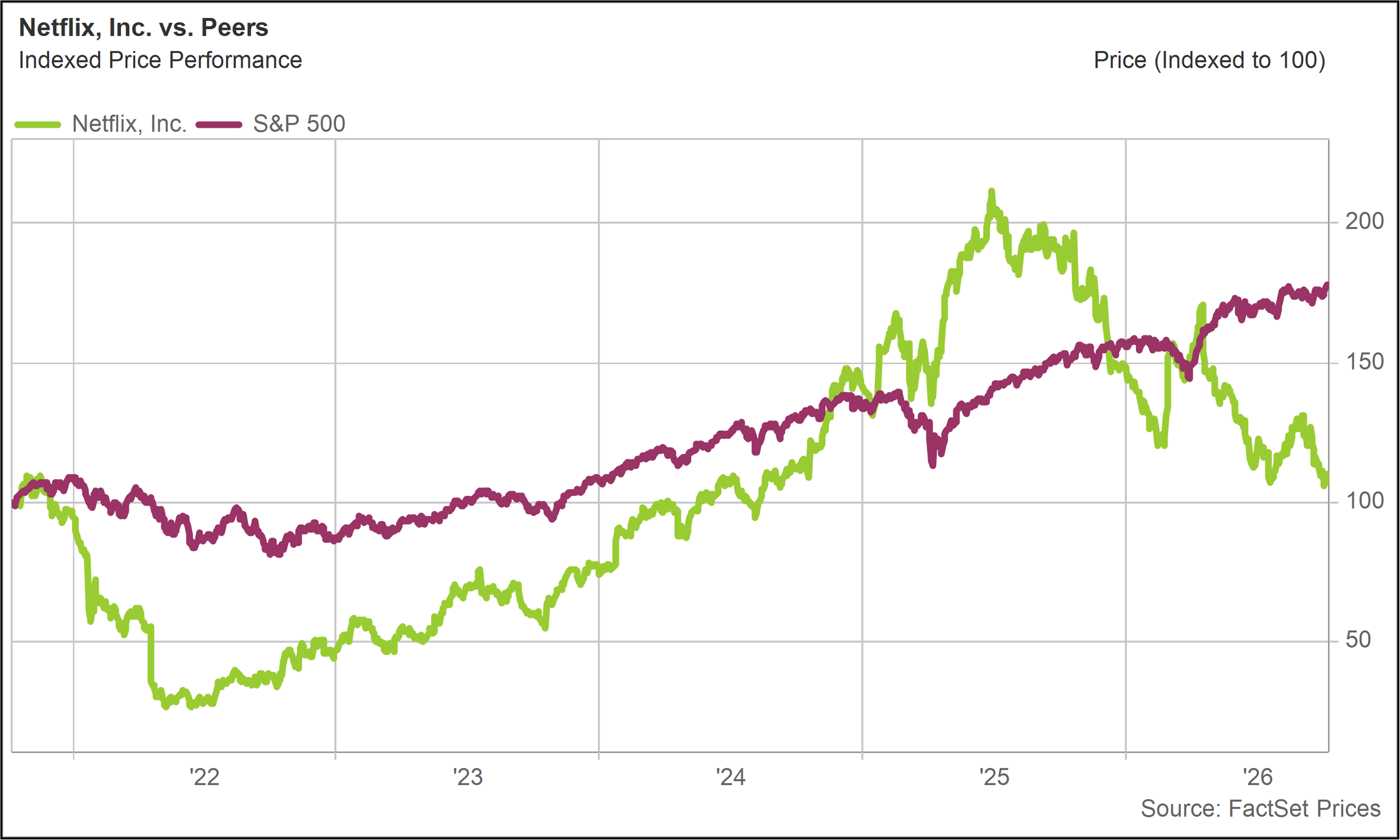
Netflix now trades at roughly 18 to 20 times expected 2027 earnings, whereas it used to trade close to 40 times forward earnings back around its 2025 peak.
The stock is no longer richly valued. The multiple is now broadly in-line with the rest of the S&P 500.
But inexpensive relative to its own history does not necessarily mean compelling.
Investors have alternatives that, in our view, stand a better chance of benefiting from the proliferation of AI and its improvement as a technology.
For example, as we recently discussed (MAG7 Monitor: Meta’s AI Breakout), they can own Meta Platforms (META). META now competes directly with Netflix for audience attention and in many respects offers a similar valuation profile.
To be fair, Netflix still has strong assets, real cash flow, and relatively sticky customers. It should not be underestimated. The company has reinvented itself repeatedly, and it could do so again.
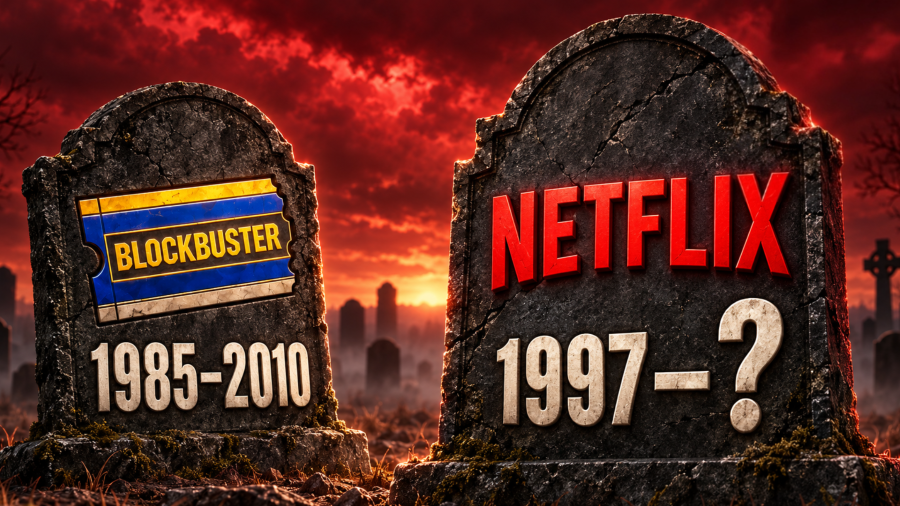
But there is also the lesson of Blockbuster.
Great businesses rarely disappear because everything stops working at once. They disappear because the world changes around them faster than they change themselves.
Netflix became one of the defining companies of the cloud era because it understood that technology had changed the rules of entertainment.
But the rules are changing again, rapidly. And this time, Netflix is the incumbent.