The election and interest rates
One encouraging immediate market development has been a decline in Treasury yields.
The benchmark 10-year Treasury yield initially retreated toward 4.9%, while the US dollar weakened against other major currencies.
Part of the explanation is that divided government reduces the likelihood of additional fiscal stimulus, potentially limiting future federal borrowing requirements.
Investors may also be anticipating somewhat slower economic growth (related to political resistance to AI), which could reduce pressure on the Federal Reserve to maintain restrictive monetary policy.
Lower interest rates resulting from improving inflation and greater fiscal discipline would be broadly constructive. Lower rates resulting from deteriorating economic growth would present a more complicated picture.
Still, for income-oriented investors, the change in direction is potentially significant.
As we have discussed in recent reports, higher long-term yields have placed considerable pressure on dividend-paying stocks, REITs, Utilities, and other businesses whose valuations are sensitive to interest rates.
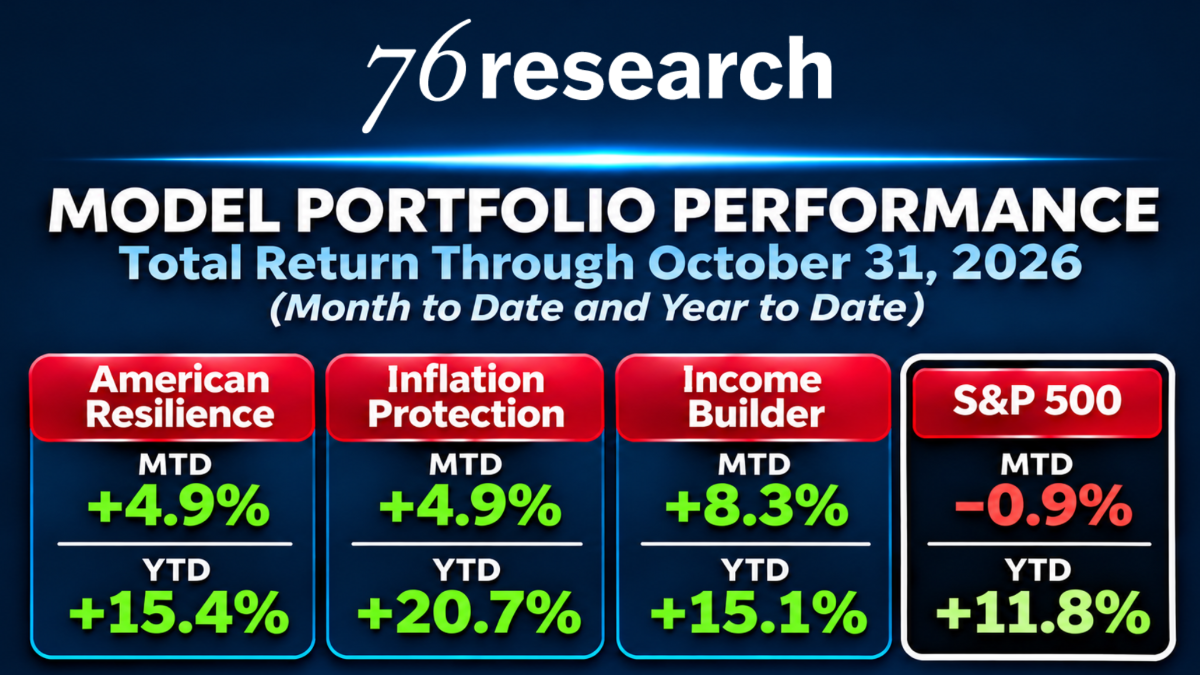
In October, we witnessed how relief on long-term rates could benefit income-oriented portfolios. For example, our Income Builder Model Portfolio advanced 8.3% in October, versus -0.9% for the S&P 500.
A sustained retreat in yields could provide additional support for these types of investments.
Meanwhile, a weaker dollar may benefit internationally exposed US companies and certain real assets. Both gold and Bitcoin advanced in the immediate aftermath of the election.
These developments reinforce the importance of maintaining diversification across different economic scenarios.
The threat to AI
Although the broader stock market is rallying, some AI infrastructure companies have come under considerable selling pressure.
This reflects one of the election's most important long-term implications. The political backlash against AI infrastructure is becoming increasingly powerful—and increasingly bipartisan.
Nowhere is this more apparent than Texas.
With abundant energy resources, available land, and historically business-friendly policies, Texas has emerged as one of the most important locations for the massive data center buildout.
The state accounts for a substantial share of planned US data center capacity (around 25% of the national total by some estimates).
Governor-elect Gina Hinojosa campaigned on restricting data center development, including a statewide moratorium until stronger protections are established for local communities.
But opposition to AI infrastructure was already growing among Republicans, who sensed popular pushback after initially taking a more pro-growth position.
Abbott himself had moved to restrict data center construction, ordering a halt to new state permits pending an audit of electricity and water requirements.
For investors, local political opposition to building AI infrastructure could impact the pace of development. But it does not mean the underlying demand for intelligence is disappearing.
If anything, growing demand combined with constraints on supply could make existing AI infrastructure and secured power capacity substantially more valuable.
Companies with access to electricity, strategically located facilities, and the ability to develop or operate infrastructure efficiently may gain meaningful competitive advantages.
At the same time, restrictions on new construction could delay projects, raise costs, and make it more difficult for hyperscalers to expand computing capacity.
Scarcity can enhance the value of existing assets, but an inability to expand capacity could also limit the industry's growth.
It is an important development we are focusing on across our Model Portfolios.
Ultimately, we believe the economic trajectory of AI will depend more on technological progress, the economics of deployment, and the commercial demand for intelligence than on politics, which the leading players will now have to navigate more carefully.
Looking beyond the election
The midterms have dramatically changed the political landscape, but the most important economic questions facing investors remain familiar.
Will AI continue to deliver productivity improvements and commercial opportunities that justify enormous infrastructure investment?
Will oil prices finally normalize, allowing inflation and interest rates to retreat?
And will the underlying strength of the American economy continue to translate into corporate earnings growth?
We remain constructive on the long-term potential of AI, while recognizing that the industry faces meaningful technological, financial, and increasingly political challenges.
We are also encouraged by the prospect of lower energy prices and the opportunities that may emerge as interest rates decline.
Opinions will vary on the best course of action with respect to Iran from a security perspective. But it appears that the administration, in the aftermath of this election, will be more inclined to work toward an outcome that brings oil prices down sooner rather than later.
Political fortunes can change dramatically in a single night. The economic forces that ultimately determine long-term investment returns generally move on a very different timetable.