|
| American Resilience Model Portfolio |
|
| Monthly Portfolio Review: December 2025Publication date: January 5, 2026 |
|
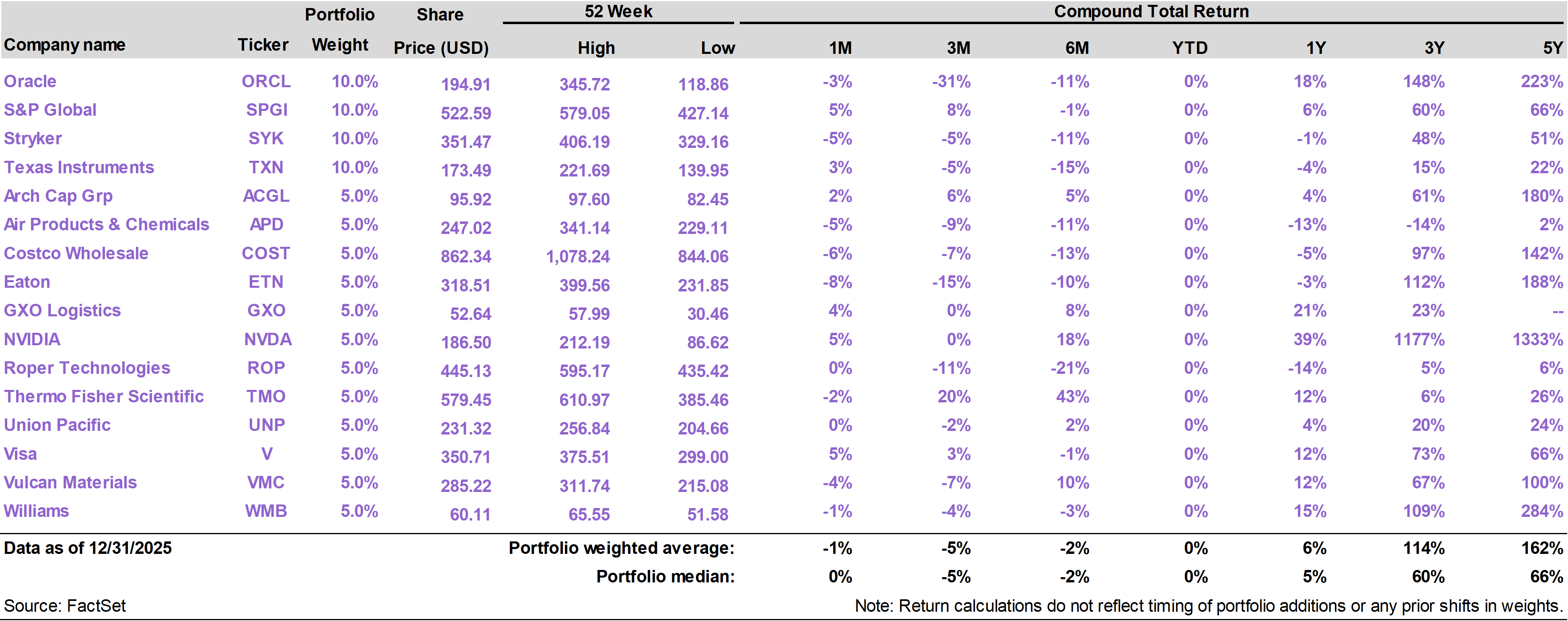
| | | Current portfolio holdings |
|
|
| | FOR SUBSCRIBER USE ONLY. DO NOT FORWARD OR SHARE. |
|
| | | December was a neutral month for stocks, with the S&P 500 essentially flat and the Nasdaq Composite down 1%. The American Resilience portfolio was flat for the month. Although December was relatively calm, the S&P 500 finished the year very close to all-time highs. 2025 concluded as another tech-led year, with a few mega-cap names generating very high returns on strong AI-related growth. We expect the AI theme to remain a key growth driver in 2026. The Fed implemented another rate cut in December and signaled a more optimistic outlook on inflation. We see the potential for a positive inflation surprise this year, as many underlying inflation trends are moving in a favorable direction. If inflation undershoots, this could be quite positive for stocks by paving the way for further rate cuts—especially with Trump appointing a new Fed Chair within the next few months.
|
|
| | | The American Resilience portfolio generated a total return of -0.5% in December, versus the S&P 500 Index return of 0.1%. On a one-year basis through the end of the month, the portfolio returned 10.2%, versus 17.9% for the S&P 500.
The top performing portfolio positions in December were NVIDIA (NVDA), which returned 5%; Visa (V), which returned 5%; and S&P Global (SPGI), which returned 5%.
The worst performing positions in the portfolio were Eaton (ETN), which declined 8%; Costco (COST), which declined 6%; and Air Products & Chemicals (APD), which declined 5%. |
|
| Calm end to a strong year
While December was basically a flat month for stocks, the bigger picture is that stocks generally delivered quite strong returns over the course of the year. The S&P 500 closed the year just about 1% below its all-time highest levels.
Technology stocks mildly underperformed in December but ultimately led the way in 2025. The indexes with the most tech exposure did the best.
The NASDAQ Composite returned 21% in 2025, versus 18% for the S&P 500 and 11% for the S&P 500 Equal Weighted Index (which captures the average stock in the index and has much lower exposure to mega-cap tech stocks). |
|
|
| S&P 500, NASDAQ, S&P 500 Equal WeightTotal Return (12/31/24 - 12/31/25) |
|
| Mag 7 continue to lead
Given their extreme importance to the market now, we have begun tracking the Magnificent Seven mega-caps, including Broadcom (AVGO), directly via our regularly recurring Mag 7 Monitor.
These stocks played a critical role in driving the upside in the broader market last year, delivering an average total return of approximately 26%, which exceeded the Nasdaq. |
|
|
| Mag 7 - Total Return(12/31/24 - 12/31/25) |
|
| The success of the Mag 7 in 2025 was clearly AI-driven. Interestingly, only three of the stocks—AVGO, Alphabet (GOOGL), and NVIDIA (NVDA)—actually outperformed the S&P 500. But the performance of these three stocks was extremely strong and made up for the relatively subdued performance of the rest of them.
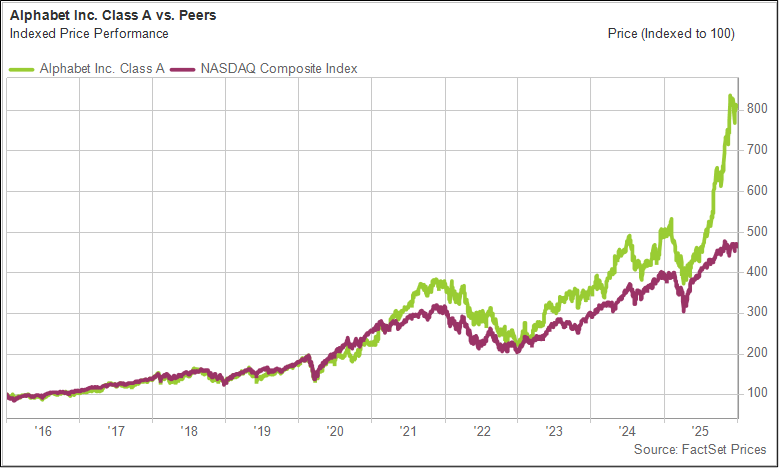
GOOGL’s success this year (up 66%) was particularly notable, after about a decade of basically in-line performance with the Nasdaq.
GOOGL shares broke out in the final months of 2025 as investors recognized the success of its Gemini AI offering as a top AI model. The market also now has greater confidence in GOOGL’s ability to use AI to reinvent its leading internet search business without cannibalizing it. |
|
|
| GOOGL vs. Nasdaq- Total Return(Last 10 Years) |
|
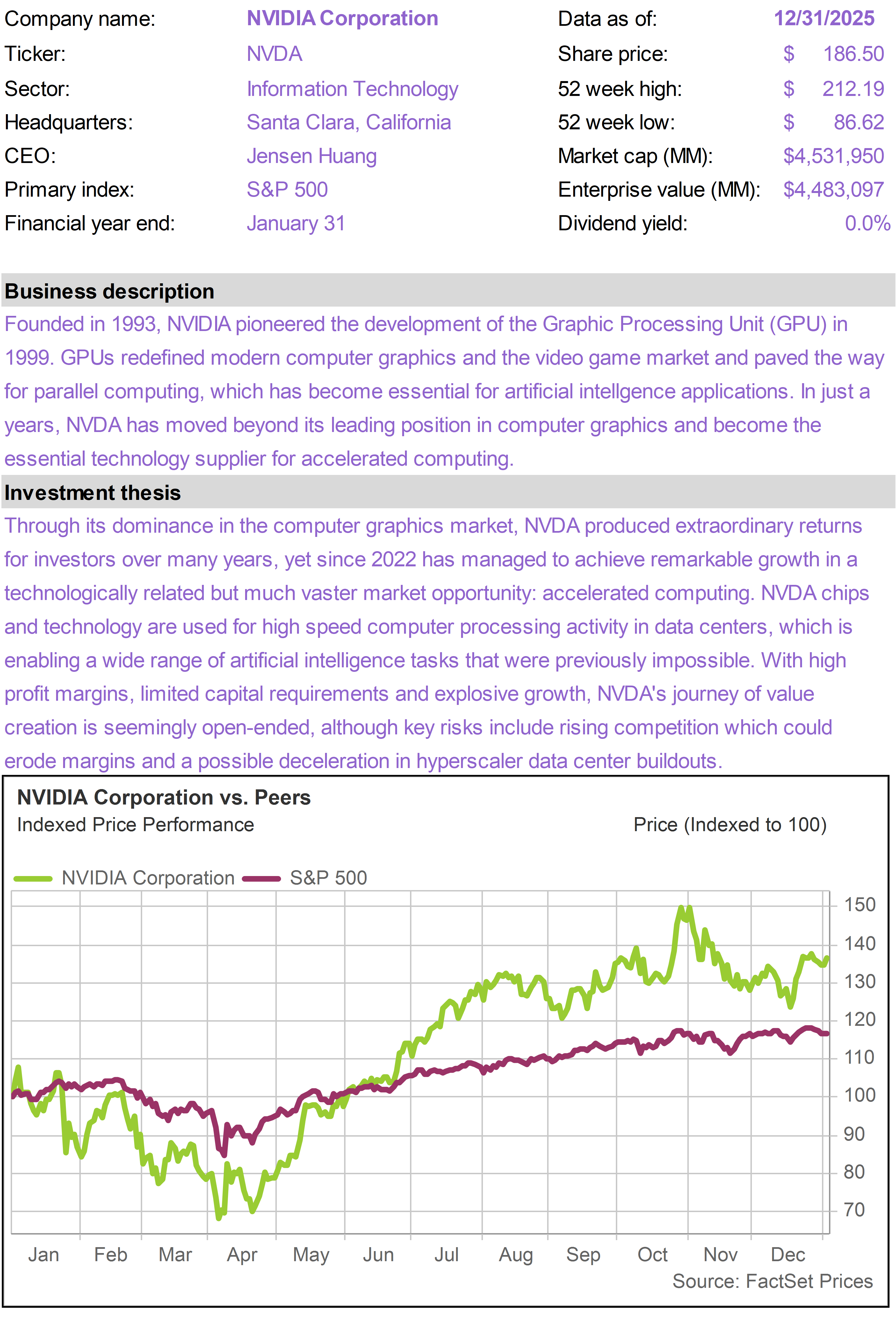
| NVDA and AVGO succeeded in 2025 as the two leading hardware players in AI.
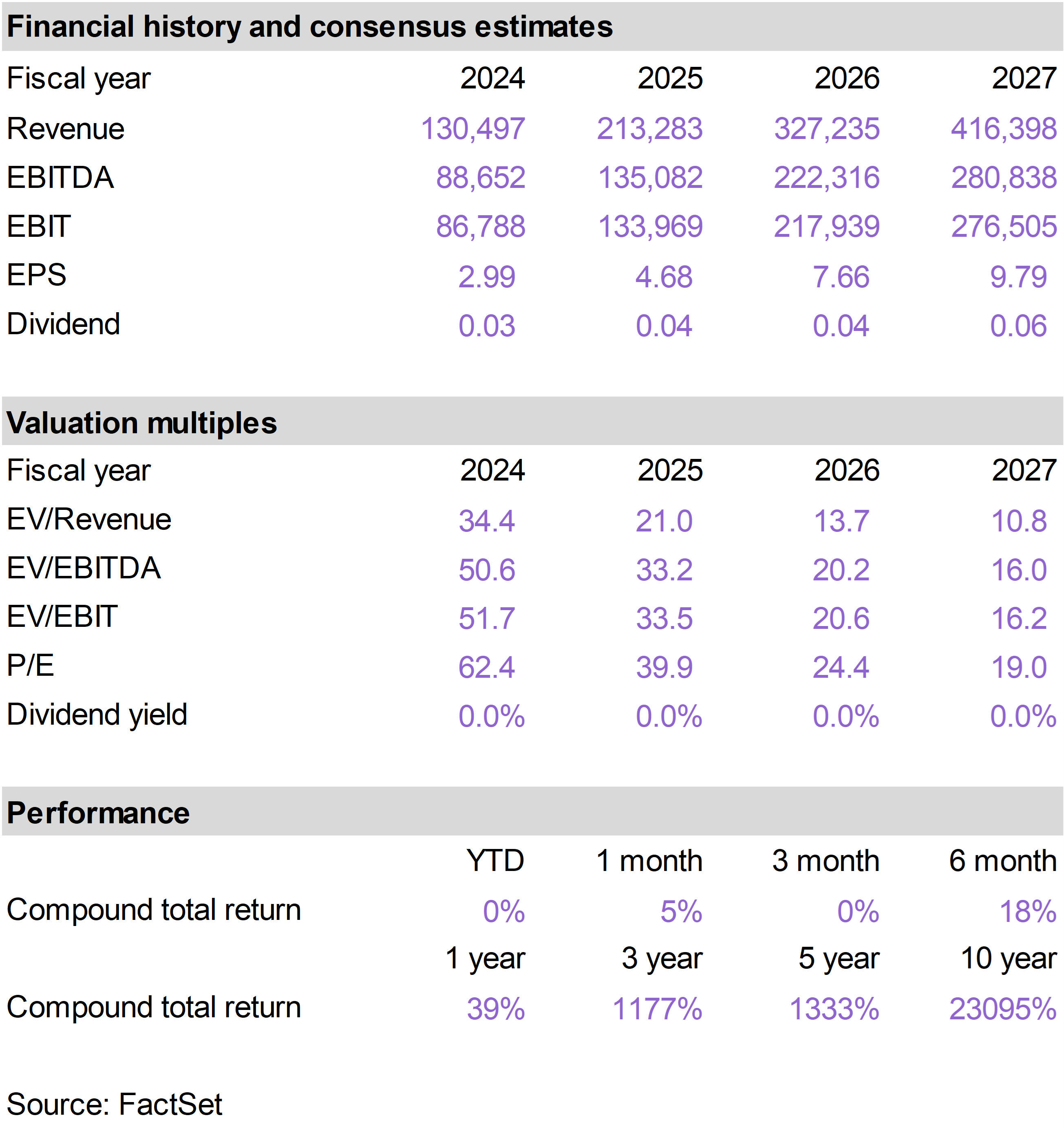
Despite some volatility along the way, especially in April with the tariff panic, NVDA shares delivered another impressive result on the back of continued earnings growth and a healthy outlook.
In 2025, AVGO asserted itself as a critically important AI hardware player through Application-Specific Integrated Circuits (ASICS). The company designs and manufactures these custom AI chips, often in close partnership with its customers, including GOOGL.
While there is concern among tech investors that AVGO’s ASICS represent a competitive threat to NVDA’s Graphics Processing Units (GPUs), both companies thrived in 2025 on broad demand for the key equipment that makes AI possible.
Heading into the new year, AI remains the growth engine of the stock market. Companies across the economy are benefiting from the AI build-out and increasingly from AI adoption, which allows for faster growth and lower costs.
Real progress on inflation
AI growth may be driving the economy and stock market forward, but inflation is the main factor holding them back. Inflation remains somewhat elevated, keeping the Federal Reserve in a still “restrictive” policy stance.
The good news is that inflation appears to be easing—a main reason stocks touched all-time highs in the final quarter of the year. That easing trend showed up across several measures as the year progressed.
Goods inflation continued to cool as supply chains normalized, while housing-related inflation—one of the stickier components—began to decelerate with a lag.
Wage growth also moderated without a sharp rise in unemployment, reinforcing confidence that inflation could come down without a recession.
Against the backdrop of moderating inflation, at its most recent meeting in December, the Fed dropped short-term rates by another quarter-point. This was the third rate cut since Jerome Powell’s late-August 2025 pivot in Jackson Hole.
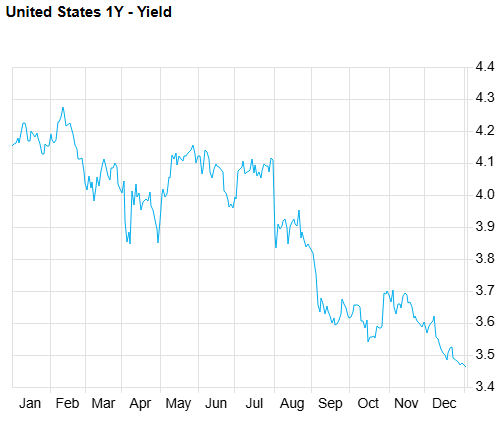
An improving inflation outlook led to a substantial decline in One-year Treasury yields over the course of the year, especially in the final months. |
|
|
| One-Year Treasury Yields(Last 12 months) |
|
| Rates influence sector performance
The Financial sector led performance in December. This can be explained to a large degree by shifts in the yield curve.
With the December interest rate cut, short-term interest rates fell notably. The One-year Treasury yield fell from 3.59% at the end of November to 3.47% at the end of December.
Meanwhile, partly as a result of an improved growth outlook, long-term Treasury yields rose. The Ten-year Treasury yield increased from 4.01% at the end of November to 4.17% at the end of December.
These shifts in the yield curve—in this case, a “steepening,” with short rates coming down and long rates going up—were not extreme but can be impactful in an otherwise relatively quiet market.
Financial stocks, especially banks, benefit from a steeper yield curve. Banks have to pay depositors less in an environment of lower short-term interest rates. If long-term rates simultaneously rise, they can earn more by placing those funds into higher yielding long-term instruments. |
|
|
| | Given the rise in long-term yields in December, it is unsurprising that Utilities were the worst performing sector, followed by other defensive sectors that are also sensitive to movements in long-term rates (Real Estate, Health Care, Consumer Staples).
Utilities are stocks but trade with a high-correlation to long-term bonds because their value is similarly based on stable long-term cash flows. The weakness in Utilities in December reflects the mild increase in long-term rates. |
|
| Could inflation undershoot?
After several years of high inflation, an increasingly important question for markets is whether inflation could fall faster and further than expected. Several factors seem to be pointing in that direction.
First, goods inflation has already cooled meaningfully as one-time tariff impacts (which were probably milder than many people expected anyway) have already become embedded in price levels.
Second, housing inflation, which moves with long lags, is beginning to roll over as lower new-lease growth rates slowly feed into official data. The shelter component represents as much as one-third of the Consumer Price Index (CPI).
Third, moderately rising unemployment alleviates wage pressures. Businesses are no longer scrambling to fill open positions as they were just a few years ago, when aggressive post-pandemic hiring led to notable labor shortages in certain areas.
When inflation peaked in 2022, the unemployment rate was as low as 3.5%, versus 4.6% today. To avoid inflation, the economy requires some labor market slack.
All of these positive cyclical trends are playing out just as AI-driven productivity growth, a more structural factor, is only now starting to take hold.
Inflation in recent months has been running just below 3%, meaningfully above the Fed’s 2% target. This is basically the only reason that Fed has not been more aggressively cutting short-term rates, which are still elevated, as unemployment rates creep up.
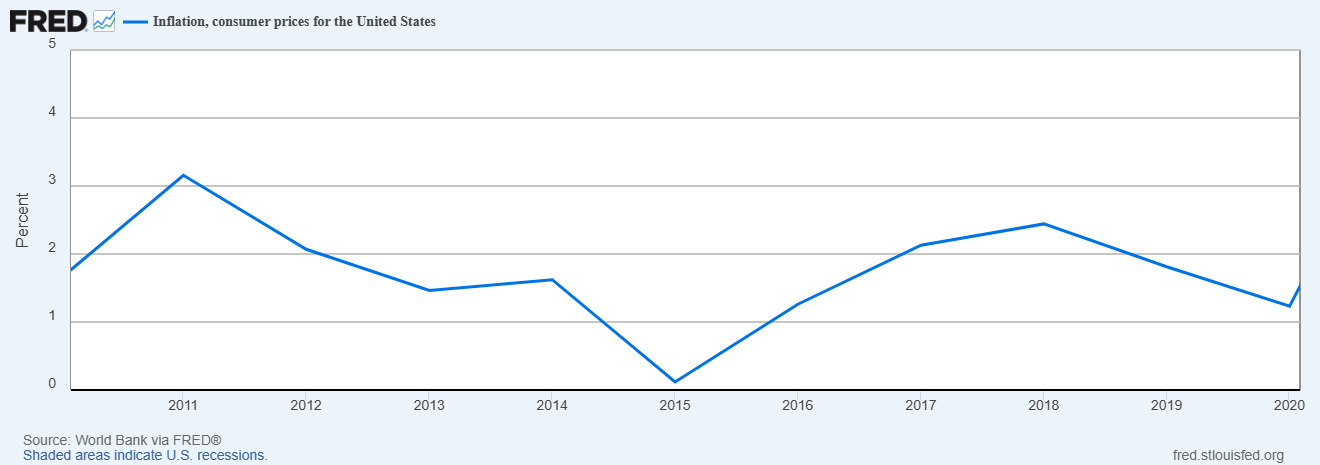
But it is worth remembering that for the ten-year period that preceded the pandemic, inflation rates were consistently below the Fed’s semi-official 2% target. |
|
|
| Increase in Consumer Price Index (CPI)(2010-2020) |
|
| The pandemic created an inflationary shock to the system that took many years to work through—a combination of supply chain disruptions and excessive monetary and fiscal stimulus.
Now, we potentially find ourselves returning to conditions that prevailed before the pandemic hit—a nimble, productive, high-tech economy that bypasses inflationary pressures.
As we look forward to 2026, we are mindful of the possibility of positive surprises on the inflation front. This would give the Fed, especially under the leadership of whoever President Trump decides to appoint as the next Chair, significant leeway to cut rates.
A return to the “old normal” of persistently low inflation is not currently priced into markets with long-term inflation expectations still north of 2%. This optimistic scenario represents a potentially significant source of upside for stocks, and risk assets in general, in the year ahead. |
|
| | |
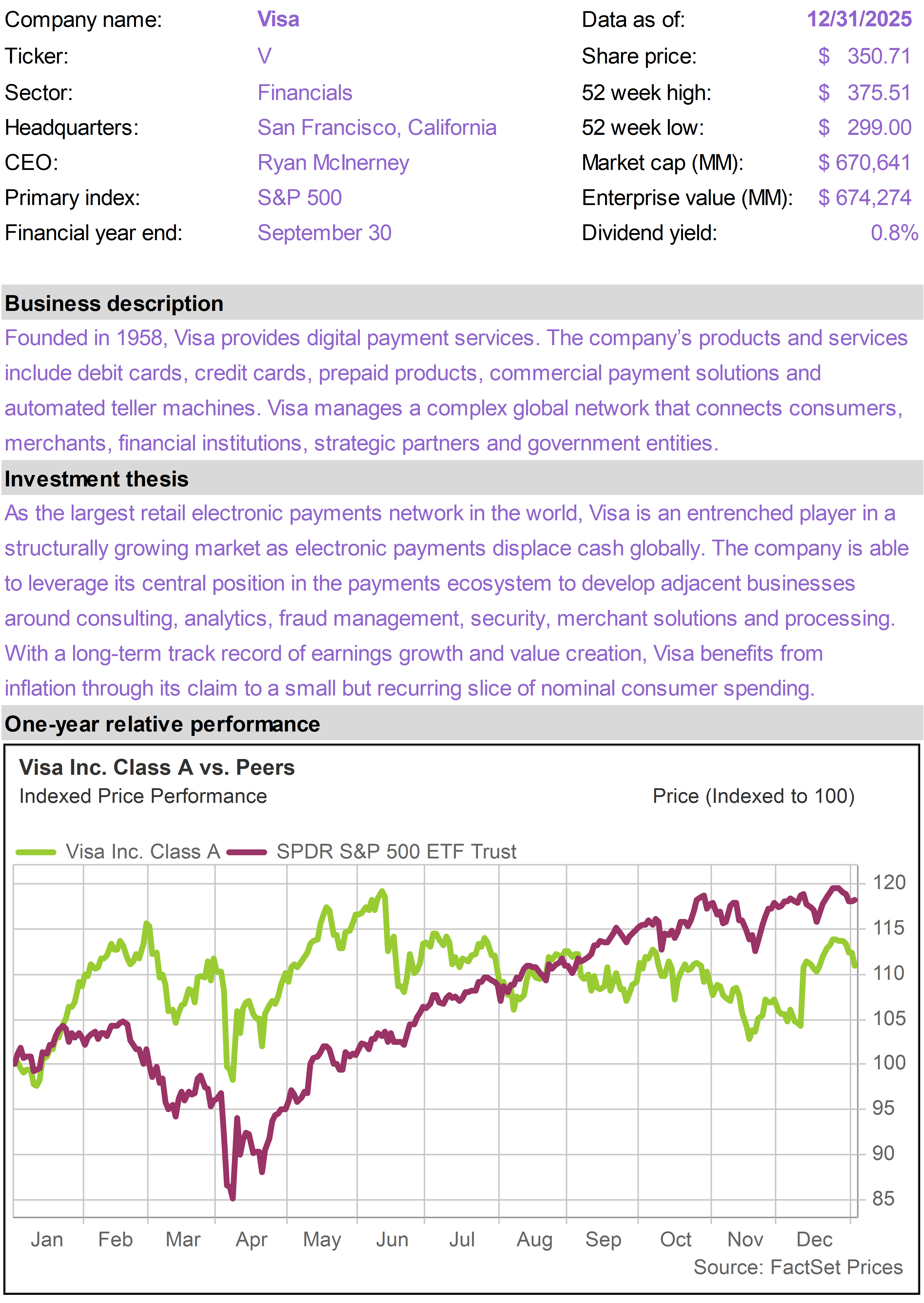
The top performing stocks in the portfolio in December were NVIDIA (NVDA), which returned 5%; Visa (V), which returned 5%; and S&P Global (SPGI), which returned 5%.
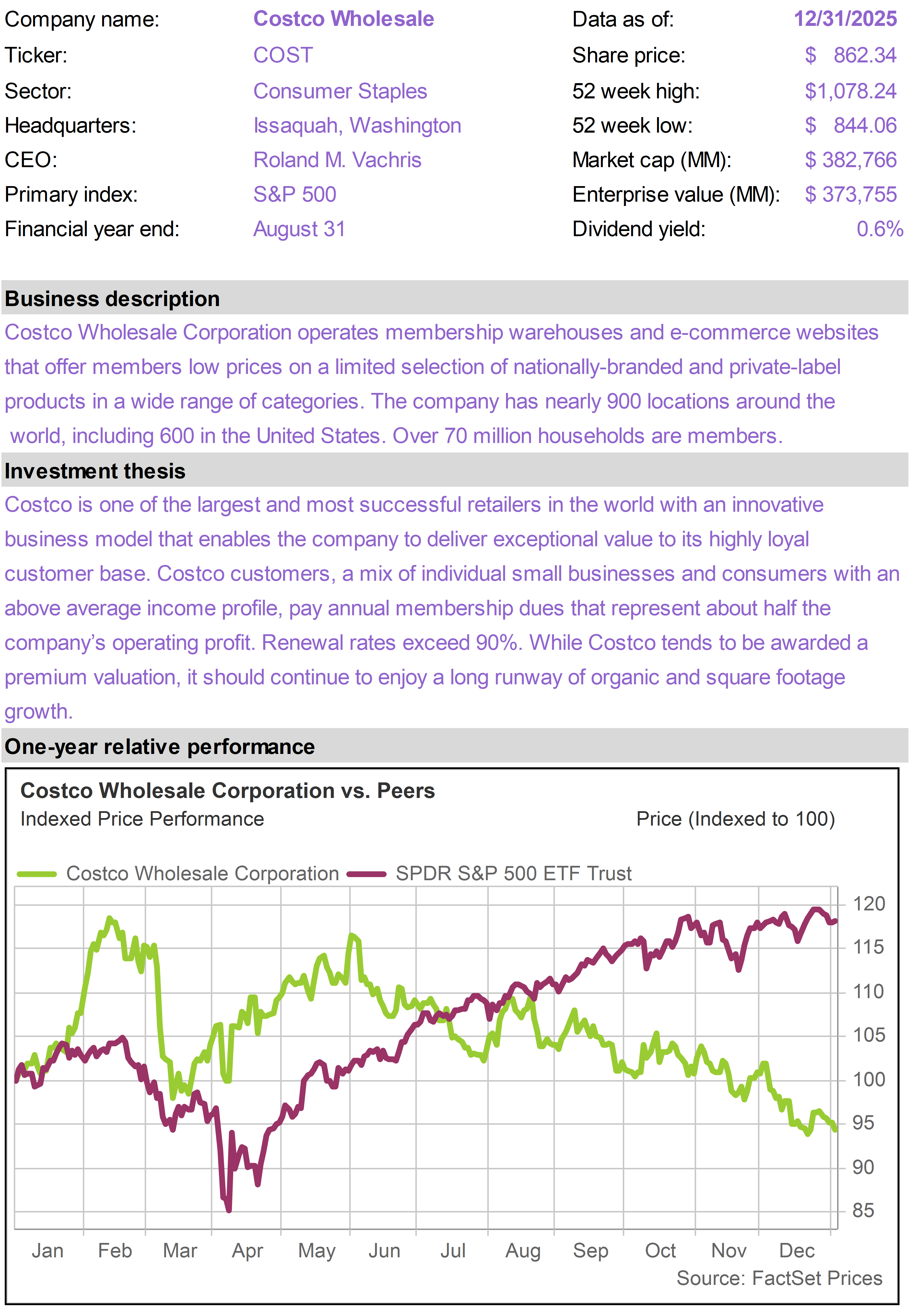
The worst performers in the portfolio this month were Eaton (ETN), which returned -8%; Costco (COST), which returned -6%; and Air Products & Chemicals (APD), which returned -5%. |
|
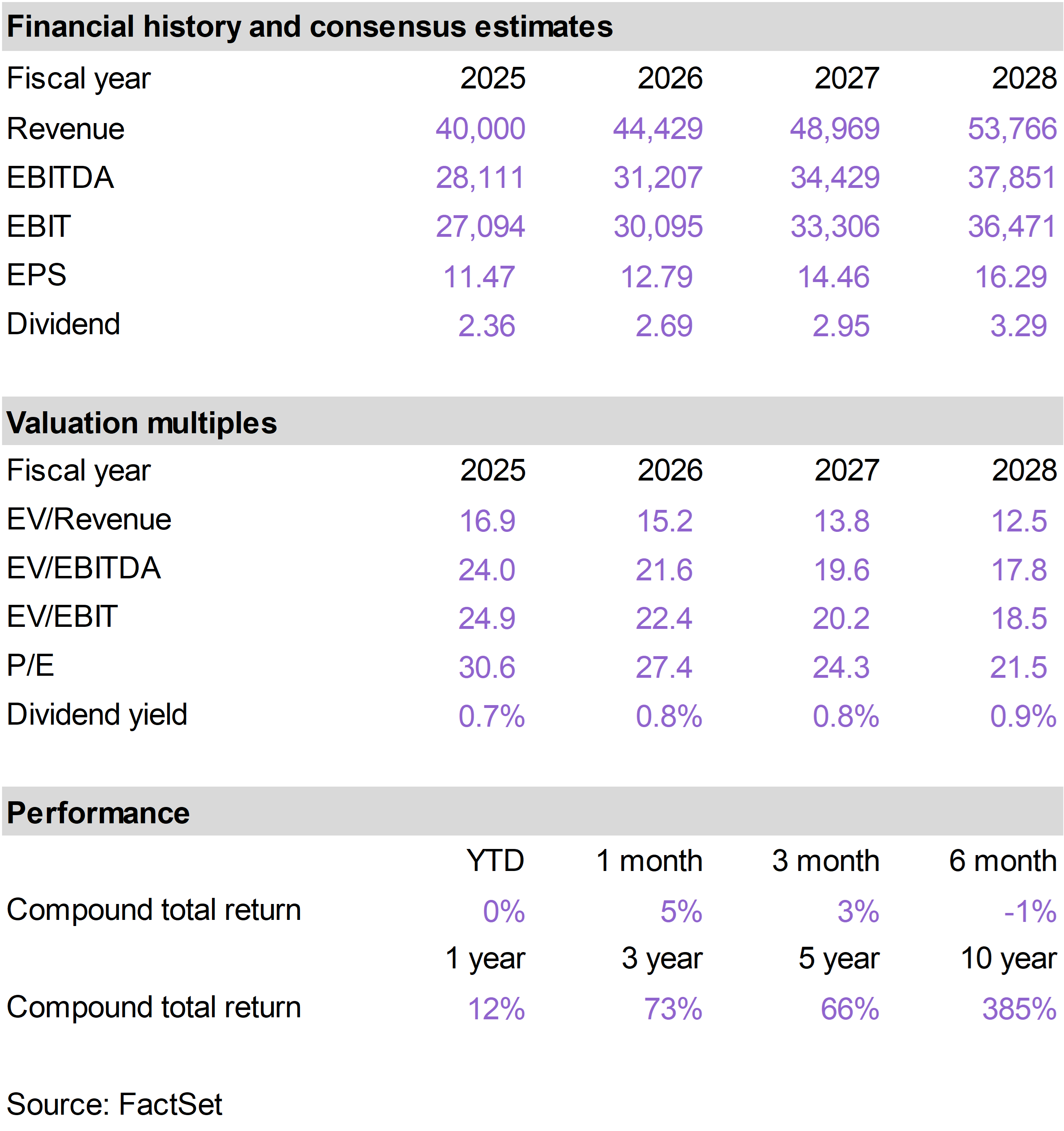
| Shares of NVDA advanced in December as investor confidence returned following some weakness in November. As we discussed last month, one of the key debates around NVDA now is the competitive risk posed by ASICS chips that are produced by Broadcom (AVGO) and others.
Perceptions of this risk have held NVDA shares back, despite its most recent earnings results, which were released in mid-November and significantly exceeded expectations.
We expect ASICS chips, which are best suited for specific tasks rather than general purpose computing, to play an important role in AI deployments. But we also expect NVDA to continue to grow at high rates.
Over time, anxiety around this specific competitive threat should continue to subside, perhaps in a way similar to how the DeepSeek (decentralized AI) threat diminished after surfacing in early 2025.
V shares advanced on expectations of strong fourth quarter consumer spending and continued progress on crypto-related initiatives.
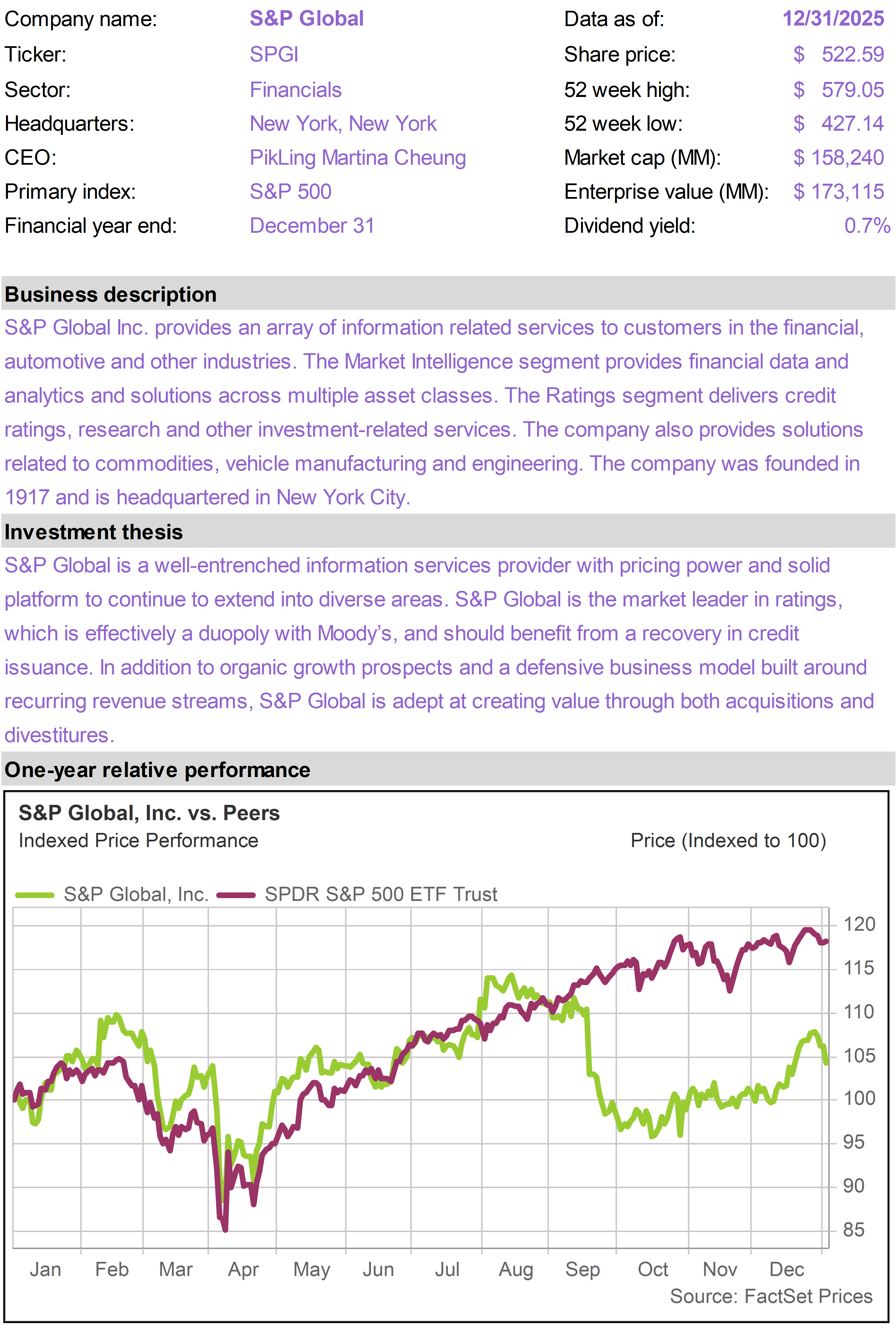
SPGI, a leading financial information services, showed strength after its November Investor Day conference. SPGI argued that its two biggest businesses are set up for solid, profitable growth in the years ahead.
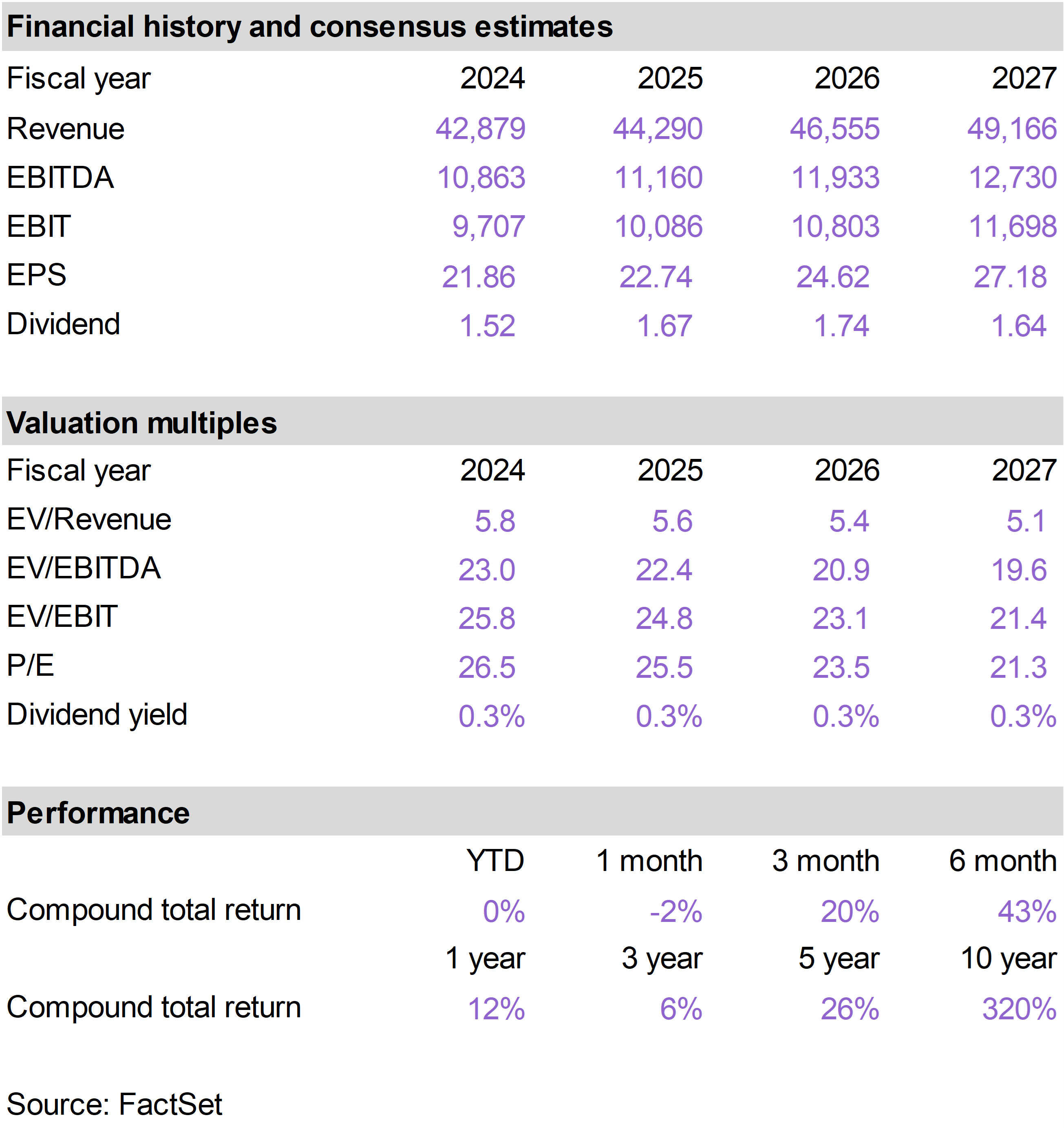
The company’s Market Intelligence division, which accounts for a little over one-third of revenue, is benefiting from better data, improved technology, and new AI-driven products.
Its Ratings business, which makes up another roughly one-third of revenue, is also in a favorable spot. Financing conditions remain healthy, and an expected pickup in global mergers and acquisitions should lead to more bond issuance that requires credit ratings. That activity could accelerate in early 2026.
Although there were no important fundamental developments in December, ETN shares declined as a few analysts trimmed their estimates for 2026 on a more conservative outlook.
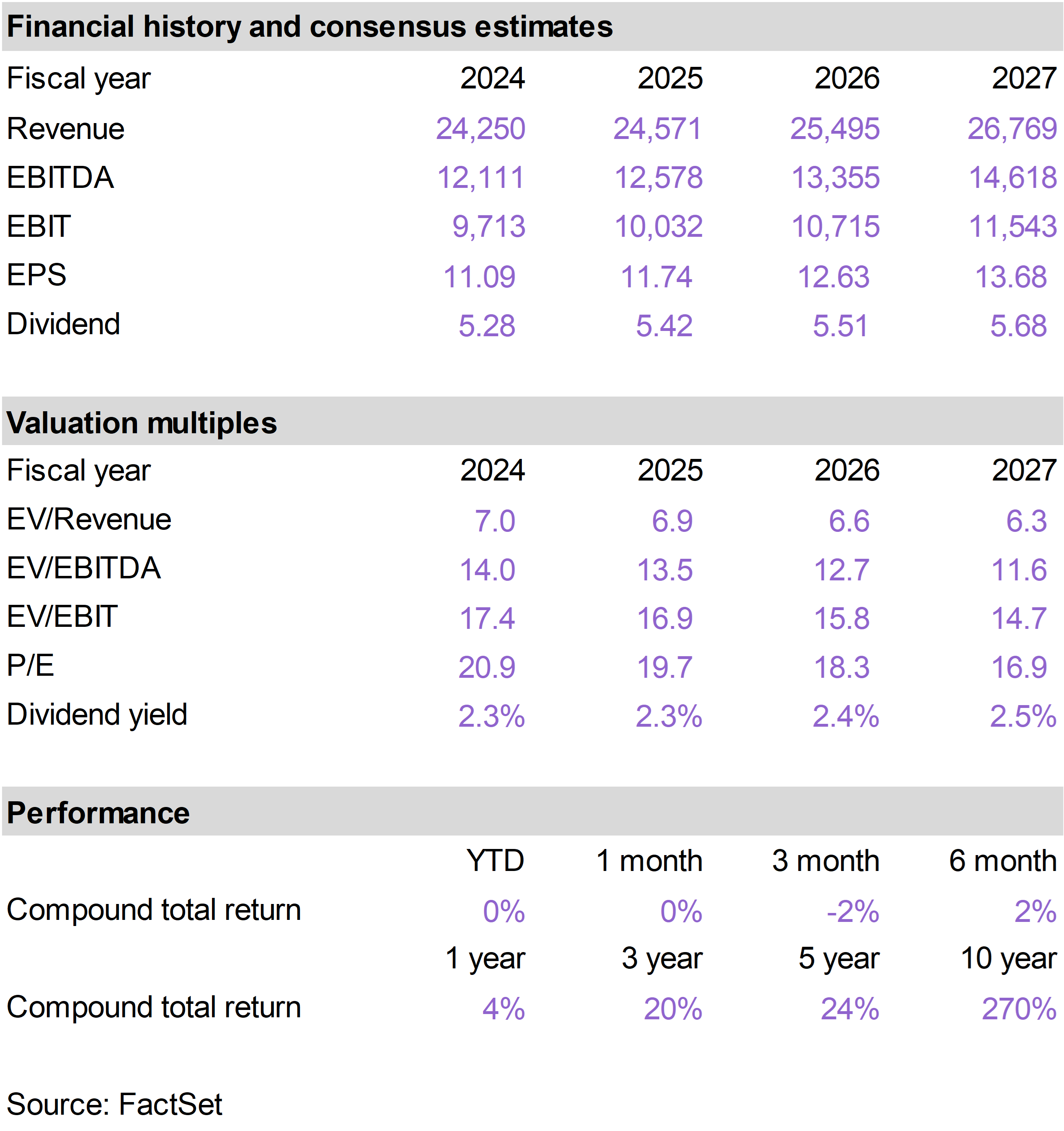
COST shares retreated along with other consumer staples names in December and in reaction to some concerns about intensified competition.
After a strong performance in November, following an earnings beat, APD shares slid as certain analysts trimmed forecasts. |
|
| | |
| | |
| | |
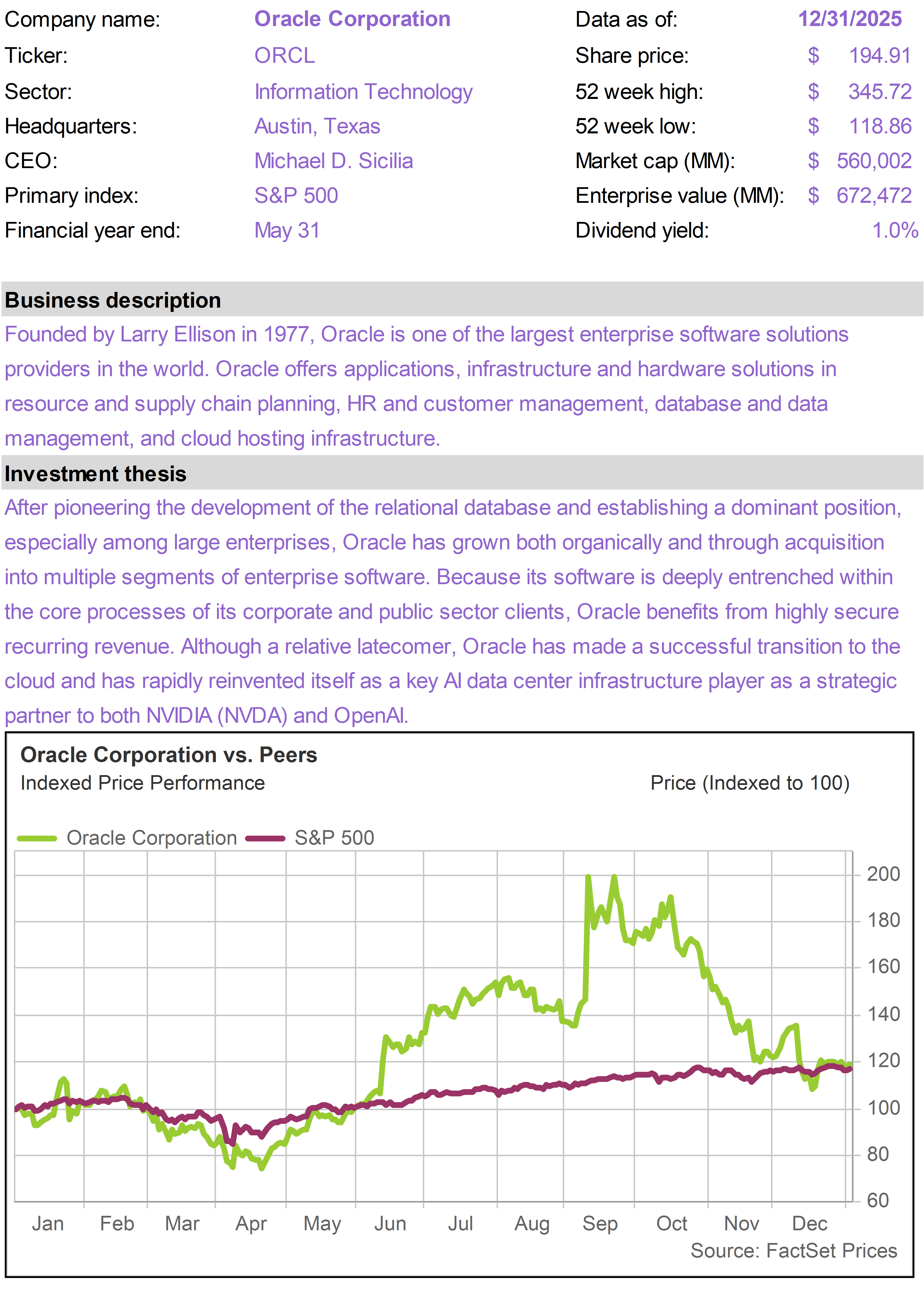
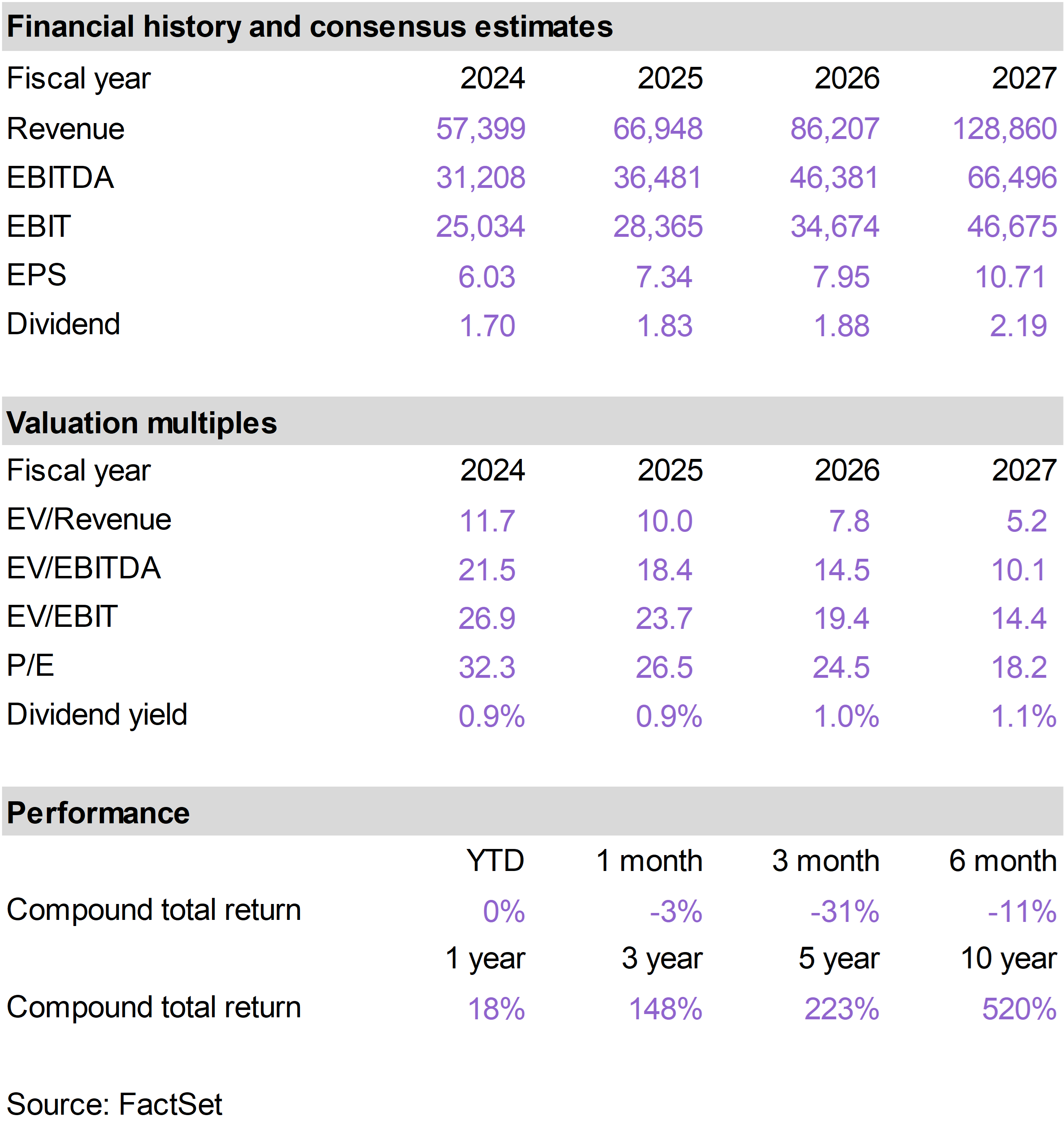
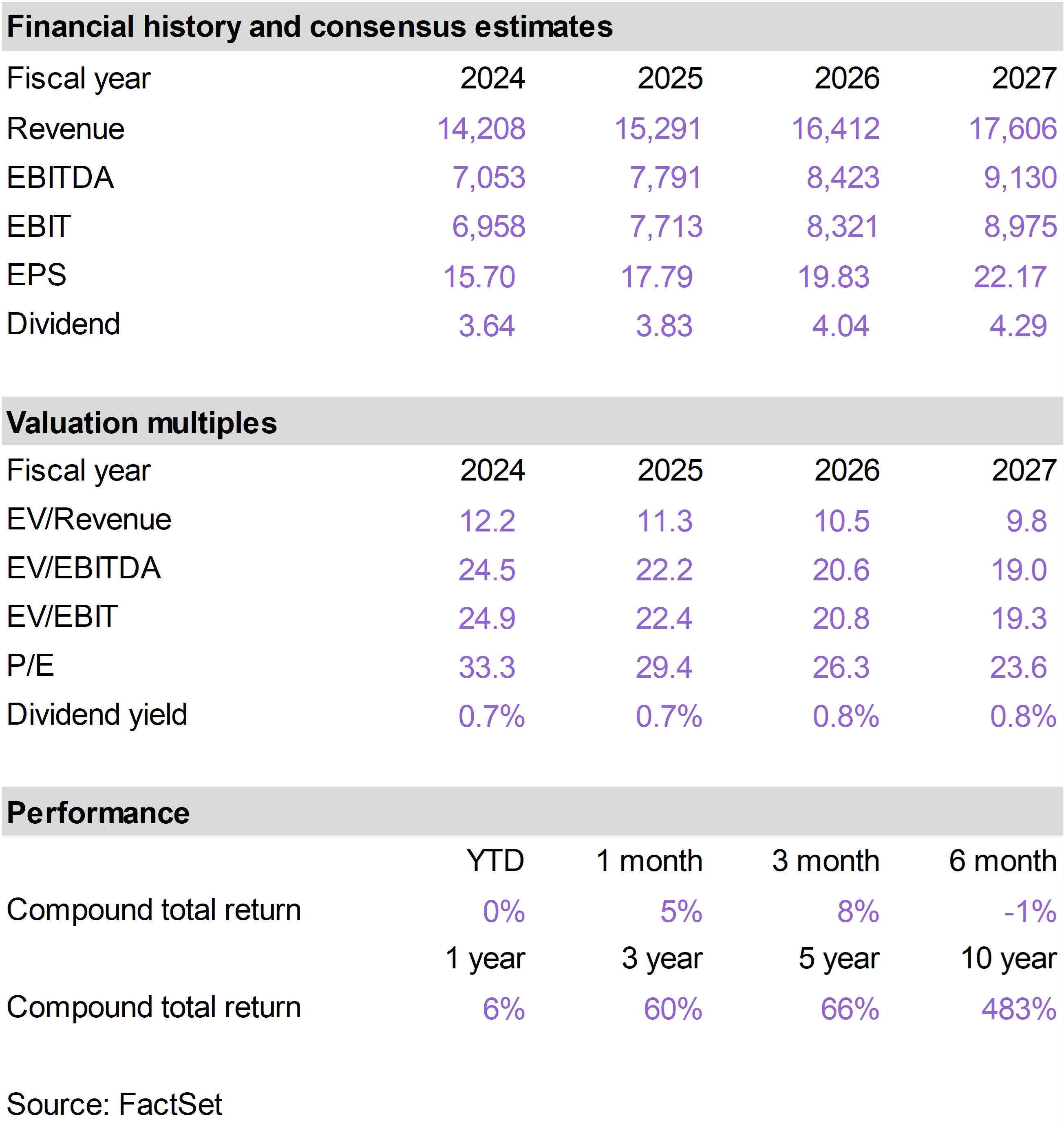
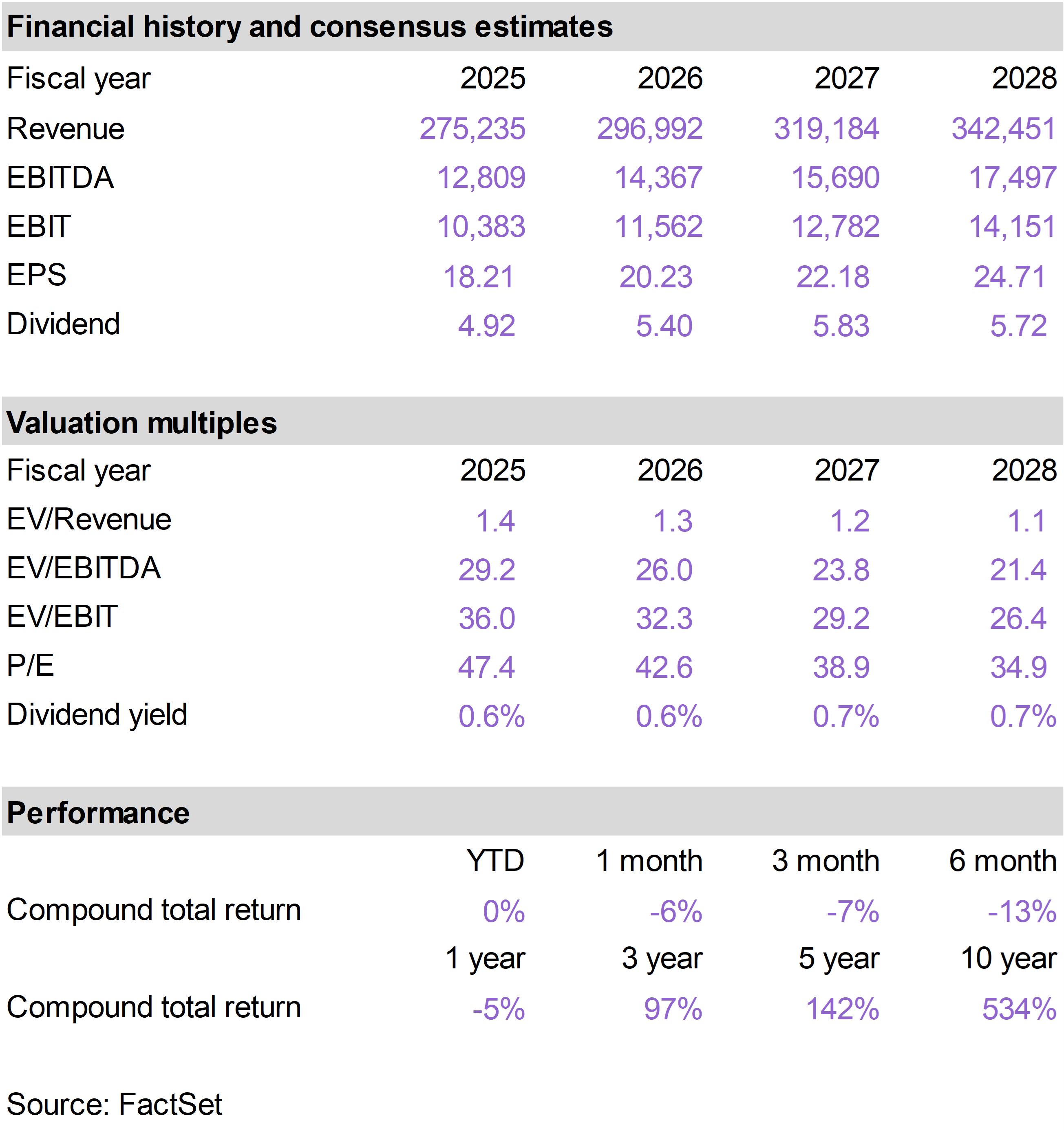
| | | Oracle Corporation (ORCL) |
|
|
|
| | |
|
| | |
|
| | |
|
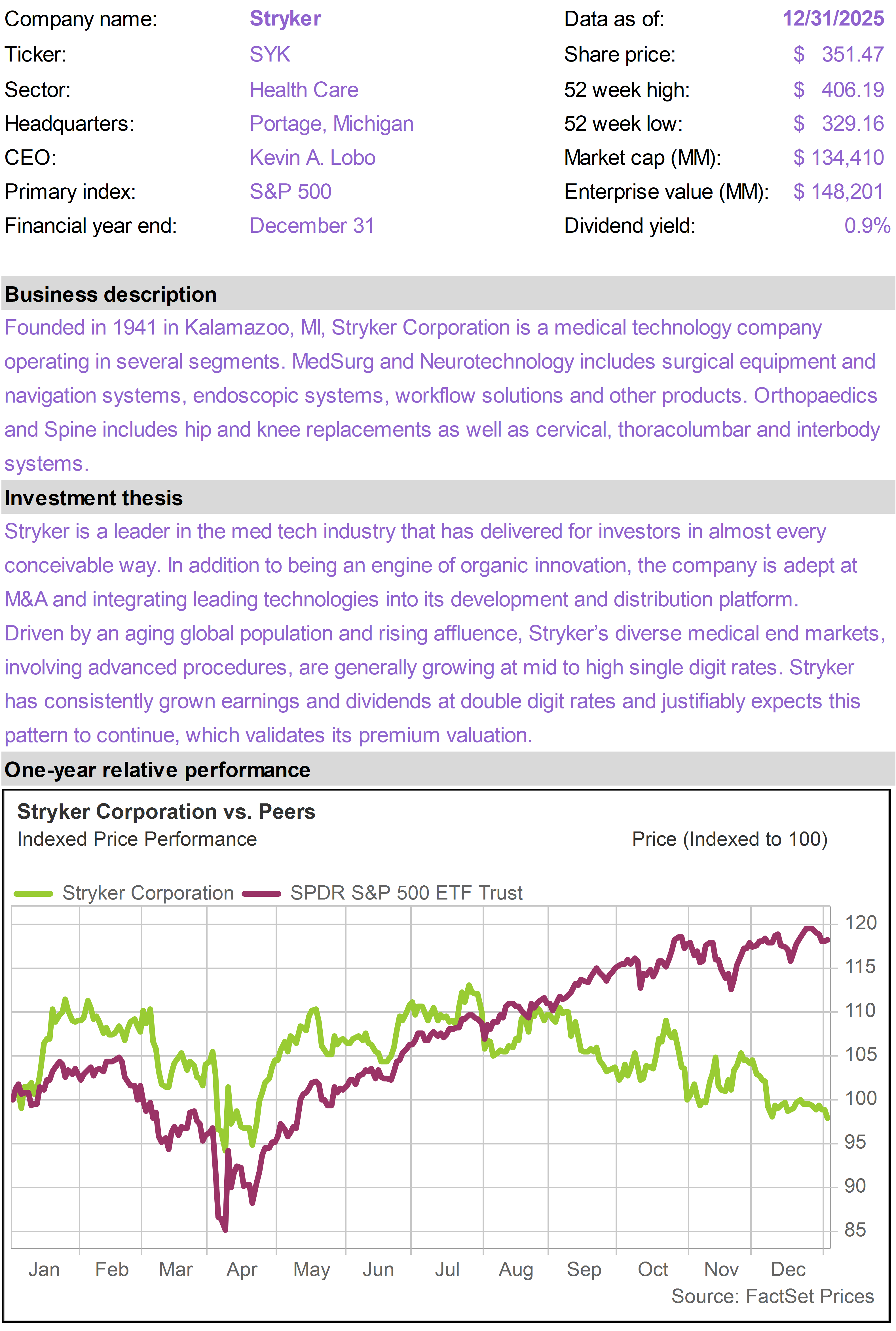
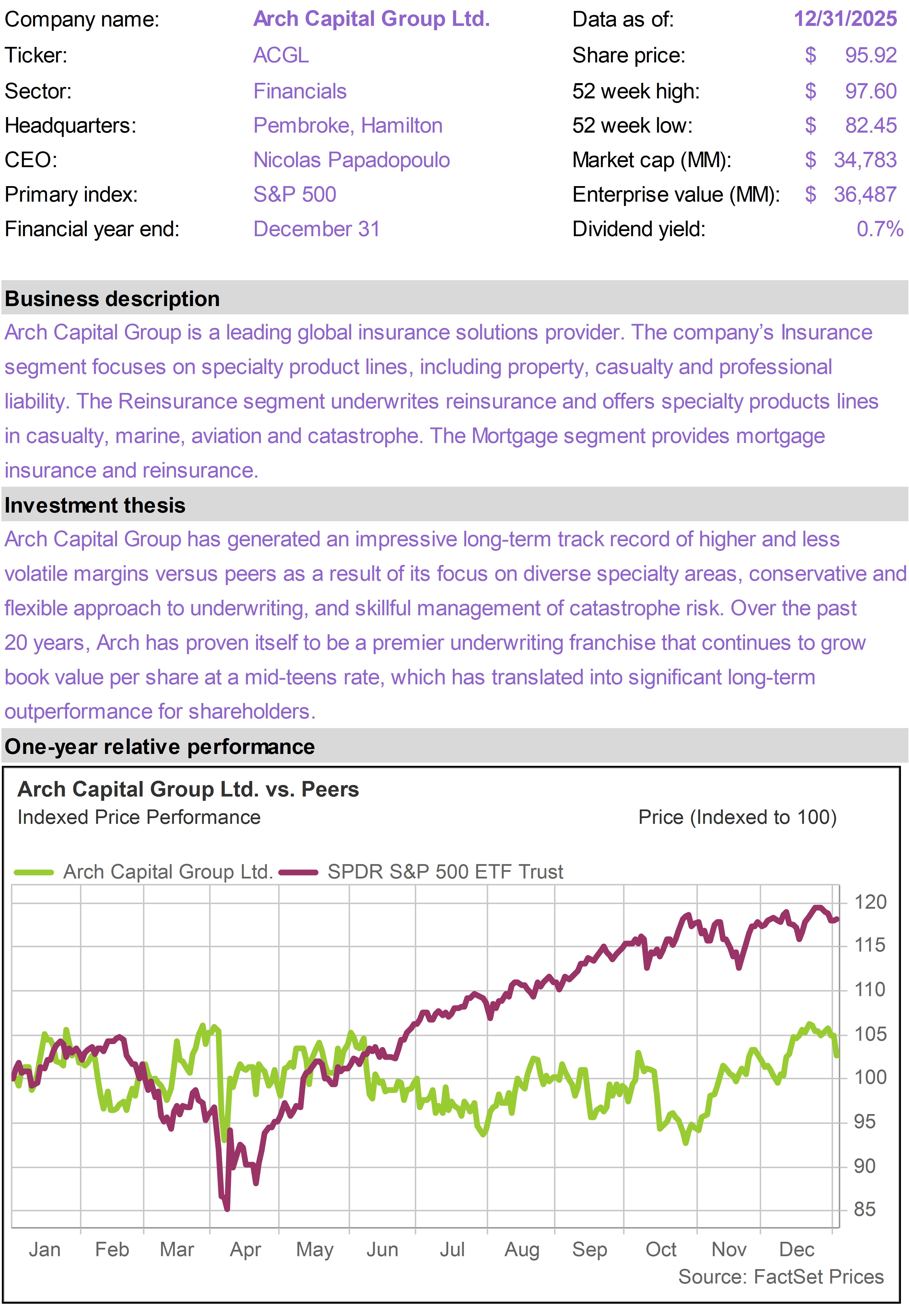
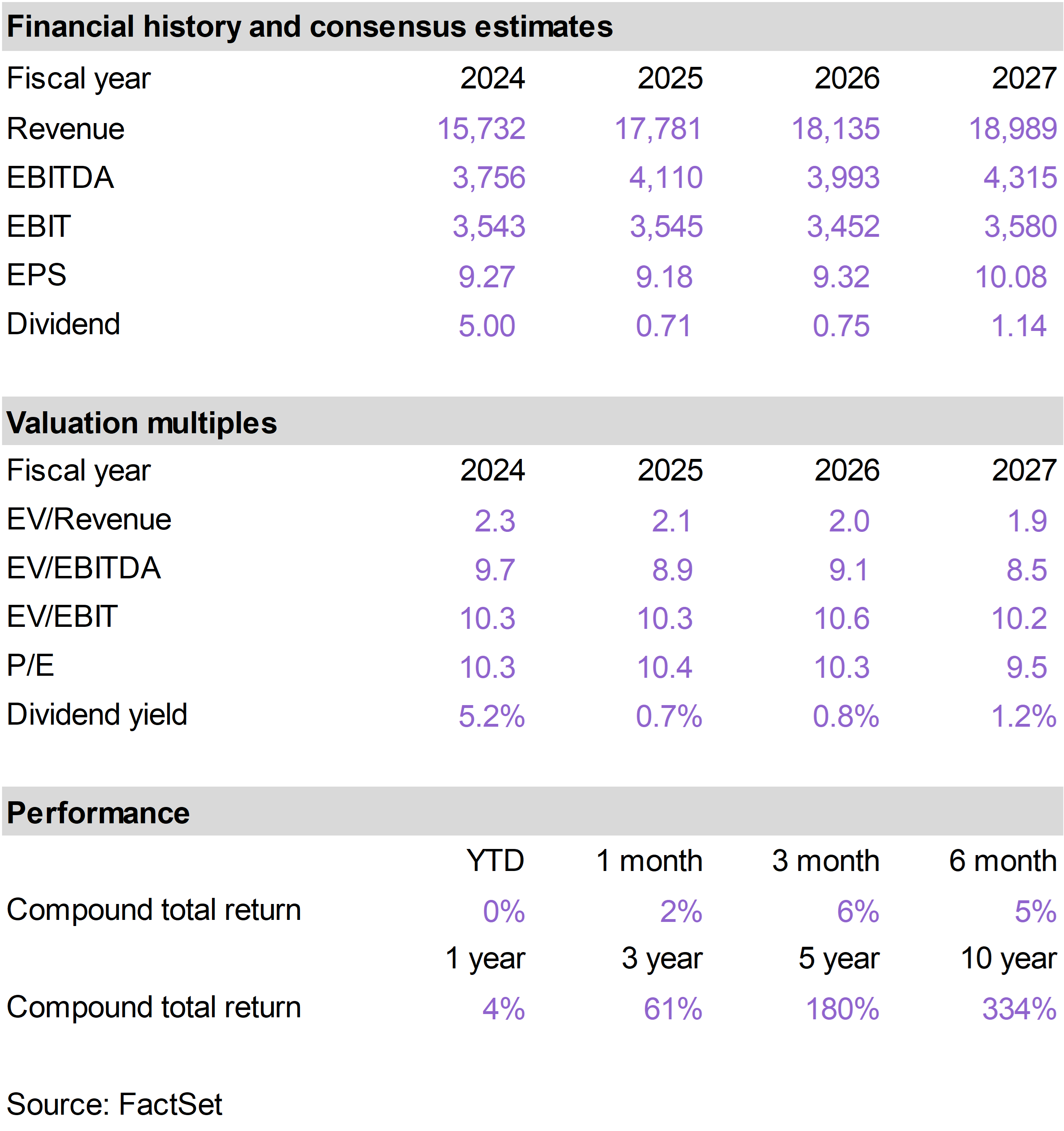
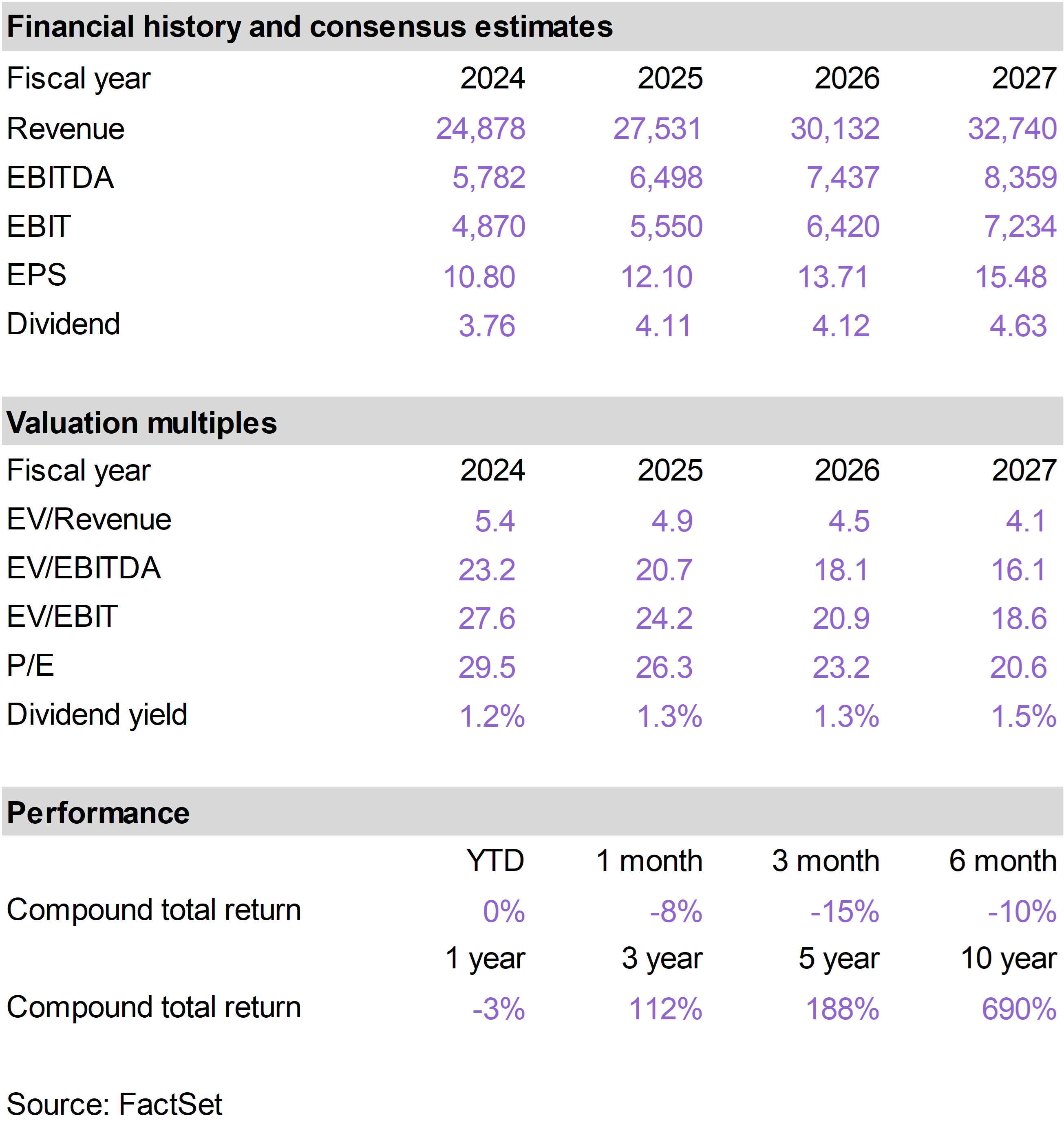
| | Arch Capital Group (ACGL) |
|
|
|
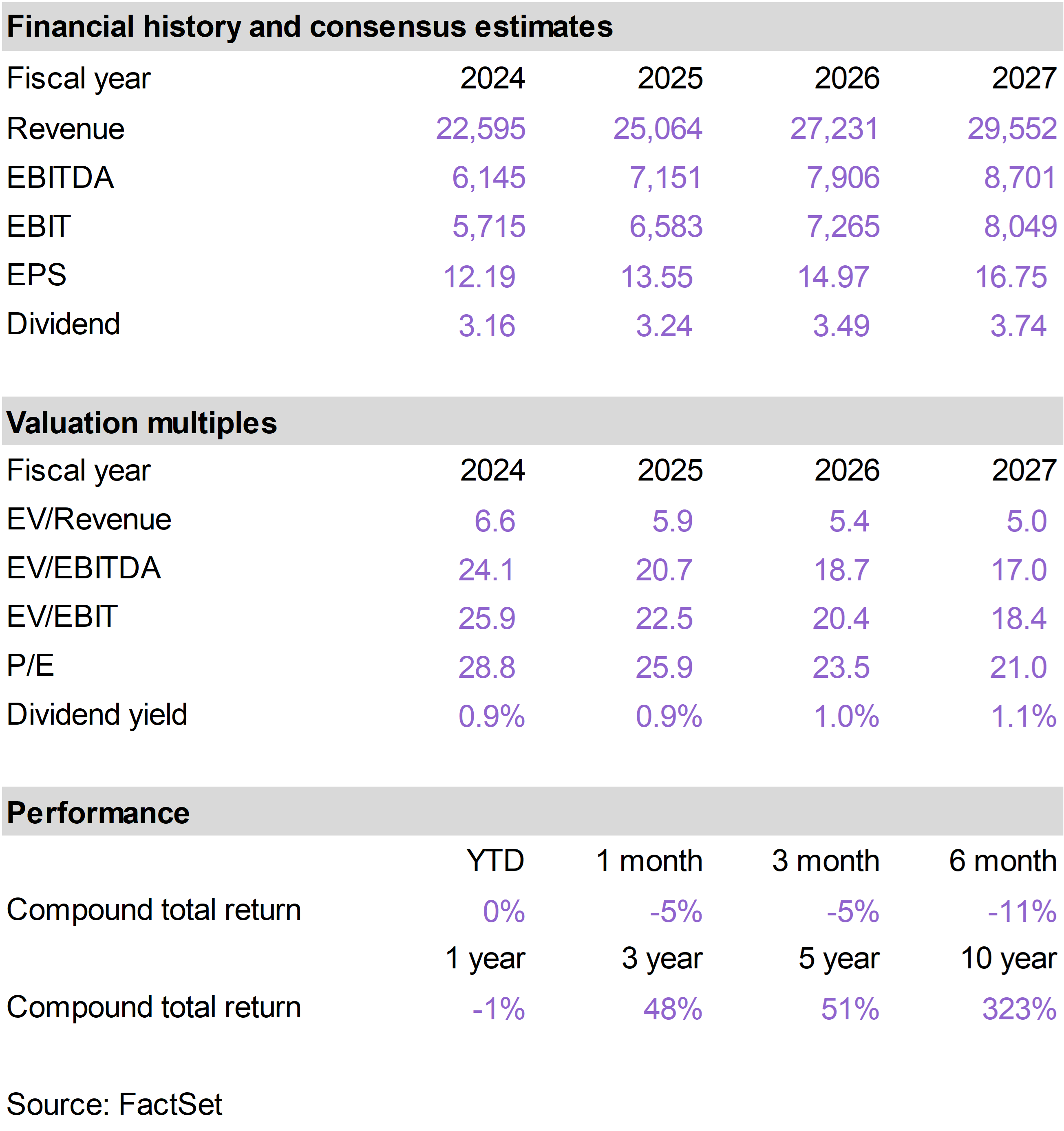
| | Air Products & Chemicals (APD) |
|
|
|
| | |
|
| | |
|
| | |
|
| | |
|
| | |
|
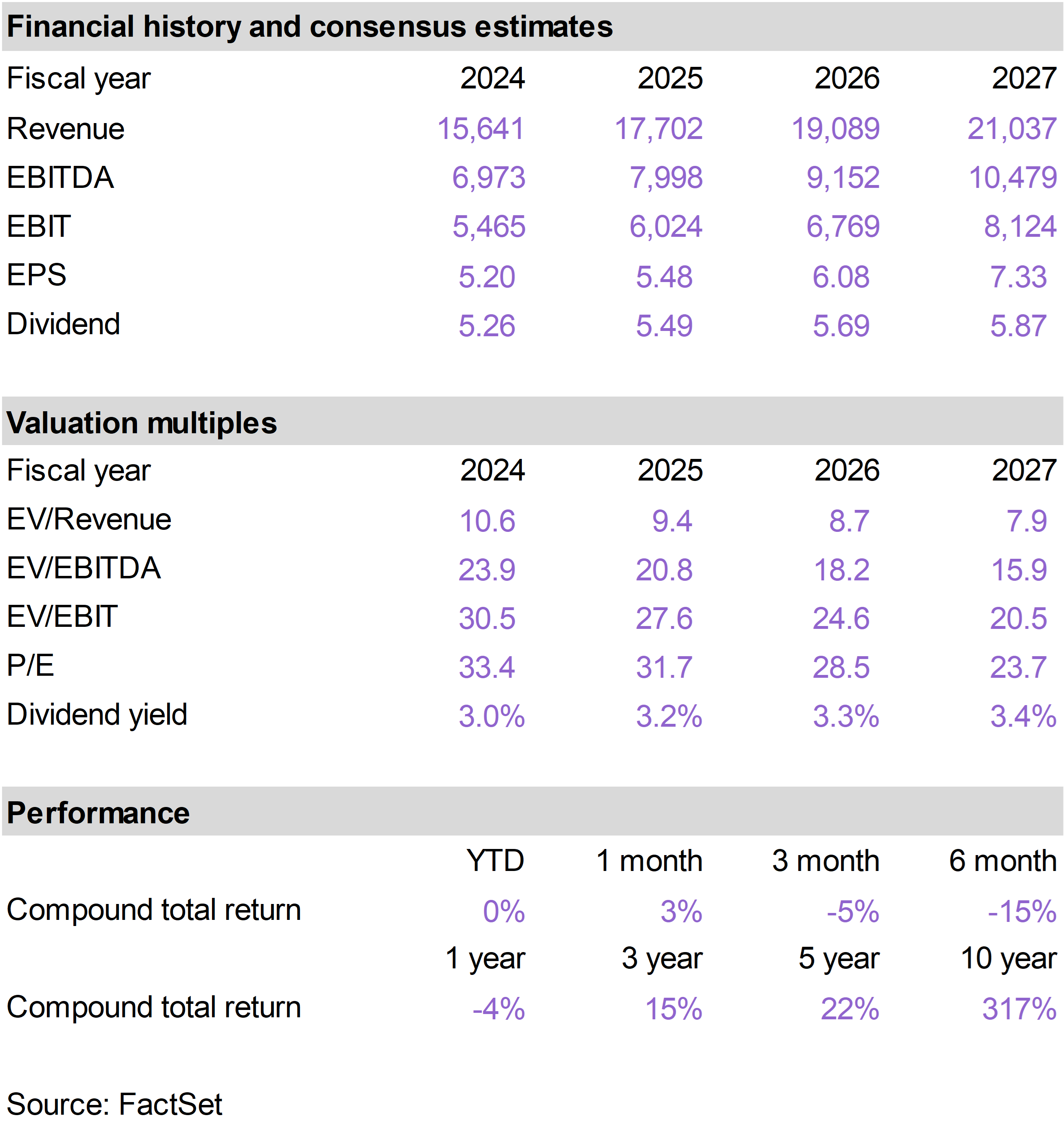
| | Thermo Fisher Scientific (TMO) |
|
|
|
| | |
|
| | |
|
| | |
|
| | |
|
| | The 76research American Resilience Model Portfolio is designed to provide exposure to growth businesses that operate with competitive advantages in structurally attractive markets. The objective is to identify businesses that can survive and thrive across different macroeconomic environments and whatever geopolitical crises may unfold. The holdings are intended as long-term investments to drive portfolio compounding with minimal need to realize taxable gains. Emphasis is placed on critical markers of business quality such as barriers to entry, physical scarcity of assets, balance sheet strength, effective capital allocation and durable long-term growth drivers. These assessments are paired with careful consideration of valuation and risk. |
|
| | FOR SUBSCRIBER USE ONLY. DO NOT FORWARD OR SHARE. |
|
| | | |
|
|
|
|
| |
|