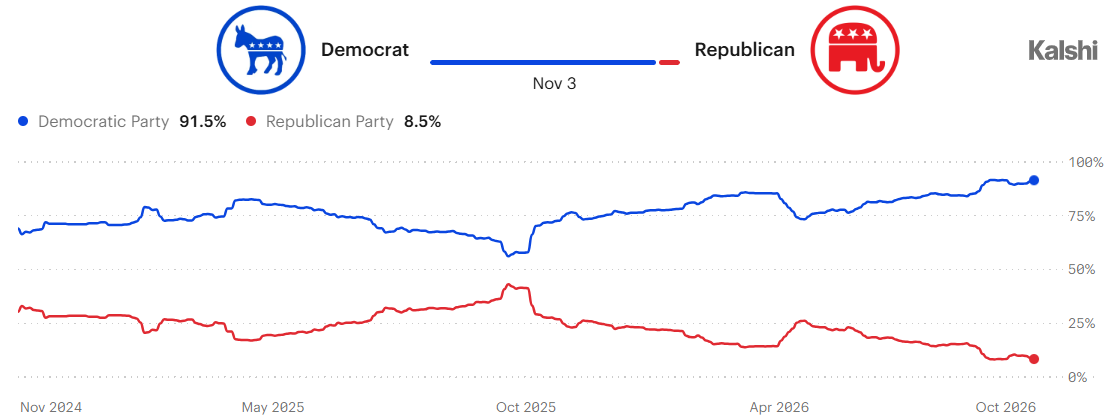
With midterm elections less than two weeks away, investors are understandably concerned. The two major political parties have starkly different economic agendas—and fundamentally different visions of American capitalism.
What happens on November 3 could shift the balance of power in Washington—but whether it changes the outlook for the stock market is another question.
President Trump faces the real possibility of losing Republican control of one or both chambers of Congress, as Democrats look to take advantage of widespread public frustration over high gasoline prices resulting from the war with Iran.
On top of this, many proudly socialist candidates appear to have real support this election cycle, suggesting we have potentially entered a new era of American politics.
Most polls are pointing to a successful night for the Democrats, especially in the House of Representatives.
Major prediction markets currently assign Democrats roughly a 90% probability of winning control of the House, along with approximately a two-thirds chance of taking the Senate.
But polls, as we have seen in recent election cycles, are unreliable and typically favor Democrat candidates.
And while prediction markets ought to represent an objective market-based signal of probable outcomes, they are not necessarily perfect.
When it comes to midterms this year, we think investors should pay heed to consensus expectations—without treating them as a done deal.
In our view, Republican success in Congressional elections would be the much more market-friendly outcome, for a variety of reasons. The stock market has shown repeatedly that it favors the pro-growth Trump agenda.
Given prevailing expectations, if Republicans actually do manage to hold control, this would likely drive a boost to market sentiment.
Retaining control of the House may be quite difficult, but we view a Republican majority in the Senate as still highly plausible, notwithstanding the conventional wisdom.