This is the classic “go woke, go broke” problem that has afflicted many once great American companies in recent years, including Anheuser-Busch InBev (BUD) and, most recently, Nike (NKE), which recently was dropped from the S&P 100 Index.
When a company caves into political pressure and mismanages its brand or products, it can be quite damaging, especially in the short-term.
The good new is, from an investment standpoint, that is often a fixable problem.
For example, shares of BUD are now almost 50% above their 2023 lows, when the stock was hammered by a consumer boycott following its controversial promotional partnership with Dylan Mulvaney.
Since then, BUD has pursued more traditional advertising approaches, emphasizing classic American themes that are more aligned with its customer base.
The real problems start to emerge, however, when poor management and product decisions—influenced in some cases by political agendas—are paired with much deeper structural challenges.
BUD operates in a totally different industry, yet it offers an instructive parallel to NFLX.
While BUD shares have recovered, the company—and the beverage industry more broadly—still faces a potentially intractable headwind: younger consumers simply are not drinking as much alcohol as they once did.
Super Bowl commercials featuring Lynyrd Skynyrd ballads and bald eagles, great as they are, may not be enough to counter that trend.
Netflix management now finds itself in a similar predicament. It is confronting a serious structural challenge alongside its own questionable decisions around content.
Technological change is what allowed Netflix to disrupt Blockbuster’s dominance of the home video market. Now Netflix is at risk of losing its own audience to new forms of entertainment that are the result of technological innovation.
While Netflix does have some real strengths as a business, and there are certain things management can try to do, we are cautious about the long-term outlook.
We also do not find the shares interesting at current levels, even as the valuation has declined.
A lower earnings multiple is certainly helpful, but it does nothing to prevent the very real threat that ongoing technological change, especially from AI, poses to Netflix’s business model.
From FAANG to failure?
Netflix built one of the greatest businesses of the internet era by disrupting the entertainment establishment. Now it is the establishment.
Netflix began by replacing the video store. Then it replaced the DVD. Then it began challenging broadcast and cable television.
Eventually, it even challenged Hollywood itself.
The launch of original programming such as House of Cards demonstrated that a Silicon Valley company could become one of the most important producers of television in the world.
Netflix was so successful and became so synonymous with technology-driven growth that, some time around 2013, it earned a place in the original FANG acronym alongside Facebook, Amazon and Google.
Apple was later added, creating FAANG—the predecessor to today’s Magnificent Seven, the elite circle of mega-cap stocks that dominate the S&P 500 Index.
(Notably, Netflix is no longer seen as a member of this privileged group. Its market capitalization is currently less than $300 billion, which does not even place it among the top 30.)
The reason Netflix used to keep such illustrious company was that Wall Street did not view it as simply another entertainment company. It was a technology platform.
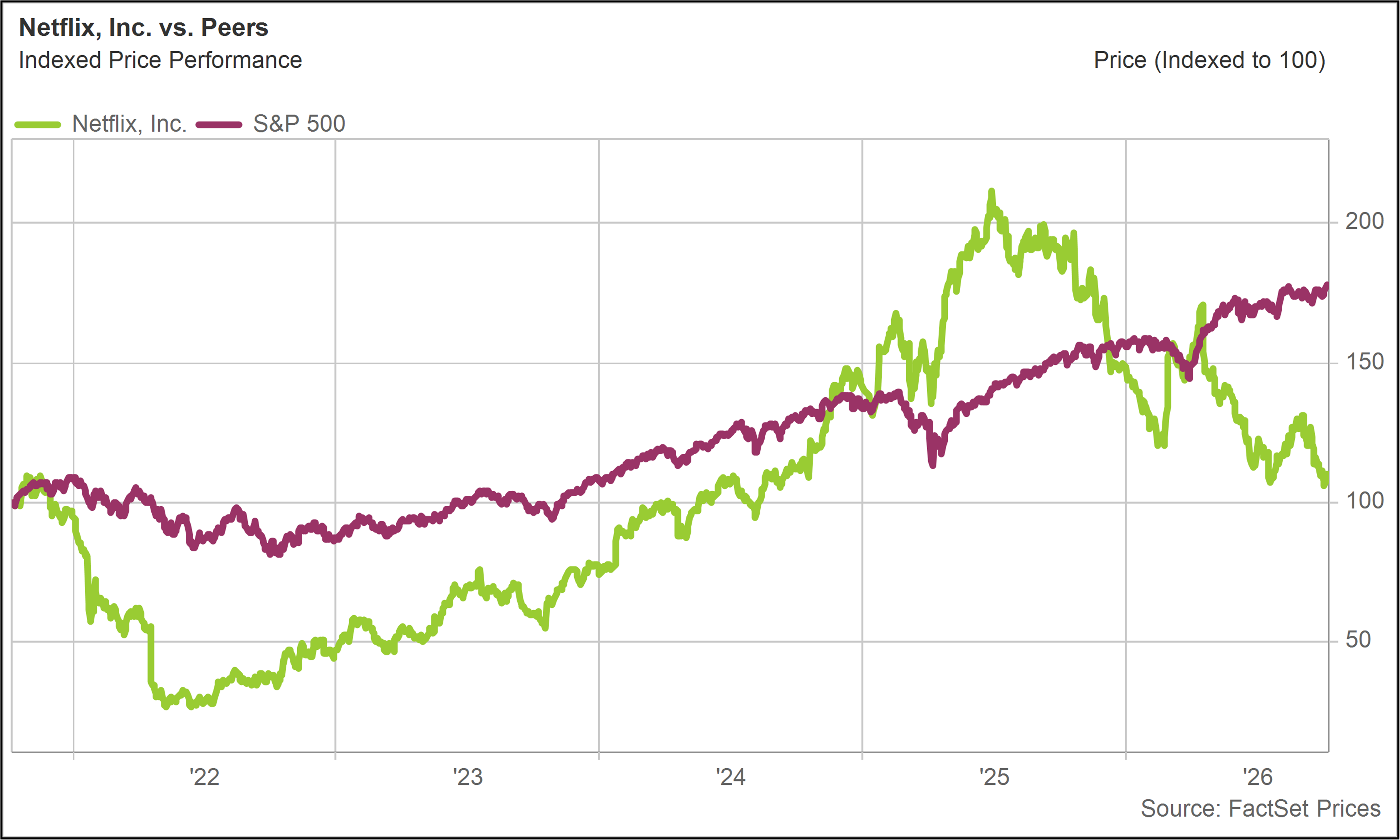
For years, Netflix produced extraordinary returns. But its recent stock performance tells a very different story.
After declining in 2022 along with other growth stocks, the shares staged a strong recovery and eventually reached new highs. Since then, however, the stock has fallen sharply and now trades roughly 50% below peak levels, even as earnings have continued to rise.