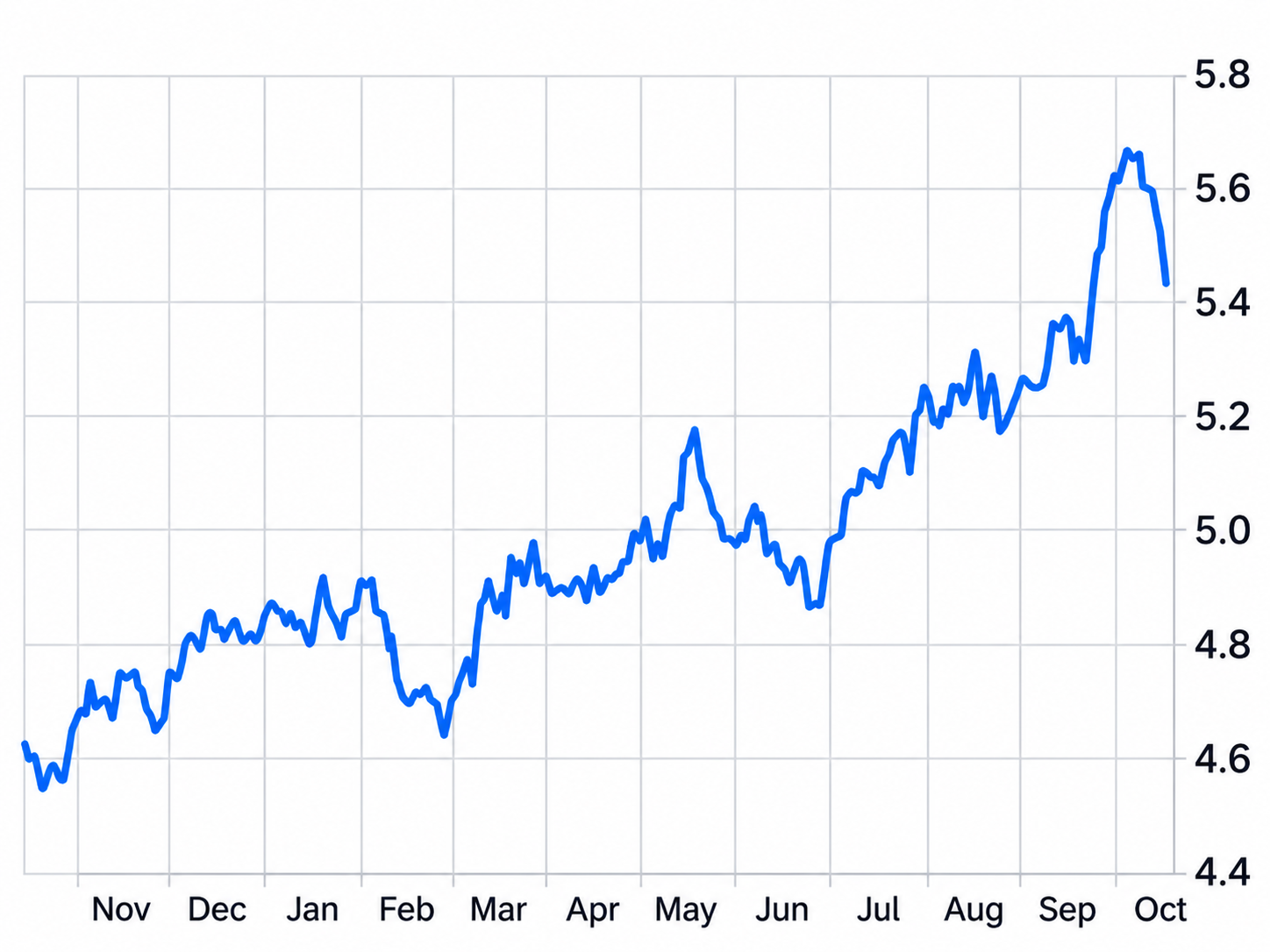
The divergence between short-term and long-term interest rates this week raises an important question…
Has the relentless upward pressure on long-term interest rates finally reached a turning point?
If so, this could have important implications for investors well beyond the bond market itself.
Many high-quality stocks that are interest rate sensitive are now trading at much more attractive valuations and currently offer high dividend yields. Such stocks stand to benefit from a stabilization or reversal of the rising long-term interest rate trend.
Below, we discuss the macroeconomic variables that have the potential to drive long-term interest rates lower—and why investors should consider positioning themselves for this scenario.
We also revisit three specific investment opportunities within our Income Builder Model Portfolio that we believe stand out in the current environment. These businesses continue to perform well fundamentally but have suffered from a valuation perspective as long-term rates have risen.
For these particular stocks, a sustained change in the trajectory of long-term rates could turn that headwind into a powerful tailwind.
The other side of the bull market
Notwithstanding this week's volatility, the stock market has been enjoying another impressive year.
Through October 16, the S&P 500 Index has gained approximately 11.9% in 2026. The NASDAQ 100 is doing even better, up 15.6%.
Both of these widely followed benchmarks have been propelled by another exceptional year for technology stocks and other companies benefiting from the AI revolution.
And since these indexes are weighted by market capitalization, the largest and most highly valued tech companies have contributed disproportionately to their returns.
Yet when we look more closely at the performance of individual stocks, a much different picture emerges.
More than 40% of S&P 500 constituents have actually declined this year. The median stock has gained just 4%, and approximately one-quarter of the companies in the index have lost more than 11%.
September offered an especially dramatic example of this divergence.
While the capitalization-weighted S&P 500 was nearly flat, the Equal-Weighted S&P 500—which assigns the same importance to every company—declined almost 5%. Tech stocks, meanwhile, advanced 5%, while nearly every other sector lost ground.
Rising long-term interest rates are a major reason for this significant divide.
The yield on 10-Year Treasuries has expanded approximately 1% so far this year. While a 1% move may sound small, it is approximately 30% higher than where it began.
Many AI-related companies have benefited from rapidly expanding growth expectations, but higher bond yields have created substantial valuation pressure across many other areas of the equity market.
The impact has been particularly severe for companies that investors traditionally value for their dependable earnings and dividends.
Real Estate Investment Trusts (REITs), Utilities and other income-producing businesses have suffered as investors have demanded more attractive returns to compete with higher bond yields.
In many cases, these valuation declines have occurred despite strong underlying business fundamentals.
To be clear, we do remain optimistic about the long-term outlook for AI and the companies positioned to benefit from this historic technological transformation. But the recent volatility in technology stocks is a reminder that even the most promising growth stories are vulnerable to changing expectations.
Many interest-rate-sensitive stocks, on the other hand, have already experienced substantial valuation adjustments—and their dividend yields have become significantly more attractive.
Investors can now acquire ownership interests in these durable businesses at prices that reflect a much less forgiving interest rate environment.
When stocks behave like bonds
To understand the impact of higher interest rates on stock valuations, it helps to understand one of the most important valuation concepts applied to bonds: duration.
Duration is a calculation of how sensitive an investment's value is to changes in interest rates.
Consider two Treasury bonds, one maturing in two years and another in 30 years. If market interest rates rise, both bonds generally decline in price because newly issued bonds offer more attractive yields.
But the 30-year bond will ordinarily experience a much larger price decline. Its investors must wait much longer to recover their principal, while receiving interest payments that have become less competitive.
The further into the future a bond’s expected cash flows occur, the more sensitive its value is to changes in interest rates. The effects of even small changes in interest rates compound over time and therefore have a much greater impact on present value.
A similar principle helps explain how interest rates affect certain stocks.
Ultimately, a stock's value reflects the present value of the cash flows investors expect a business to generate in the future. When interest rates rise, those future cash flows become less valuable in today's dollars.
This effect can be particularly visible among companies with stable, predictable earnings and dividends.
REITs, utilities, infrastructure companies, and other income-producing businesses are frequently viewed as alternatives to fixed-income securities.
When Treasury bonds offered yields of 1% or 2%, investors were willing to pay relatively high valuations for businesses offering dependable dividends.
But when investors can earn more than 5% on a government bond, the calculation changes. Investors demand more attractive returns from dividend-paying stocks as well, often forcing their share prices lower.
What could drive a drop in long-term rates?
We see several plausible scenarios in which long-term interest rates could decline substantially and reverse much of the valuation pressure that has weighed on income-producing stocks.
The most immediate catalyst would be a reversal in oil prices.
As we discussed in our recent 76report on Iran (Iran Is Running Out of Financial Oxygen—Will Oil Prices Finally Break?), the economic pressure on the Iranian regime continues to build.
While the timing remains highly uncertain, a resolution of the conflict that restores more normal shipping activity through the Strait of Hormuz could lead to a substantial decline in energy prices.
Given how much of the recent inflation acceleration has been driven by energy costs, lower oil prices could quickly improve the inflation outlook—and reduce the pressure on the Fed to maintain restrictive monetary policy.
Interest rates also tend to follow a clear historical pattern. Periods of monetary tightening eventually give way to much lower interest rates.
Higher borrowing costs gradually work their way through the economy, discouraging investment, slowing housing activity and weakening demand. Eventually, the cumulative impact of tighter monetary policy can become difficult to ignore.
In previous cycles, long-term Treasury yields have often begun declining well before the Fed actually started cutting rates, as bond investors anticipated weaker economic conditions.
Over the past 30 years, we have seen three major tightening cycles, excluding the current one. These have each been followed by significant drops in both short-term and long-term interest rates.